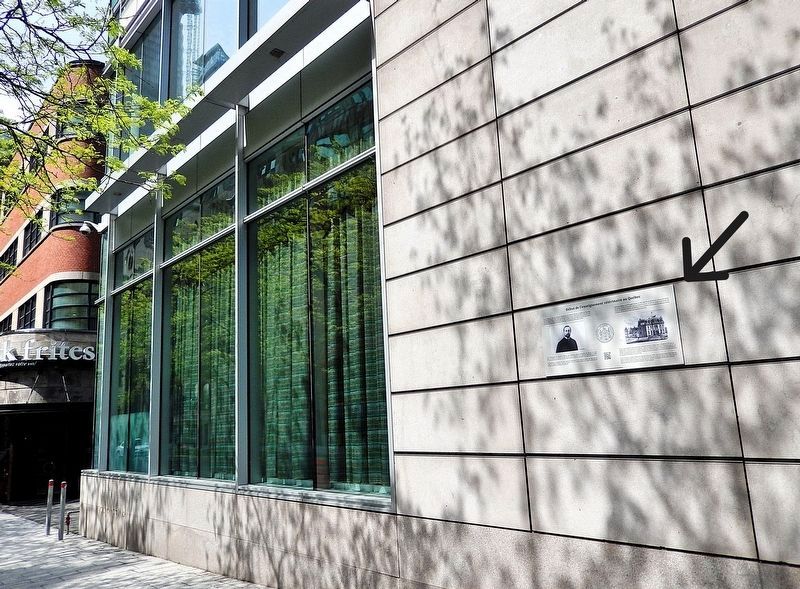
Début de l'enseignement vétérinaire au Québec
⎯⎯⎯
Start of Veterinary Education in Québec
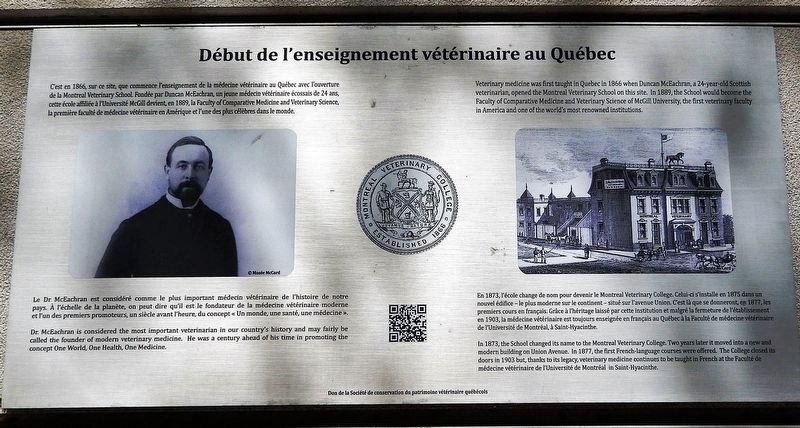

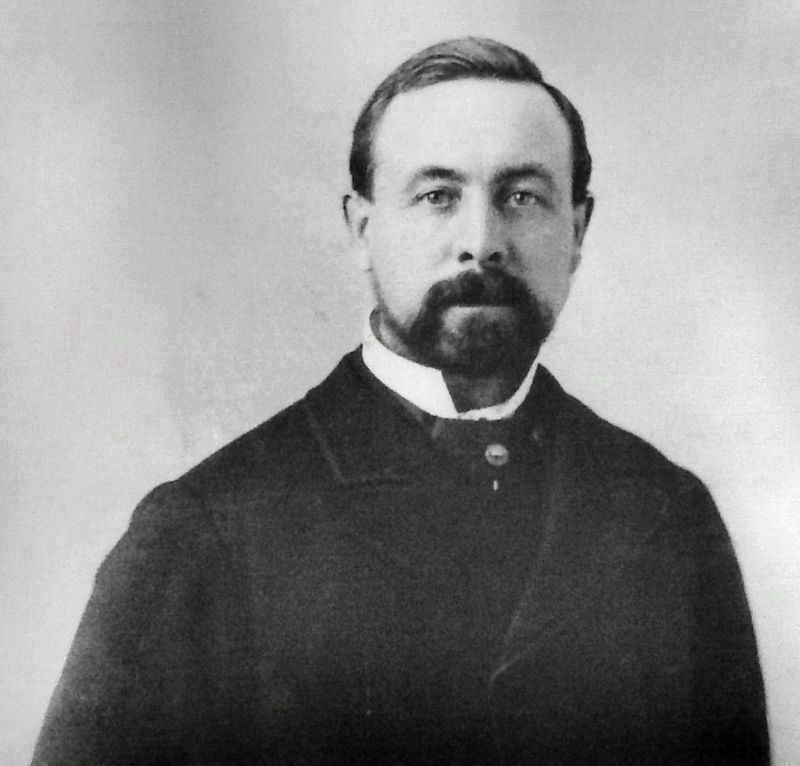
Le Dr McEachran est considéré comme le plus important médecin vétérinaire de l'histoire de notre pays. À l'échelle de la planète, on peut dire qu'il est le fondateur de la médecine vétérinaire moderne et l'un des premiers promoteurs, un siècle avant l'heure, du concept « Un monde, une santé, une médecine ».
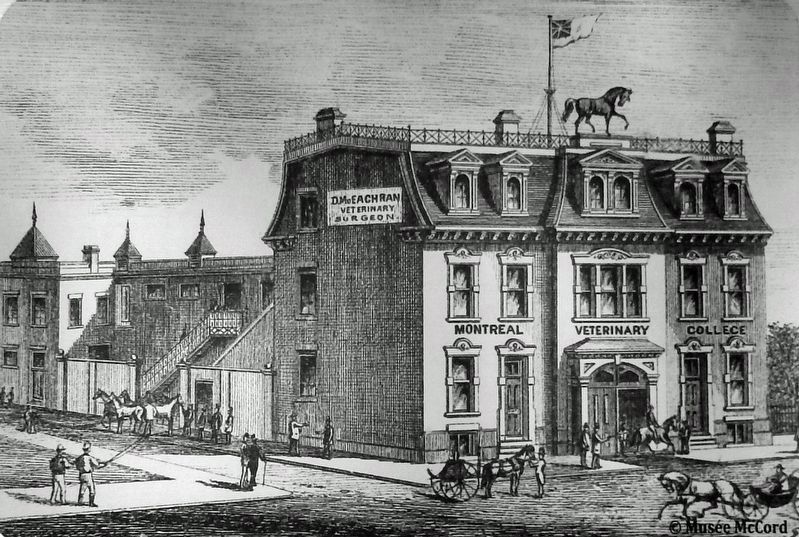
En 1873, l'école change de nom pour devenir le Montreal Veterinary College. Celui-ci s'installe en 1875 dans un nouvel édifice — le plus moderne sur le continent — situé sur l'avenue Union. C'est là que se donneront, en 1877, les premiers cours en français. Grâce à l'héritage laissé par cette institution et malgré la fermeture de l'établissement en 1903, la médecine
this page online
Dr. McEachran is considered the most important veterinarian in our country's history and may fairly be called the founder of modern veterinary medicine. He was a century ahead of his time in promoting the concept “One World, One Health, One Medicine.”
In 1873, the School changed its name to the Montreal Veterinary College. Two years later it moved into a new and modern building on Union Avenue. In 1877, the first French-language courses were offered. The College closed its doors in 1903 but, thanks to its legacy, veterinary medicine continues to be taught in French at the Faculté de médecine vétérinaire de l'Université
Erected by La Société de conservation du patrimoine vétérinaire québécois/The Quebec Veterinary Heritage Conservation Society.
Topics. This historical marker is listed in these topic lists: Animals • Education • Science & Medicine. A significant historical year for this entry is 1866.
Location. 45° 30.166′ N, 73° 33.657′ W. Marker is in Montréal, Québec. It is in Downtown Montreal. It is at the intersection of Rue Saint-Antoine Ouest and Place Jean-Paul-Riopelle, on the left when traveling north on Rue Saint-Antoine Ouest. The marker is mounted at eye-level on the east side of the building at this location. Touch for map. Marker is at or near this postal address: 1000 Place Jean-Paul-Riopelle, Montréal QC H2Z 2B2, Canada. Touch for directions.

Regionally, this marker is in Central Canada. Globally, it is in North America, the Western Hemisphere, and the Western World. Historically, it finds itself in what was once a British colony, the Viceroyalty of New France, the Haudenosaunee (Iroquois) Confederacy, and Rupert’s Land.
Other nearby markers. At least 8 other markers are
Also see . . .
1. Duncan McNab McEachran (Wikipedia).
Excerpt: Born in Campbeltown, Scotland, McEachran graduated from the Edinburgh Veterinary College in 1861 and received his license to practice from Royal College of Veterinary Surgeons. In 1862, he emigrated to Canada West, and in 1863 he helped set up, along with primary founder Andrew Smith, the Upper Canada Veterinary School (later the Ontario Veterinary(Submitted on April 1, 2025, by Cosmos Mariner of Cape Canaveral, Florida.)College). He left after three years, moving to Montreal. In 1867, Smith and McEachran again joined forces to publish the first veterinary textbook in Canada for farmers, The Canadian horse and his diseases.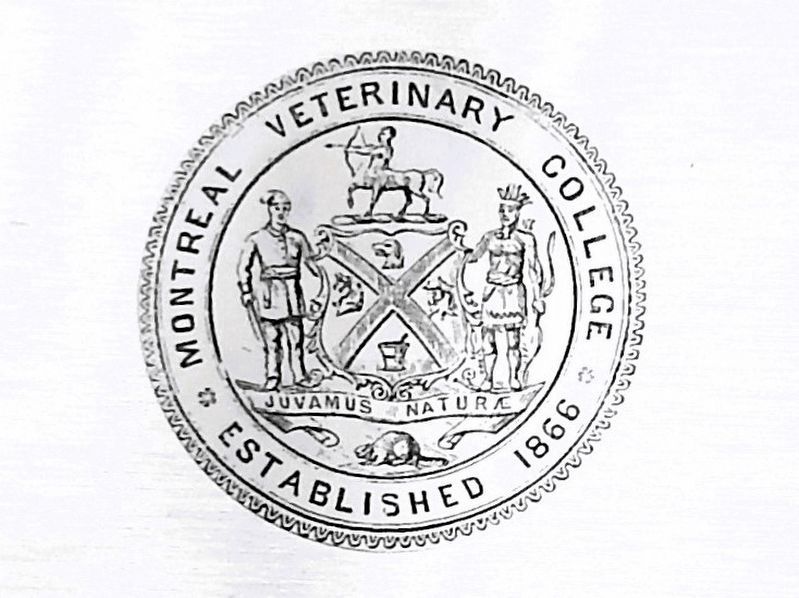 4. Marker detail: Montreal Veterinary College Seal
In the late 1880s he helped establish two large horse breeding ranches in Alberta and then provided management for others from his home in Montreal. For his contribution to the field of agriculture in the province of Quebec and in Canada, McEachran was posthumously inducted to Canadian Agricultural Hall of Fame in 1962 and to the Agricultural Hall of Fame of Quebec in 1992. He was named a National Historic Person by the federal government in 2016.
2. Duncan McNab McEachran (1841-1924) (Parks Canada).
Excerpt: As founder of the Montreal Veterinary College in 1866, Duncan McNab McEachran was a pioneer in veterinary education in North America. His work influenced the development of his profession and championed an educational model which combined theory, clinical teaching and research into animal disease. McEachran also served as the first(Submitted on April 1, 2025, by Cosmos Mariner of Cape Canaveral, Florida.)Chief Veterinary Inspector for the Dominion and in this role oversaw the establishment of an organized system of veterinary sanitation measures to counter contagious diseases, thus promoting the export of Canadian livestock.Photographed by Cosmos Mariner, May 20, 20245. Début de l'enseignement vétérinaire au Québec/Start of Veterinary Education in Québec MarkerThe marker is mounted at eye-level on the east side of the building at this location.A part of the Montréal elite, McEachran was involved in municipal affairs, such as the campaign for clean milk, and served as a veterinarian with the Militia Field Battery of Artillery of Montréal from 1877 to 1886. A keen horse lover, McEachran raised some fine animals and served as a judge at agricultural competitions in Canada and the United States.
Credits. This page was last revised on March 16, 2026. It was originally submitted on March 30, 2025, by Cosmos Mariner of Cape Canaveral, Florida. This page has been viewed 140 times since then and 36 times this year. Photos: 1. submitted on March 31, 2025, by Cosmos Mariner of Cape Canaveral, Florida. 2, 3, 4, 5. submitted on April 1, 2025, by Cosmos Mariner of Cape Canaveral, Florida.
