
DeFuniak Springs in Walton County, Florida — The American South (South Atlantic)
The Florida Chautauqua Resort/Campus
1885-1935
Photographed by Brandon D Cross
1. The Florida Chautauqua Resort/Campus Marker
Inscription.
The Florida Chautauqua Resort/Campus. (center panel)
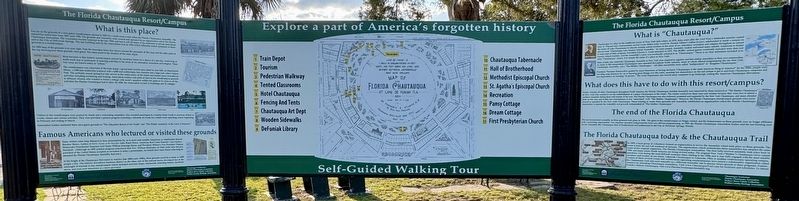
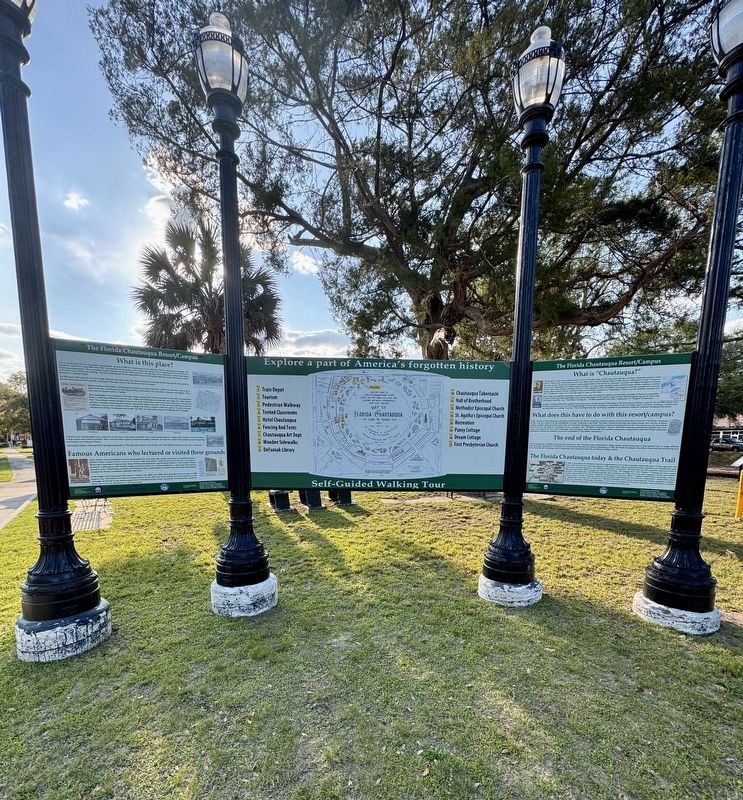
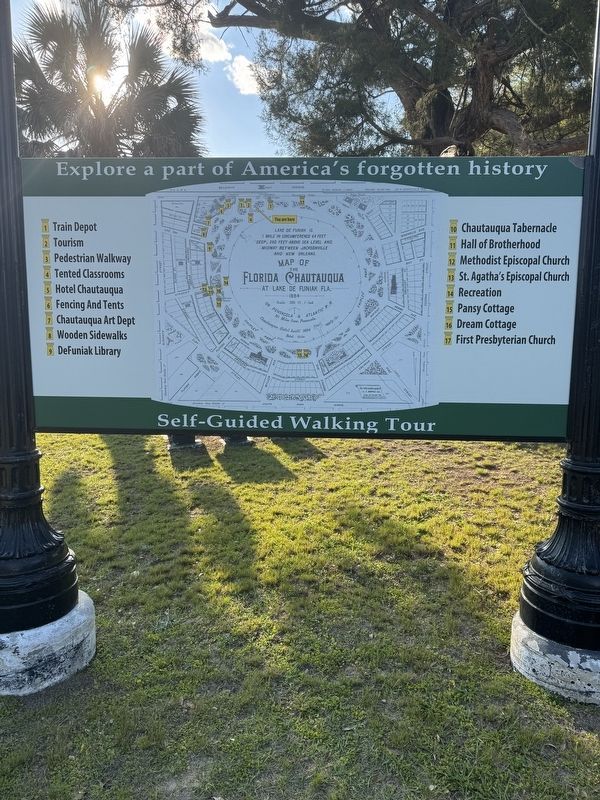
Explore a part of Americas forgotten history Self-Guided Walking Tour Map of the Florida Chautauqua at Lake of De Funiak Florida. 1 Train Depot . 2 Tourism . 3 Pedestrian Walkway . 4 Tented Classrooms . 5 Hotel Chautauqua . 6 Fencing and Tents . 7 Chautauqua Art Dept . 8 Wooden Sidewalks . 9 DeFuniak Library . 10 Chautauqua Tabernacle . 11 Hall of Brotherhood . 12 Methodist Episcopal Church . 13 St. Agathas Episcopal Church . 14 Recreation . 15 Pansy Cottage . 16 Dream Cottage . 17 First Presbyterian Church, (left panel)
What is this place?. You are on the grounds of a once-gated resort/campus opened in 1885 for a multi-week event called the Florida Chautauqua Assembly. The assemblies lasted here from 1885 until 1928. The grounds and Assembly were owned and operated by an organization called The Florida Chautauqua Association. The Association became bankrupt in the late 1920s and had to sell off many of the structures to private individuals and to the City of DeFuniak Springs. The last building sold by the Association was in 1935 which officially ended operation of these grounds as a resort/campus., An 1884 map of the grounds is to your right. Note the boundary fence line drawn around the perimeter of this map and the entry point at the top showing how these grounds were gated. The entry point is the location of the train depot., Most travelers to this historic resort/campus arrived by excursion trains for a choice of a one-day, week-long or multi-week stay to participate in learning activities in the areas of art, education, recreation and religion. These four areas are known today as "pillars.", The resort/campus was comprised of the train depot, a grand hotel (which once stood to your left), art department library, a 2,500-seat auditorium (replaced with a 4,000-seat auditorium), four churches and a large park called Chipley Park. The perfectly-round spring-fed lake served as the center-piece of the resort and hosted many recreational activities including swimming and boating. Association leaders sold plots of land on the resort/campus grounds to affluent citizens who wanted to build a cottage with maid's quarters within the gates to be close to all the activities the Florida Chautauqua had to offer. By 1888, the Association owned 12 buildings and 33 cottages., Visitors to the resort/campus were greeted by bands and a welcoming committee who escorted passengers to a nearby ticket booth to purchase tickets to events, classes and various activities. They were provided a printed program including a schedule of events for a multi-week operating season beginning in February and ending in March., Association leaders marketed these once-gated grounds as "The Education Resort of the South" and "The Winter Assembly in the Land of Summer.",
Famous Americans who lectured or visited these grounds. Some visitors came long distances to hear presentations by, or to meet such notable Americans as Abolitionist Harriet Beecher Stowe, Author of Battle Hymn of the Republic Julia Ward Howe, American Red Cross Founder Clara Barton, Democratic Presidential Nominee and Orator William Jennings Bryan, and Woodrow Wilson's Vice President Thomas Marshall. [Although an 1895 printed program announces that Gov. William McKinley of Ohio (who later became president of the United States) accepted an invitation to make a presentation, no records have been found indicating he attended the Florida Chautauqua Assembly that year.] , At the height of the Chautauqua Movement in America (late 1800s-early 1900s), these grounds received as many as 4,000 people a day. The historic downtown business district on the other side of the railroad tracks developed due to the onslaught of tourism to this resort/campus which included souvenir shops, restaurants, boarding houses, hardware stores, and even such attractions as a merry-go-round. (captions) The arrival of one of the Saturday excursion trains Art Department Auditorium Library Train Depot L.A.N.R.R. Station for Florida Chautauqua Association, De Funiak Springs, Florida Hotel Brother Stephen McPherson, popular street preacher during the Florida Chautauqua , (right panel)
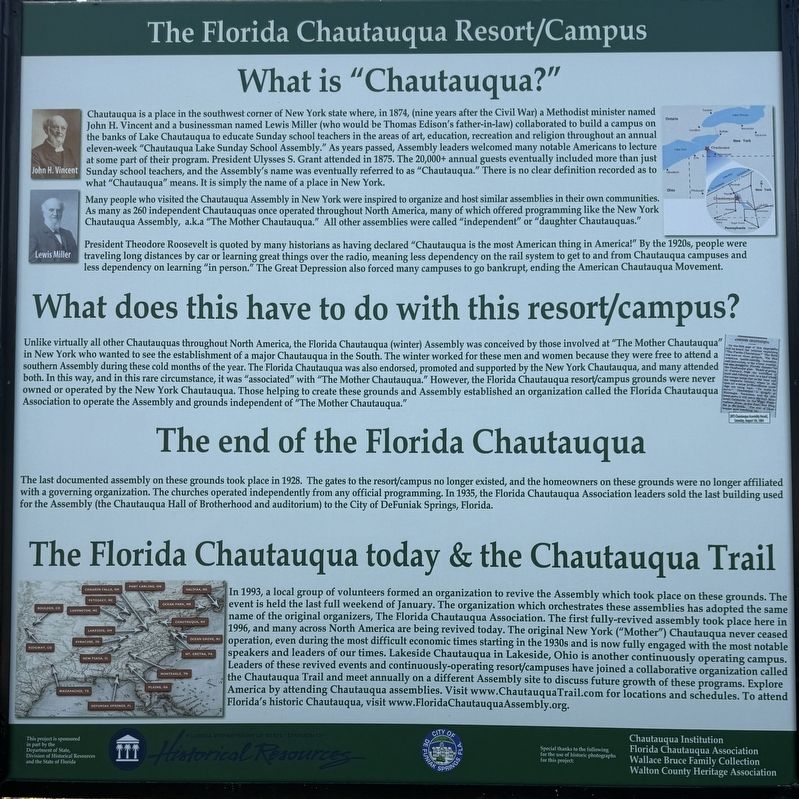
What is Chautauqua?. Chautauqua is a place in the southwest corner of New York state where, in 1874, (nine years after the Civil War) a Methodist minister named John H. Vincent and a businessman named Lewis Miller (who would be Thomas Edison's father-in-law) collaborated to build a campus on the banks of Lake Chautauqua to educate Sunday school teachers in the areas of art, education, recreation and religion throughout an annual eleven-week "Chautauqua Lake Sunday School Assembly." As years passed, Assembly leaders welcomed many notable Americans to lecture at some part of their program. President Ulysses S. Grant attended in 1875. The 20,000+ annual guests eventually included more than just Sunday school teachers, and the Assembly's name was eventually referred to as "Chautauqua." There is no clear definition recorded as to what "Chautauqua" means. It is simply the name of a place in New York. Many people who visited the Chautauqua Assembly in New York were inspired to organize and host similar assemblies in their own communities. As many as 260 independent Chautauquas once operated throughout North America, many of which offered programming like the New York Chautauqua Assembly, a.k.a "The Mother Chautauqua." All other assemblies were called "independent" or "daughter Chautauquas." President Theodore Roosevelt is quoted by many historians as having declared "Chautauqua is the most American thing in America!" By the 1920s, people were traveling long distances by car or learning great things over the radio, meaning less dependency on the rail system to get to and from Chautauqua campuses and less dependency on learning "in person." The Great Depression also forced many campuses to go bankrupt, ending the American Chautauqua Movement.,
What does this have to do with this resort/campus?. Unlike virtually all other Chautauquas throughout North America, the Florida Chautauqua (winter) Assembly was conceived by those involved at "The Mother Chautauqua" in New York who wanted to see the establishment of a major Chautauqua in the South. The winter worked for these men and women because they were free to attend a southern Assembly during these cold months of the year. The Florida Chautauqua was also endorsed, promoted and supported by the New York Chautauqua, and many attended both. In this way, and in this rare circumstance, it was "associated" with "The Mother Chautauqua." However, the Florida Chautauqua resort/campus grounds were never owned or operated by the New York Chautauqua. Those helping to create these grounds and Assembly established an organization called the Florida Chautauqua Association to operate the Assembly and grounds independent of "The Mother Chautauqua."
The end of the Florida Chautauqua. The last documented assembly on these grounds took place in 1928. The gates to the resort/campus no longer existed, and the homeowners on these grounds were no longer affiliated with a governing organization. The churches operated independently from any official programming. In 1935, the Florida Chautauqua Association leaders sold the last building used for the Assembly (the Chautauqua Hall of Brotherhood and auditorium) to the City of DeFuniak Springs, Florida. ,
The Florida Chautauqua today and the Chautauqua Trail. In 1993, a local group of volunteers formed an organization to revive the Assembly which took place on these grounds. The event is held the last full weekend of January. The organization which orchestrates these assemblies has adopted the same name of the original organizers, The Florida Chautauqua Association. The first fully-revived assembly took place here in 1996, and many across North America are being revived today. The original New York ("Mother") Chautauqua never ceased operation, even during the most difficult economic times starting in the 1930s and is now fully engaged with the most notable speakers and leaders of our times. Lakeside Chautauqua in Lakeside, Ohio is another continuously operating campus. Leaders of these revived events and continuously-operating resort/campuses have joined a collaborative organization called the Chautauqua Trail and meet annually on a different Assembly site to discuss future growth of these programs. Explore America by attending Chautauqua assemblies. Visit www.ChautauquaTrail.com for locations and schedules. To attend Florida's historic Chautauqua, visit www.FloridaChautauquaAssembly.org, (captions) John H. Vincent Lewis Miller (NY) Chautauqua Assembly Herald, Saturday, August 16th, 1884
(center panel)
Explore a part of Americas forgotten history
Self-Guided Walking Tour
Map of the Florida Chautauqua at Lake of De Funiak Fla.
1 Train Depot 2 Tourism 3 Pedestrian Walkway 4 Tented Classrooms 5 Hotel Chautauqua 6 Fencing and Tents 7 Chautauqua Art Dept 8 Wooden Sidewalks 9 DeFuniak Library 10 Chautauqua Tabernacle 11 Hall of Brotherhood 12 Methodist Episcopal Church 13 St. Agathas Episcopal Church 14 Recreation 15 Pansy Cottage 16 Dream Cottage 17 First Presbyterian Church
(left panel)
What is this place?
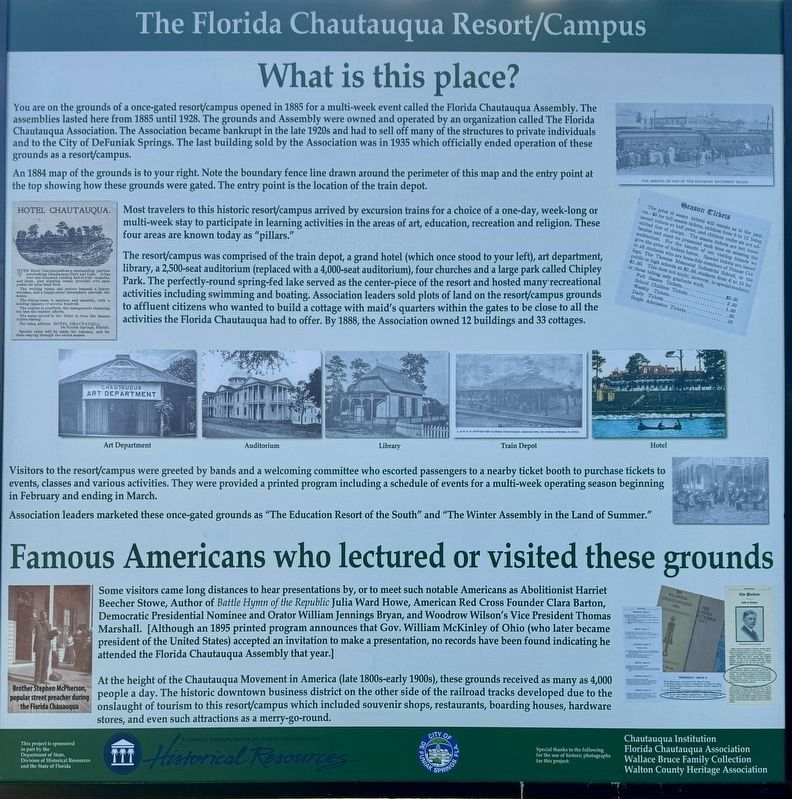
You are on the grounds of a once-gated resort/campus opened in 1885 for a multi-week event called the Florida Chautauqua Assembly. The assemblies lasted here from 1885 until 1928. The grounds and Assembly were owned and operated by an organization called The Florida Chautauqua Association. The Association became bankrupt in the late 1920s and had to sell off many of the structures to private individuals and to the City of DeFuniak Springs. The last building sold by the Association was in 1935 which officially ended operation of these grounds as a resort/campus.
An
Click or scan to see this page online
1884 map of the grounds is to your right. Note the boundary fence line drawn around the perimeter of this map and the entry point at the top showing how these grounds were gated. The entry point is the location of the train depot.
Most travelers to this historic resort/campus arrived by excursion trains for a choice of a one-day, week-long or multi-week stay to participate in learning activities in the areas of art, education, recreation and religion. These four areas are known today as "pillars."
The resort/campus was comprised of the train depot, a grand hotel (which once stood to your left), art department library, a 2,500-seat auditorium (replaced with a 4,000-seat auditorium), four churches and a large park called Chipley Park. The perfectly-round spring-fed lake served as the center-piece of the resort and hosted many recreational activities including swimming and boating. Association leaders sold plots of land on the resort/campus grounds to affluent citizens who wanted to build a cottage with maid's quarters within the gates to be close to all the activities the Florida Chautauqua had to offer. By 1888, the Association
Photographed by Brandon D Cross
2. The Florida Chautauqua Resort/Campus Marker
owned 12 buildings and 33 cottages.
Visitors to the resort/campus were greeted by bands and a welcoming committee who escorted passengers to a nearby ticket booth to purchase tickets to events, classes and various activities. They were provided a printed program including a schedule of events for a multi-week operating season beginning in February and ending in March.
Association leaders marketed these once-gated grounds as "The Education Resort of the South" and "The Winter Assembly in the Land of Summer."
Famous Americans who lectured or visited these grounds
Some visitors came long distances to hear presentations by, or to meet such notable Americans as Abolitionist Harriet Beecher Stowe, Author of Battle Hymn of the Republic Julia Ward Howe, American Red Cross Founder Clara Barton, Democratic Presidential Nominee and Orator William Jennings Bryan, and Woodrow Wilson's Vice President Thomas Marshall. [Although an 1895 printed program announces that Gov. William McKinley of Ohio (who later became president of the United States) accepted an invitation to make a presentation, no records have been found indicating he attended
Photographed by Brandon D Cross
3. The Florida Chautauqua Resort/Campus Marker (center panel)
the Florida Chautauqua Assembly that year.]
At the height of the Chautauqua Movement in America (late 1800s-early 1900s), these grounds received as many as 4,000 people a day. The historic downtown business district on the other side of the railroad tracks developed due to the onslaught of tourism to this resort/campus which included souvenir shops, restaurants, boarding houses, hardware stores, and even such attractions as a merry-go-round. (captions)
The arrival of one of the Saturday excursion trains
Art Department
Auditorium
Library
Train Depot
L.A.N.R.R. Station for Florida Chautauqua Association, De Funiak Springs, Florida
Hotel
Brother Stephen McPherson, popular street preacher during the Florida Chautauqua
(right panel)
What is Chautauqua?
Chautauqua is a place in the southwest corner of New York state where, in 1874, (nine years after the Civil War) a Methodist minister named John H. Vincent and a businessman named Lewis Miller (who would be Thomas Edison's father-in-law) collaborated to build a campus on the banks of Lake Chautauqua to educate Sunday school teachers in the areas of art, education,
Photographed by Brandon D Cross
4. The Florida Chautauqua Resort/Campus Marker (left panel)
recreation and religion throughout an annual eleven-week "Chautauqua Lake Sunday School Assembly." As years passed, Assembly leaders welcomed many notable Americans to lecture at some part of their program. President Ulysses S. Grant attended in 1875. The 20,000+ annual guests eventually included more than just Sunday school teachers, and the Assembly's name was eventually referred to as "Chautauqua." There is no clear definition recorded as to what "Chautauqua" means. It is simply the name of a place in New York.
Many people who visited the Chautauqua Assembly in New York were inspired to organize and host similar assemblies in their own communities. As many as 260 independent Chautauquas once operated throughout North America, many of which offered programming like the New York Chautauqua Assembly, a.k.a "The Mother Chautauqua." All other assemblies were called "independent" or "daughter Chautauquas."
President Theodore Roosevelt is quoted by many historians as having declared "Chautauqua is the most American thing in America!" By the 1920s, people were traveling long distances by car or learning great things over the radio,
Photographed by Brandon D Cross
5. The Florida Chautauqua Resort/Campus Marker (right panel)
meaning less dependency on the rail system to get to and from Chautauqua campuses and less dependency on learning "in person." The Great Depression also forced many campuses to go bankrupt, ending the American Chautauqua Movement.
What does this have to do with this resort/campus?
Unlike virtually all other Chautauquas throughout North America, the Florida Chautauqua (winter) Assembly was conceived by those involved at "The Mother Chautauqua" in New York who wanted to see the establishment of a major Chautauqua in the South. The winter worked for these men and women because they were free to attend a southern Assembly during these cold months of the year. The Florida Chautauqua was also endorsed, promoted and supported by the New York Chautauqua, and many attended both. In this way, and in this rare circumstance, it was "associated" with "The Mother Chautauqua." However, the Florida Chautauqua resort/campus grounds were never owned or operated by the New York Chautauqua. Those helping to create these grounds and Assembly established an organization called the Florida Chautauqua Association to operate the Assembly and grounds independent of "The Mother Chautauqua."
The end of the Florida Chautauqua
The last documented assembly on these grounds took place in 1928. The gates to the resort/campus no longer existed, and the homeowners on these grounds were no longer affiliated with a governing organization. The churches operated independently from any official programming. In 1935, the Florida Chautauqua Association leaders sold the last building used for the Assembly (the Chautauqua Hall of Brotherhood and auditorium) to the City of DeFuniak Springs, Florida.
The Florida Chautauqua today & the Chautauqua Trail
In 1993, a local group of volunteers formed an organization to revive the Assembly which took place on these grounds. The event is held the last full weekend of January. The organization which orchestrates these assemblies has adopted the same name of the original organizers, The Florida Chautauqua Association. The first fully-revived assembly took place here in 1996, and many across North America are being revived today. The original New York ("Mother") Chautauqua never ceased operation, even during the most difficult economic times starting in the 1930s and is now fully engaged with the most notable speakers and leaders of our times. Lakeside Chautauqua in Lakeside, Ohio is another continuously operating campus. Leaders of these revived events and continuously-operating resort/campuses have joined a collaborative organization called the Chautauqua Trail and meet annually on a different Assembly site to discuss future growth of these programs. Explore America by attending Chautauqua assemblies. Visit www.ChautauquaTrail.com for locations and schedules. To attend Florida's historic Chautauqua, visit www.FloridaChautauquaAssembly.org
(captions)
John H. Vincent
Lewis Miller
(NY) Chautauqua Assembly Herald, Saturday, August 16th, 1884
Erected by Florida Department of State and the City of DeFuniak Springs.
Location. 30° 43.194′ N, 86° 6.868′ W. Marker is in DeFuniak Springs, Florida, in Walton County. It is on Circle Drive west of South 7th Street, on the right when traveling west. Located on the grounds of the DeFuniak Springs Visitor Center. Touch for map. Marker is at or near this postal address: 1162 Circle Drive, Defuniak Springs FL 32435, United States of America. Touch for directions.

Regionally, this marker is on the Florida Panhandle. It is also in the American South, specifically in the Deep South, and on the Gulf Coast. Globally, it is in the North Atlantic Region, North America, a Gulf of Mexico state, the Western Hemisphere, the Western World, and the Anglosphere. Historically, it finds itself in what was once New Spain, the territory of the Mississippian Culture, one of the Confederate States of America, and the Antebellum South.
Credits. This page was last revised on April 1, 2025. It was originally submitted on March 31, 2025, by Brandon D Cross of Flagler Beach, Florida. This page has been viewed 210 times since then and 32 times this year. Photos:1, 2, 3, 4, 5. submitted on March 31, 2025, by Brandon D Cross of Flagler Beach, Florida. • Bernard Fisher was the editor who published this page.
