Near Maxton in Robeson County, North Carolina — The American South (South Atlantic)
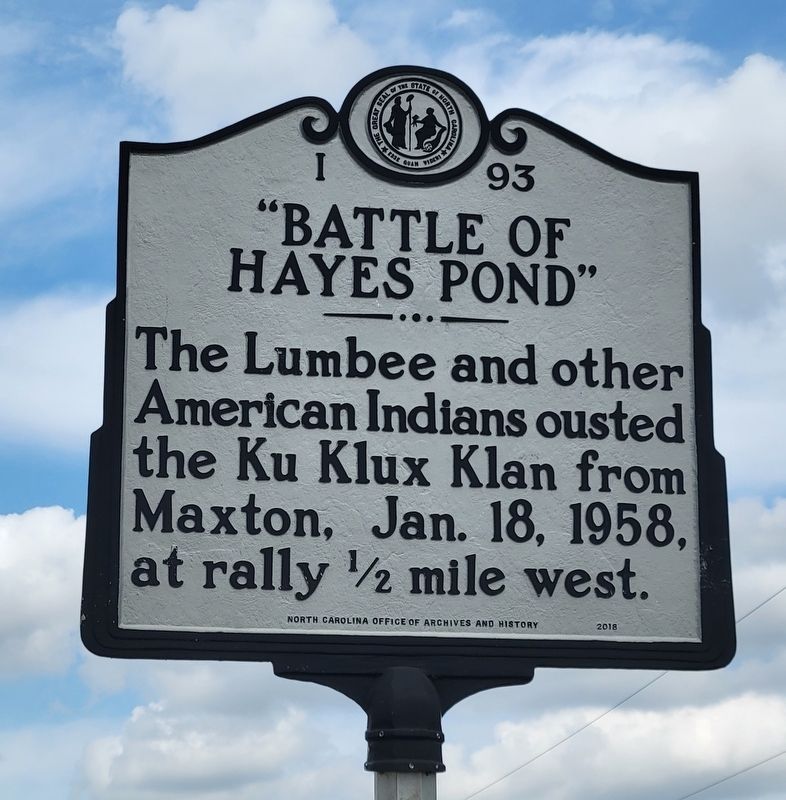
“Battle of Hayes Pond”
Photographed by J. J. Prats, March 29, 2025
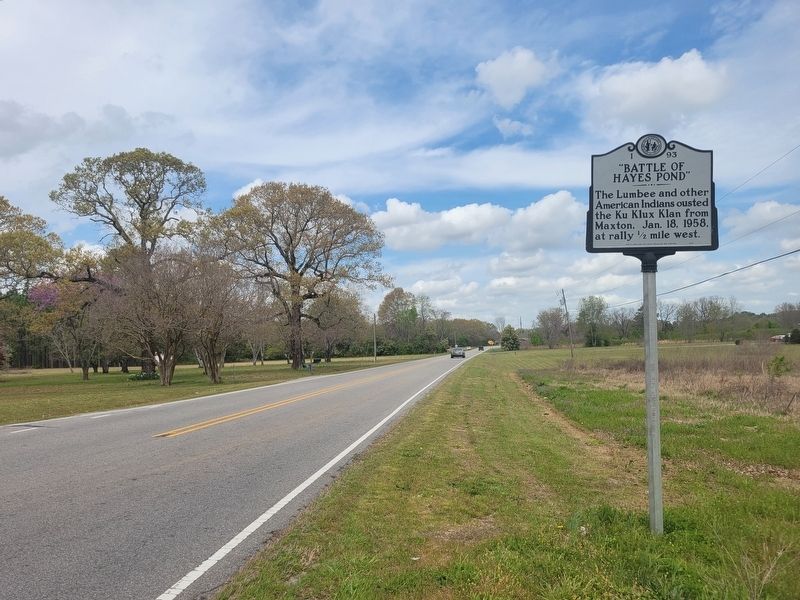
1. “Battle of Hayes Pond” Marker
Erected 2018 by North Carolina Office of Archives and History. (Marker Number I-93.)
Topics. This historical marker is listed in these topic lists: Civil Rights • Notable Places. A significant historical date for this entry is January 18, 1958.
Location. 34° 43.345′ N, 79° 21.186′ W. Marker is near Maxton, North Carolina, in Robeson County. It is at the intersection of South Patterson Street and Maxton Pond Road, on the left when traveling south on South Patterson Street. Touch for map. Marker is at or near this postal address: 1100 S Patterson St, Maxton NC 28364, United States of America. Touch for directions.

Regionally, this marker is in the Coastal Plain. It is also in the American South and specifically in the Upper South. Globally, it is in North America, the Western Hemisphere, the Western World, and the Anglosphere. Historically, it finds itself in what was once the territory of the Mississippian Culture, one of the original Thirteen Colonies, one of the Confederate States of America, and
this page online
Other nearby markers. At least 8 other markers are within 5 miles of this marker, measured as the crow flies: Town of Shoe Heel / Carolina Methodist College (approx. one mile away); Carolina College (approx. 1.1 miles away); Maxton War Memorial (approx. 1.2 miles away); Maxton Alma Railroad Bell (approx. 1.2 miles away); Laurinburg-Maxton Army Air Base (approx. 1.8 miles away); Stewart-Hawley-Malloy House (approx. 3.9 miles away); Angus W. McLean (approx. 4.4 miles away); Floral College (approx. 4.4 miles away). Touch for a list and map of all markers in Maxton.
Another marker is no longer nearby. Stewartsville Cemetery (was approx. 3½ miles away but has been permanently removed).
Also see . . .
1. Wikipedia Entry. Excerpt:
In 1956, James W. "Catfish" Cole, a KKK member from South Carolina, established the North Carolina Knights, a Klan organization aimed at defending racial segregation. ... Cole oversaw two cross burnings meant to frighten the Lumbees from racial mixing, and scheduled a Klan rally which he hoped would have a large turnout.(Submitted on March 31, 2025.)
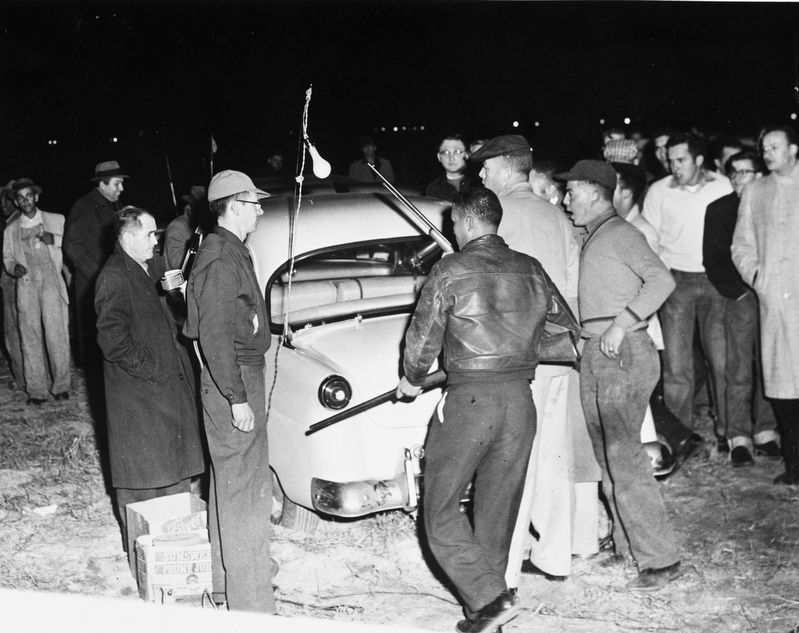
Cole and his Klansmen widely advertised their event,driving throughout the county in a truck outfitted with a loudspeaker to broadcast their plans. The announcements infuriated the Lumbee community and some decided to try to disrupt the meeting. Fearing violence, local law enforcement officials pleaded with Cole to suspend his plans, but he refused. On January 18, 1958, Cole and about 50 Klansmen, most of whom were followers of his from South Carolina, gathered in a leased cornfield near Hayes Pond, a place adjacent to the town of Maxton. Several hundred Lumbees, many armed, arrived and encircled the group and jeered at them. After an altercation in which the single light in the field was destroyed, the Lumbees began firing their weapons and most of the Klansmen fled. Cole hid in a swamp while the Lumbees seized Klan regalia and carried them to Pembroke to celebrate. Police restored order on the field and arrested one Klansman.Photographed by J. J. Prats, March 29, 20252. “Battle of Hayes Pond” Marker
Afterwards, Cole and the arrested Klansman were indicted and convicted for inciting a riot. The event was widely covered in the local and national press, which blamed the Klan for the disorder and praised the Lumbees for their actions. Cole never organizedanother public rally in Robeson County after the incident.By Bill Shaw, Fayettesville Observer. State’s Exhibit No. 5 at the trial3. Lumbees Confronting Klansmen at Hayes Pond Cornfield
2. “The Battle of Maxton Field”. North Carolina Department of Natural and Cultural Resources page. This page describes the event and a ballad recorded years later by folk singer Malvina Reynolds for Columbia Records. It includes a link to the YouTube audio performance of the song. Excerpt:
Malvina Reynolds wrote “The Battle of Maxton Field” in 1958. According to her daughter Nancy Schimmel, Malvina wrote the song at least to some extent as “revenge” against the Klan for the attempted kidnapping of herself and her family in Long Beach in 1932. The song humorously mocked the Klan, averring that history would long remember the day “When many a Klansman left the field/With buckshot in his pants.” She recorded the song for her album Malvina Reynolds Sings the Truth (Columbia, 1967)(Submitted on March 31, 2025.)
Credits. This page was last revised on March 31, 2025. It was originally submitted on March 31, 2025, by J. J. Prats of Powell, Ohio. This page has been viewed 247 times since then and 64 times this year. Photos: 1, 2, 3. submitted on March 31, 2025, by J. J. Prats of Powell, Ohio.
