Watergraafsmeer in Amsterdam, North Holland, Netherlands — Northwestern Europe
Herschel
Photographed by Andrew Ruppenstein, March 17, 2025
1. Herschel Marker

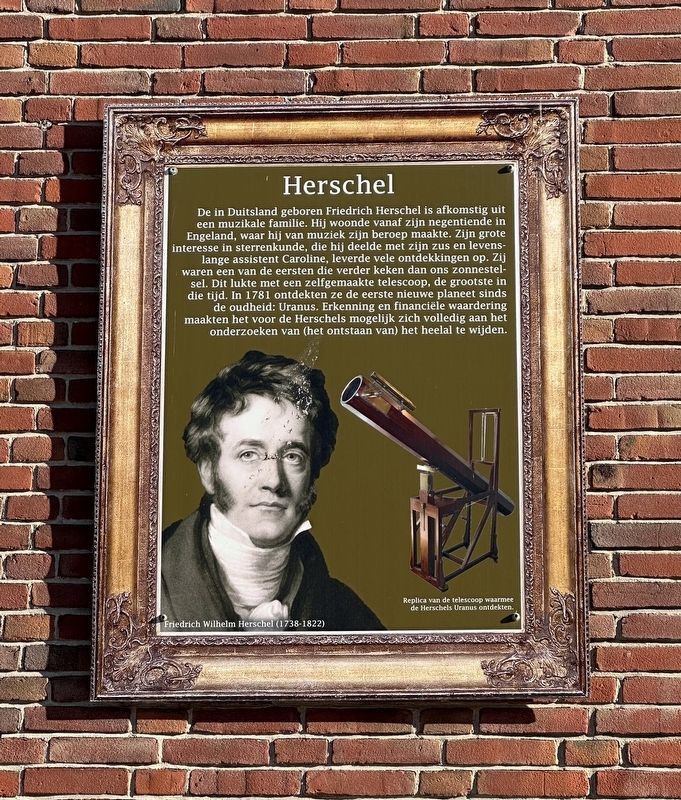
De in Duitsland geboren Friedrich Herschel is afkomstig uit een muzikale familie. Hij woonde vanaf zijn negentiende in Engeland, waar hij van muziek zijn beroep maakte. Zijn grote interesse in sterrenkunde, die hij deelde met zijn zus en levens- lange assistent Caroline, leverde vele ontdekkingen op. Zij waren een van de eersten die verder keken dan ons zonnestel- sel. Dit lukte met een zelfgemaakte telescoop, de grootste in die tijd. In 1781 ontdekten ze de eerste nieuwe planeet sinds de oudheid: Uranus. Erkenning en financiële waardering maakten het voor de Herschels mogelijk zich volledig aan het onderzoeken van (het ontstaan van) het heelal te wijden.
Friedrich Herschel, born in Germany, came from a musical family. He lived in England from the age of nineteen, where he made music his profession. His great interest in astronomy, which he shared with his sister and lifelong assistant Caroline, resulted in many discoveries. They were among the first to look beyond our solar system. They succeeded with a homemade telescope, the largest
this page online
Erected by Geef Straten Een Gezicht.
Topics and series. This historical marker is listed in this topic list: Science & Medicine. In addition, it is included in the Give Streets a Face / Geef Straten Een Gezicht, and the Scientists (GSEG) series lists. A significant historical date for this entry is March 13, 1781.
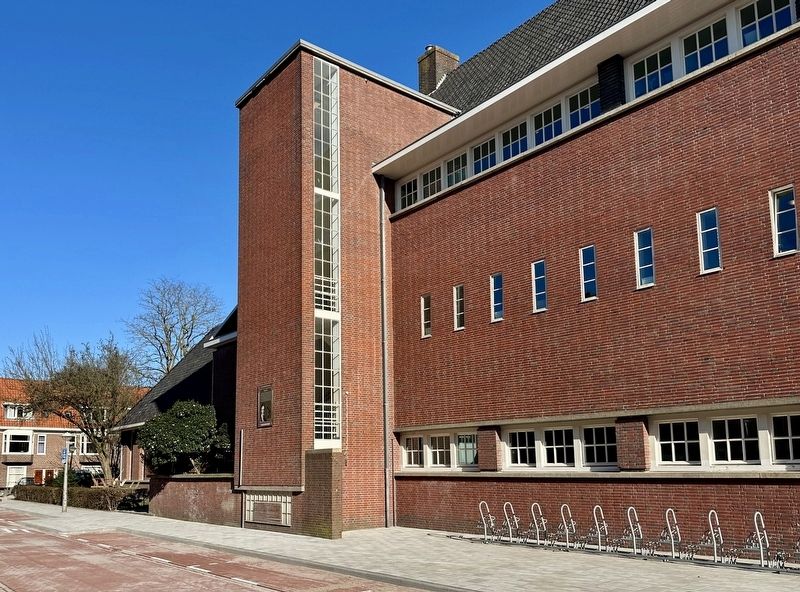
Location. 52° 21.259′ N, 4° 56.295′ E. Marker is in Amsterdam, Noord-Holland (North Holland). It is in Watergraafsmeer. It is on Herschelstraat, on the right when traveling north. The marker is mounted on the 5ᵗʰ Montessori Public Elementary School Watergraafsmeer. Touch for map. Marker is at or near this postal address: Herschelstraat 2-4, Amsterdam, Noord-Holland 1098 JA, Netherlands. Touch for directions.

Regionally, it is in Europe, the European Union, Atlantic Europe, the Benelux Low Countries, the Schengen Area, Western Europe, and the Western World. Historically, it finds
Photographed by Andrew Ruppenstein, March 17, 2025
2. Herschel Marker - wide view
Other nearby markers. At least 8 other markers are within walking distance of this marker: Kepler (about 90 meters away, measured in a direct line); Copernicus (about 120 meters away); Gallileï / Galileo (about 150 meters away); Archimedes (about 180 meters away); Isaac Newton (about 240 meters away); Laplace (approx. 0.2 kilometers away); Linnaeushof (court) (approx. 0.3 kilometers away); Alessandro Volta (approx. 0.3 kilometers away). Touch for a list and map of all markers in Amsterdam.
Related marker. Click here for another marker that is related to this marker.
Also see . . . William Herschel (Wikipedia). Excerpt:
Herschel constructed his first large telescope in 1774, after which he spent nine years carrying out sky surveys to investigate double stars. Herschel published catalogues of nebulae in 1802 (2,500 objects) and in 1820 (5,000 objects). The resolving power of the Herschel telescopes revealed that many objects called nebulae in the Messier catalogue were actually clusters of stars. On 13 March 1781 while making observations he made note of a new object in the constellation of Gemini. This would, after several weeks of verification and consultation with other astronomers, be confirmed to be a new planet, eventually given the name of Uranus. This was the first planet to be discovered since antiquity, and Herschel became famous overnight. As a result of this discovery, George III appointed him Court Astronomer. He was elected a Fellow of the Royal Society and grants were provided for the construction of new telescopes.(Submitted on April 1, 2025.)
Herschel pioneered the use of astronomical spectrophotometry, using prisms and temperature measuring equipment to measure the wavelength distribution of stellar spectra. In the course of these investigations, Herschel discovered infrared radiation. Other work included an improved determination of the rotation period of Mars, the discovery that the Martian polar caps vary seasonally, the discovery of Titania and Oberon (moons of Uranus) and Enceladus and Mimas (moons of Saturn). Herschel was made a Knight of the Royal Guelphic Order in 1816. He was the first President of the Royal Astronomical Society when it was founded in 1820. He died in August 1822, and his work was continued by his only son, John Herschel.
Credits. This page was last revised on April 1, 2025. It was originally submitted on April 1, 2025, by Andrew Ruppenstein of Lamorinda, California. This page has been viewed 94 times since then and 11 times this year. Photos: 1, 2. submitted on April 1, 2025, by Andrew Ruppenstein of Lamorinda, California.
