Watergraafsmeer in Amsterdam, North Holland, Netherlands — Northwestern Europe
Ohm
Photographed by Andrew Ruppenstein, March 17, 2025
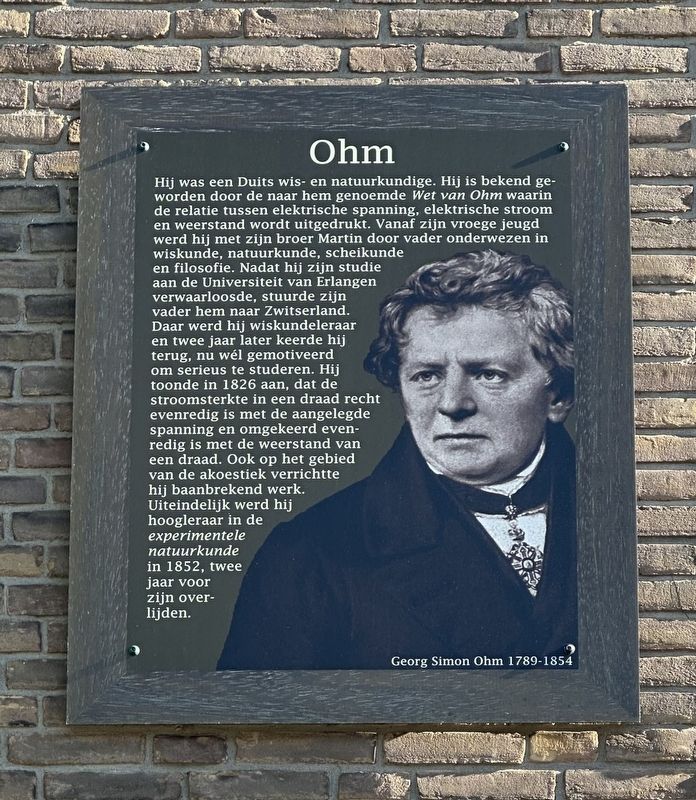
1. Ohm Marker

Hij was een Duits wis- en natuurkundige. Hij is bekend geworden door de naar hem genoemde Wet van Ohm waarin de relatie tussen elektrische spanning, elektrische stroom en weerstand wordt uitgedrukt. Vanaf zijn vroege jeugd werd hij met zijn broer Martin door vader onderwezen in wiskunde, natuurkunde, scheikunde en filosofie. Nadat hij zijn studie aan de Universiteit van Erlangen verwaarloosde, stuurde zijn vader hem naar Zwitserland. Daar werd hij wiskundeleraar en twee jaar later keerde hij terug, nu wél gemotiveerd om serieus te studeren. Hij toonde in 1826 aan, dat de stroomsterkte in een draad recht evenredig is met de aangelegde spanning en omgekeerd evenredig is met de weerstand van een draad. Ook op het gebied van de akoestiek verrichtte hij baanbrekend werk. Uiteindelijk werd hij hoogleraar in de experimentele natuurkunde in 1852, twee jaar voor zijn overlijden.
He was a German mathematician and physicist. He became famous for Ohm's Law, named after him, which expresses the relationship between electrical voltage, electrical current and resistance. From his early childhood, he and his brother Martin were taught mathematics, physics, chemistry and philosophy
this page online
Erected by Geef Straten Een Gezicht.
Topics and series. This historical marker is listed in this topic list: Science & Medicine. In addition, it is included in the Give Streets a Face / Geef Straten Een Gezicht, and the Scientists (GSEG) series lists. A significant historical date for this entry is July 6, 1854.
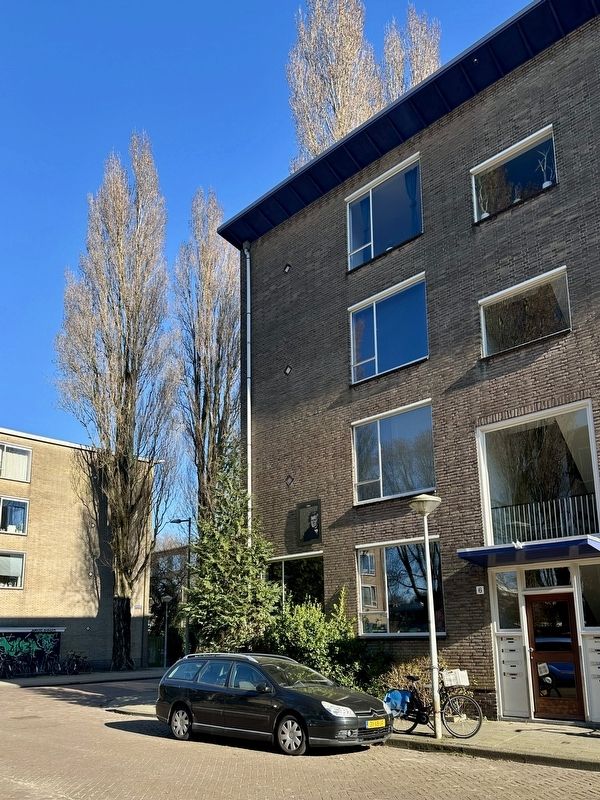
Location. 52° 21.054′ N, 4° 56.586′ E. Marker is in Amsterdam, Noord-Holland (North Holland). It is in Watergraafsmeer. It is at the intersection of Ohmstraat and Radioweg, on the right on Ohmstraat. Touch for map. Marker is at or near this postal address: Ohmstraat 6, Amsterdam, Noord-Holland 1098 SN, Netherlands. Touch for directions.

Regionally, it is in Europe, the European Union, Atlantic Europe, the Benelux Low Countries,
Photographed by Andrew Ruppenstein, March 17, 2025
2. Ohm Marker - wide view
Other nearby markers. At least 8 other markers are within walking distance of this marker: Berthelot (within shouting distance of this marker); Avogadro (within shouting distance of this marker); Edison (about 90 meters away, measured in a direct line); Lord Kelvin (about 120 meters away); Marie en Pierre Curie (about 120 meters away); Marconi (about 180 meters away); Johannes van der Waals (about 210 meters away); Rutherford (about 210 meters away). Touch for a list and map of all markers in Amsterdam.
Related markers. Click here for a list of markers that are related to this marker.
Also see . . . Georg Ohm (Wikipedia).
Georg Simon Ohm (16 March 1789 – 6 July 1854) was a German mathematician and physicist. As a school teacher, Ohm began his research with the new electrochemical cell, invented by Italian scientist Alessandro Volta. Using equipment of his own creation, Ohm found that there is a direct proportionality between the potential difference (voltage) applied across a conductor and the resultant electric current. This relation is known as Ohm's law.(Submitted on April 2, 2025.)
Credits. This page was last revised on April 2, 2025. It was originally submitted on April 2, 2025, by Andrew Ruppenstein of Lamorinda, California. This page has been viewed 103 times since then and 15 times this year. Photos: 1, 2. submitted on April 2, 2025, by Andrew Ruppenstein of Lamorinda, California.
