
Binnenstad Hoorn , North Holland, Netherlands — Northwestern Europe
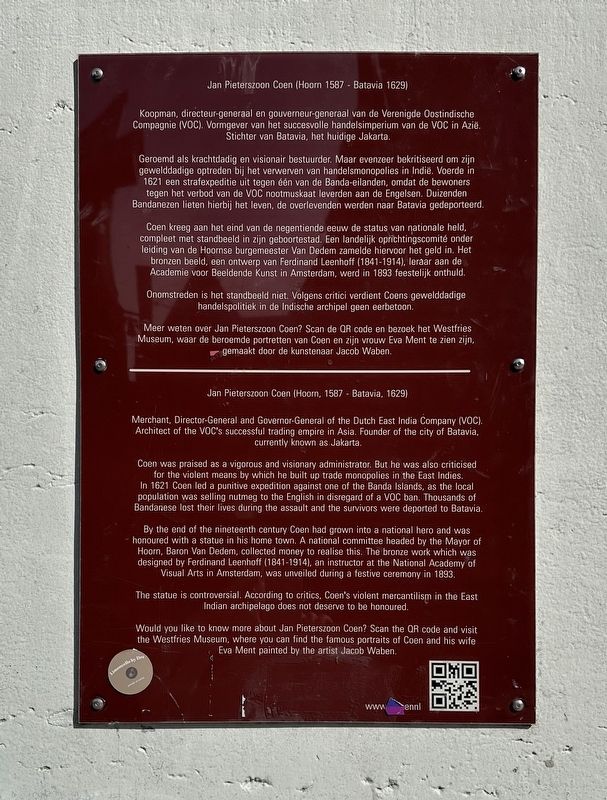
Jan Pieterszoon Coen (Hoorn 1587 - Batavia 1629)
Photographed by Andrew Ruppenstein, March 22, 2025
1. Jan Pieterszoon Coen (Hoorn 1587 - Batavia 1629) Marker

Geroemd als krachtdadig en visionair bestuurder. Maar evenzeer bekritiseerd om zijn gewelddadige optreden bij het verwerven van handelsmonopolies in Indië. Voerde in 1621 een strafexpeditie uit tegen één van de Banda-eilanden, omdat de bewoners tegen het verbod van de VOC nootmuskaat leverden aan de Engelsen. Duizenden Bandanezen lieten hierbij het leven, de overlevenden werden naar Batavia gedeporteerd.
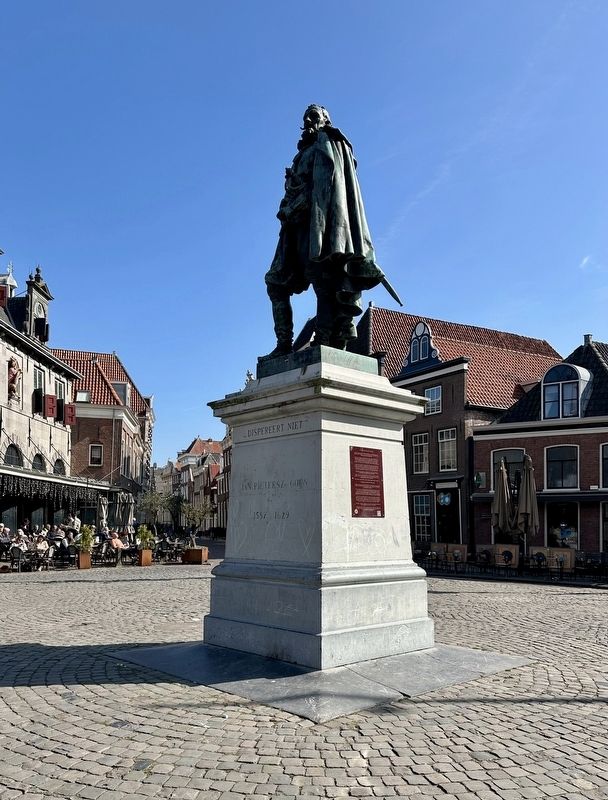
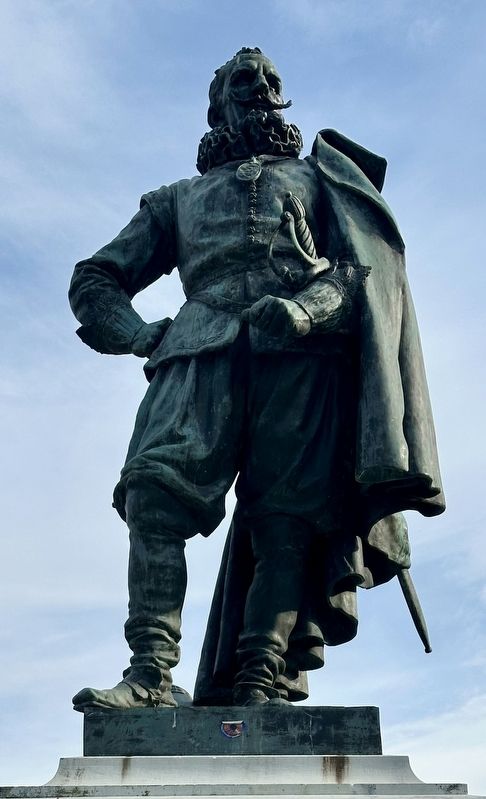
Coen kreeg aan het eind van de negentiende eeuw de status van nationale held, compleet met standbeeld in zijn geboortestad. Een landelijk oprichtingscomité onder leiding van de Hoornse burgemeester Van Dedem zamelde hiervoor het geld in. Het bronzen beeld, een ontwerp van Ferdinand Leenhoff (1841-1914), leraar aan de Academie voor Beeldende Kunst in Amsterdam, werd in 1893 feestelijk onthuld.
Onomstreden is het standbeeld niet. Volgens critici verdient Coens gewelddadige handelspolitiek in de Indische archipel geen eerbetoon.
Meer weten over Jan Pieterszoon Coen? Scan de QR code en bezoek het Westfries Museum, waar de beroemde portretten van Coen en zijn vrouw Eva Ment te zien zijn, gemaakt door de kunstenaar Jacob Waben.
Merchant, Director-General and Governor-General of the Dutch East India Company (VOC). Architect of the VOC's successful trading empire in Asia. Founder of the city of Batavia, currently known as Jakarta.
Coen was praised as a vigorous and visionary administrator. But he was also criticised for the violent means by which he built up trade monopolies in the East Indies. In 1621 Coen led a punitive expedition against one of the Banda Islands, as the local population was selling nutmeg to the English in disregard of a VOC ban. Thousands of Bandanese lost their lives during the assault and the survivors were deported to Batavia.
By the end of the nineteenth century Coen had grown into a national hero and was honoured with a statue in his home town. A national committee headed by the Mayor of Hoorn, Baron Van Dedem, collected money to realise this. The bronze work which was designed by Ferdinand Leenhoff (1841-1914), an instructor at the National Academy of Visual Arts in Amsterdam, was unveiled during a festive ceremony in 1893.
The statue is controversial. According to critics, Coen's violent mercantilism in the East Indian archipelago does not deserve to be honoured.
Would you like to know more about Jan Pieterszoon Coen? Scan the QR code and visit the Westfries Museum, where you can find the famous portraits of Coen and his wife Eva Ment painted by the artist Jacob Waben.
Topics.
this page online
Location. 52° 38.358′ N, 5° 3.555′ E. Marker is in Hoorn, Noord-Holland (North Holland). It is in Binnenstad Hoorn. It is on Roode Steen, in the median. Touch for map. Marker is at or near this postal address: Roode Steen 8, Hoorn, Noord-Holland 1621 CV, Netherlands. Touch for directions.

Regionally, it is in Europe, the European Union, Atlantic Europe, the Benelux Low Countries, the Schengen Area, Western Europe, and the Western World. Historically, it finds itself in what was once the Holy Roman Empire.
Other nearby markers. At least 8 other markers are within walking distance of this marker: Roode Steen 15 (within shouting distance of this marker); Statencollege (within shouting distance of this marker); Onderduikers in het Duitse hoofdkwartier / People in hiding at the German headquarters (within shouting distance of this marker); Hadrianus Junius (within shouting distance of this marker); Kerkstraat 10 (within shouting distance of this marker); Koepelkerk (1882) (about 120
Photographed by Andrew Ruppenstein, March 22, 2025
2. Jan Pieterszoon Coen statue and marker
Also see . . . Pala (Westfries Museum, in Dutch and English). The QR code on the marker leads to an online exhibit about the nutmeg trade, the introduction to which is excerpted below:
Pala – Indonesian for nutmeg. - Synonym for Banda. Seven volcanic islands in the Moluccas. For long the only place on earth where the Myristica fragrans, the nutmeg tree, grew. Its fruits brought prosperity, but also led to the downfall of an entire society. In 1621, Jan Pietersz Coen carried out what had been advocated for some time within the VOC: The extermination of the Bandanese people. In order to establish a monopoly on nutmeg and mace, thousands of Bandanese were murdered, starved to death or taken into slavery. Only a small number of people were able to escape from genocide.(Submitted on April 2, 2025.)
Photographed by Andrew Ruppenstein, March 22, 2025
3. Jan Pieterszoon Coen statue
Credits. This page was last revised on April 2, 2025. It was originally submitted on April 2, 2025, by Andrew Ruppenstein of Lamorinda, California. This page has been viewed 102 times since then and 9 times this year. Photos: 1, 2, 3. submitted on April 2, 2025, by Andrew Ruppenstein of Lamorinda, California.
