Edgefield in Edgefield County, South Carolina — The American South (South Atlantic)
Henry Christian Shooting & George D. Tillman
Photographed by Cosmos Mariner, April 20, 2022
1. Henry Christian Shooting & George D. Tillman Marker
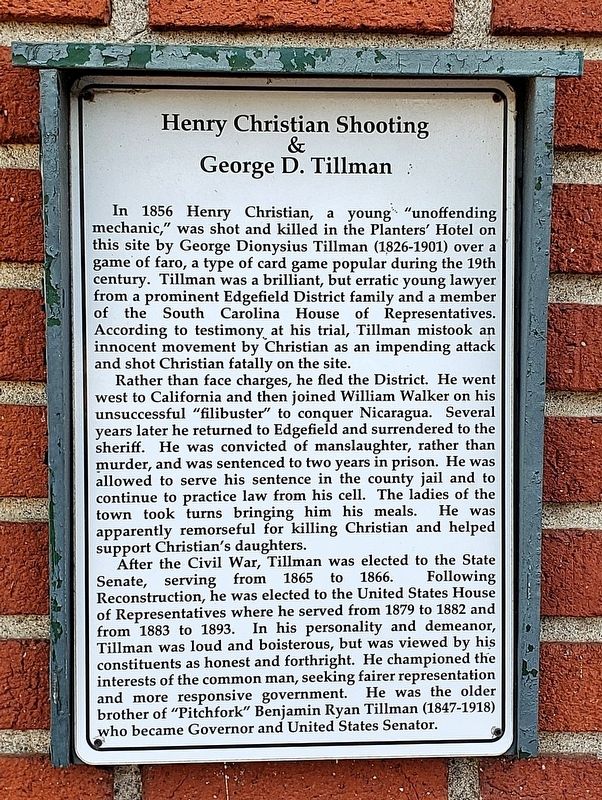
In 1856 Henry Christian, a young "unoffending mechanic," was shot and killed in the Planters' Hotel on this site by George Dionysius Tillman (1826-1901) over a game of faro, a type of card game popular during the 19th century. Tillman was a brilliant, but erratic young lawyer from a prominent Edgefield District family and a member of the South Carolina House of Representatives. According to testimony, at his trial, Tillman mistook an innocent movement by Christian as an impending attack and shot Christian fatally on the site.
Rather than face charges, he fled the District. He went west to California and then joined William Walker on his unsuccessful "filibuster" to conquer Nicaragua. Several years later he returned to Edgefield and surrendered to the sheriff. He was convicted of manslaughter, rather than murder, and was sentenced to two years in prison. He was allowed to serve his sentence in the county jail and to continue to practice law from his cell. The ladies of the town took turns bringing him his meals. He was apparently remorseful for killing Christian and helped support Christian's daughters.
After the Civil War,
this page online
Topics. This historical marker is listed in these topic lists: Government & Politics • Law Enforcement. A significant historical year for this entry is 1856.
Location. 33° 47.351′ N, 81° 55.797′ W. Marker is in Edgefield, South Carolina, in Edgefield County. It is at the intersection of Courthouse Square and Penn Street, on the left when traveling west on Courthouse Square. The marker is mounted on the left side of the entrance at the northwest corner of the building at this location, facing Courthouse Square. Touch for map. Marker is at or near this postal address: 122 Courthouse
Photographed by Cosmos Mariner, April 20, 2022
2. Henry Christian Shooting & George D. Tillman Marker
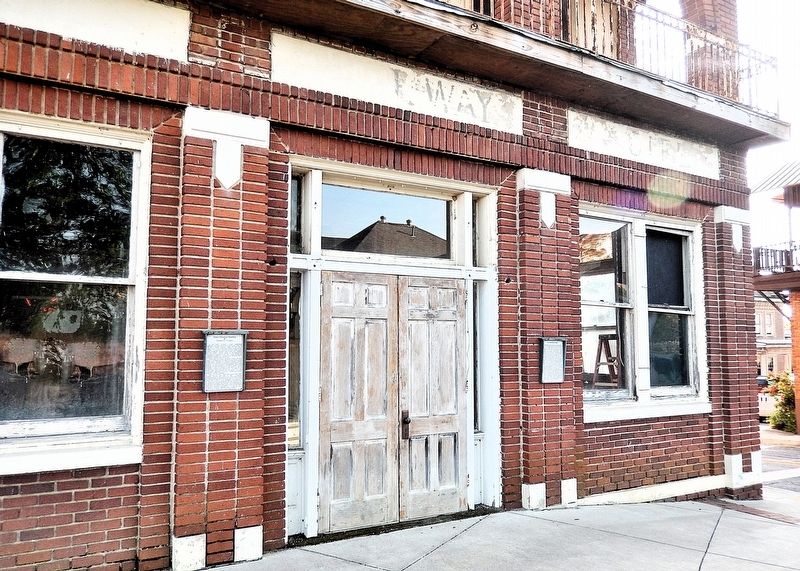
The marker is mounted on the left side of this front entrance.

Regionally, this marker is in Greater Augusta and in the Midlands. It is also in the American South and specifically in the Deep South. Globally, it is in North America, the Western Hemisphere, the Western World, and the Anglosphere. Historically, it finds itself in what was once the territory of the Mississippian Culture, one of the original Thirteen Colonies, one of the Confederate States of America, and the Antebellum South.
Other nearby markers. At least 8 other markers are within walking distance of this marker: The Plantation House (here, next to this marker); Martha M. Rich Building (here, next to this marker); First Term of Court (within shouting distance of this marker); Edgefield County World War I Memorial (within shouting distance of this marker); Edgefield County Veterans Memorial (within shouting distance of this marker); Edgefield County Confederate Monument (within shouting distance of this marker); Welcome to Historic Edgefield (within shouting distance of this marker); Governors and Lieutenant Governors from Edgefield (within
Photographed by Cosmos Mariner, April 20, 2022
3. The Plantation House Hotel (north elevation)
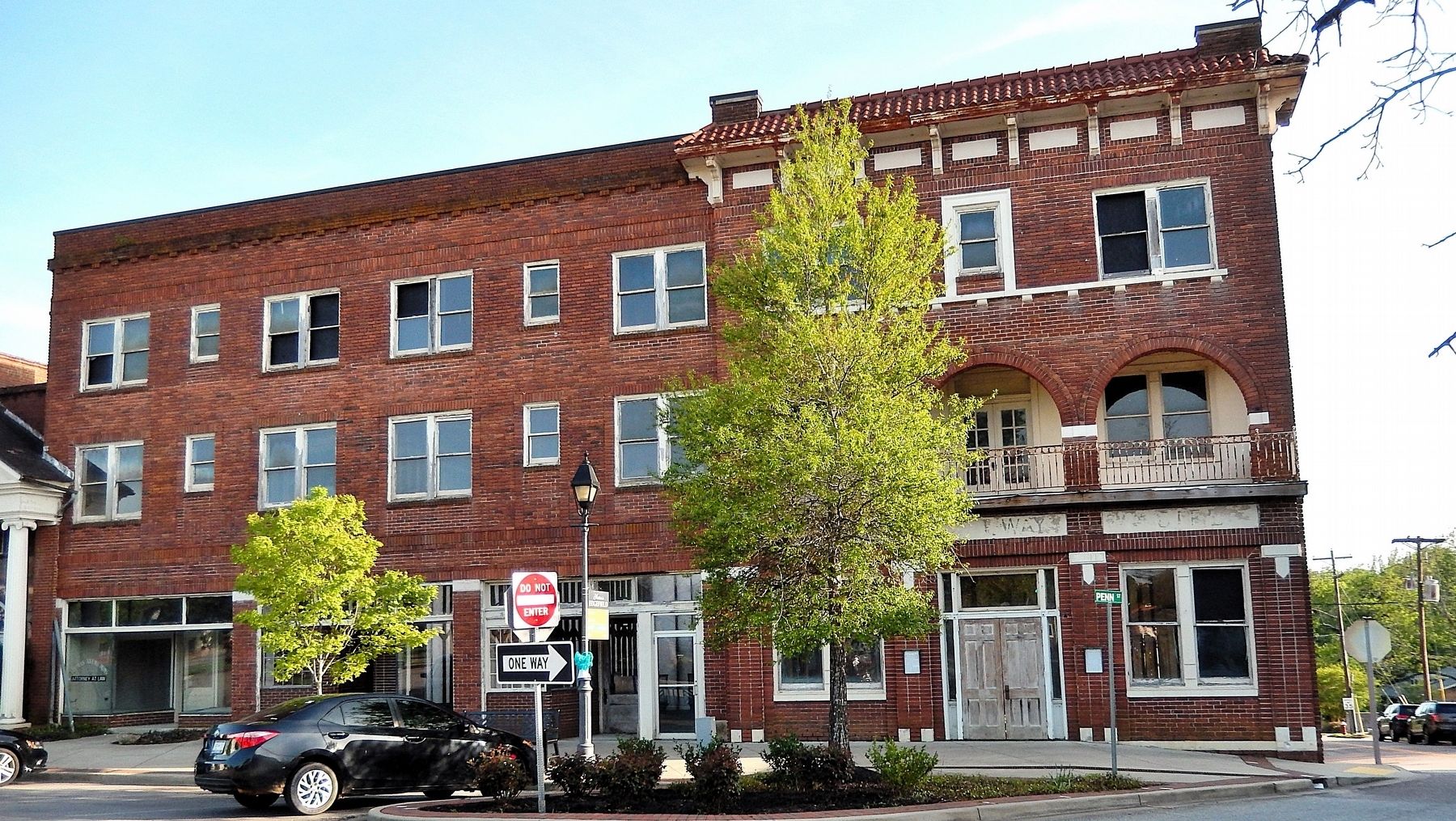
The marker is mounted on the left side of the front entrance.
Also see . . .
1. George Dionysius Tillman (Wikipedia).
Excerpt: He attended Harvard University but did not graduate. He studied law, was admitted to the bar in 1848, and commenced practice in Edgefield, South Carolina. During the American Civil War, he enlisted in the Confederate States Army. He served in the 3rd South Carolina Infantry Regiment in 1862. After the 3rd South Carolina was disbanded, he joined the 2nd South Carolina Artillery, in which he served until the close of the war.(Submitted on April 8, 2025, by Cosmos Mariner of Cape Canaveral, Florida.)
Tillman was elected to the Forty-eighth Congress from the Second district and to the four succeeding Congresses (1883–1893). He served as chairman of the Committee on Patents in the Fifty-second Congress. He was an unsuccessful candidate for renomination in 1892. He served as member of the State constitutional convention in 1895 and was an unsuccessful candidate for election as Governor of South Carolina in 1898.
2. Followers and supporters of William Walker's filibustering in Nicaragua (Wikipedia).
Excerpt: William Walker (1824–1860) was an American physician, lawyer, journalist, and mercenary. Walker then went to Nicaragua in 1855 as leader of a mercenary army employed by the Nicaraguan Democratic Party in its civil war against the Legitimists. He took control of the Nicaraguan government and in July 1856 set himself up as the country's president. Walker's regime was recognized as the legitimate government of Nicaragua by US president Franklin Pierce and it initially enjoyed the support of some important sectors within Nicaraguan society.(Submitted on April 8, 2025, by Cosmos Mariner of Cape Canaveral, Florida.)
As ruler of Nicaragua, Walker re-legalized slavery, which had been abolished in 1824, albeit this measure was never enforced, and threatened the independence of neighboring Central American republics. A military coalition led by Costa Rica defeated Walker and forced him to resign the presidency of Nicaragua on May 1, 1857. Walker then tried to re-launch his filibustering project and in 1860 he published a book, The War in Nicaragua, which cast his efforts to conquer Central America as tied to the geographical expansion of slavery. In that way, Walker sought to gain renewed support from pro-slavery forces in the Southern United States on the eve of the American Civil War. That same year Walker returned to Central America but was arrested by the Royal Navy, who handed him over to the Honduran government which executed him.
Credits. This page was last revised on April 8, 2025. It was originally submitted on April 5, 2025, by Cosmos Mariner of Cape Canaveral, Florida. This page has been viewed 220 times since then and 27 times this year. Photos: 1, 2, 3. submitted on April 8, 2025, by Cosmos Mariner of Cape Canaveral, Florida.
