Near Brownsville in Cameron County, Texas — The American South (West South Central)
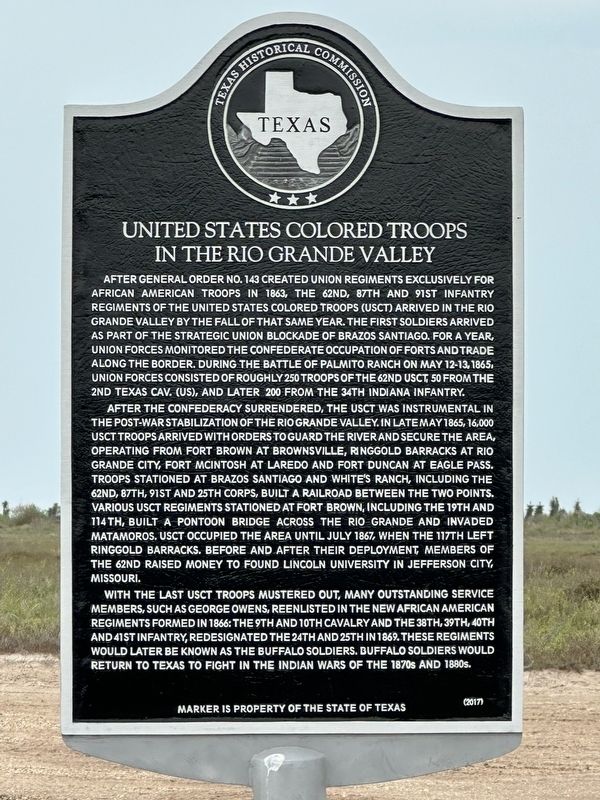
United States Colored Troops in the Rio Grande Valley
Photographed by Brian Anderson, March 26, 2025
1. United States Colored Troops in the Rio Grande Valley Marker
After the Confederacy surrendered, the USCT was instrumental in the post-war stabilization of the Rio Grande Valley. In late May 1865, 16,000 USCT troops arrived with orders to guard the river and secure the area, operating from Fort Brown at Brownsville, Ringgold Barracks at Rio Grande City, Fort McIntosh at Laredo and Fort Duncan at Eagle Pass. Troops stationed at Brazos Santiago and White’s Ranch, including the 62nd, 87th, 91st and 25th Corps, built a railroad between the two points. Various
this page online
With the last USCT troops mustered out, many outstanding service members, such as George Owens, reenlisted in the new African American regiments formed in 1866: the 9th and 10th Cavalry and the 38th, 39th, 40th and 41st Infantry, redesignated the 24th and 25th in 1869. These regiments would later be known as the Buffalo Soldiers. Buffalo Soldiers would return to Texas to fight in the Indian Wars of the 1870s and 1880s.
Erected 2017 by Texas Historical Commission. (Marker Number 20151.)
Topics. This historical marker is listed in these topic lists: African Americans • War, US Civil.
Location. 25° 58.045′ N, 97° 12.397′ W. Marker is near Brownsville, Texas, in Cameron County. It is at the intersection of Richardson Avenue and Boca Chica
Photographed by Brian Anderson, March 26, 2025
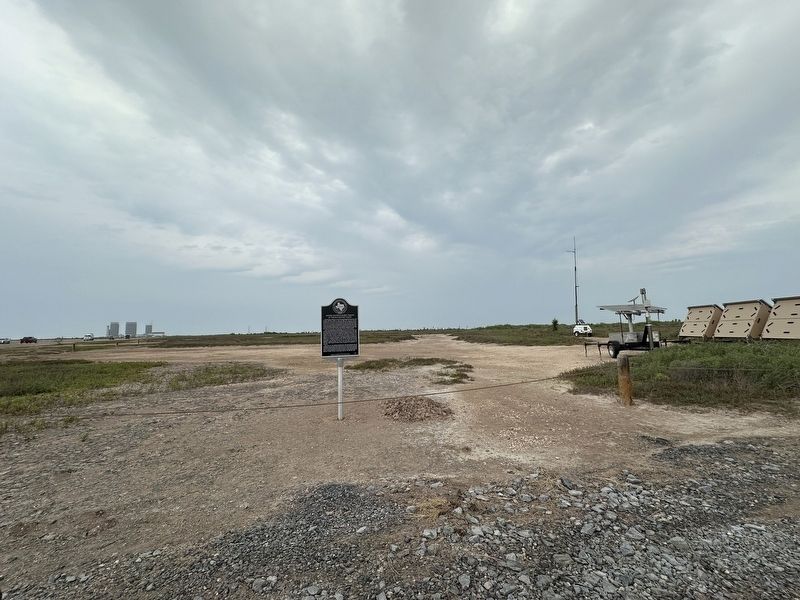
2. United States Colored Troops in the Rio Grande Valley Marker

Regionally, this marker is in South Texas. It is also in the American Borderlands, in the South, and on the Gulf Coast. Globally, it is in North America, a Gulf of Mexico state, the Western Hemisphere, the Western World, and the Anglosphere. Historically, it finds itself in what was once New Spain, the Republic of Texas, and one of the Confederate States of America.
Other nearby markers. At least 8 other markers are within 6 miles of this marker, measured as the crow flies: Site of Camp Belknap (approx. 1½ miles away); Palmetto Piling (approx. 3.7 miles away); Palmito Ranch Battlefield: Last Clash of the Blue and the Gray (approx. 5.9 miles away); Exploring The Boundaries (approx. 5.9 miles away); Battle of Palmito Ranch (approx. 5.9 miles away); The High Price of Cotton (approx. 6 miles away); Last Battle of the Civil War (approx. 6 miles away); a different marker also named The Battle of Palmito Ranch (approx. 6
Photographed by Jeff Leichsenring, July 19, 2026
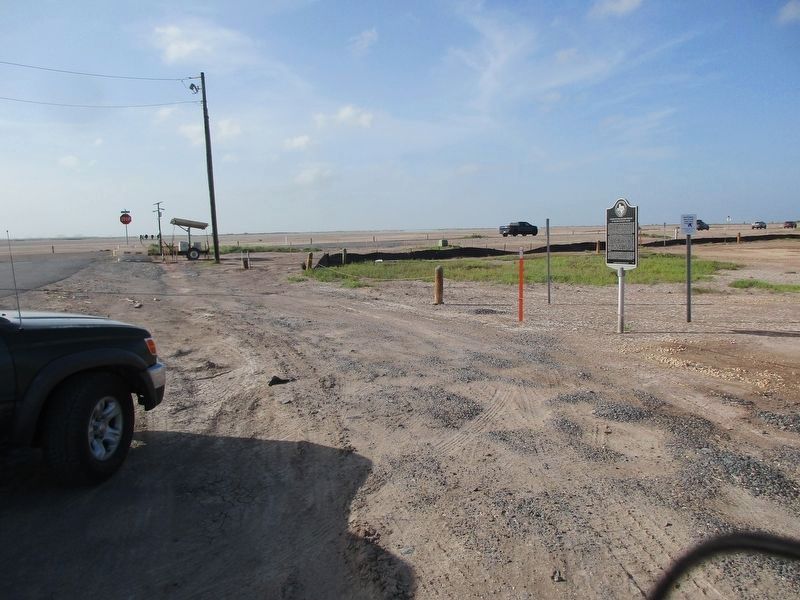
3. United States Colored Troops in the Rio Grande Valley Marker
Credits. This page was last revised on July 23, 2026. It was originally submitted on April 5, 2025, by Brian Anderson of New Albany, Ohio. This page has been viewed 1,304 times since then and 165 times this year. Photos: 1, 2. submitted on April 5, 2025, by Brian Anderson of New Albany, Ohio. 3. submitted on July 22, 2026, by Jeff Leichsenring of Garland, Texas.
