Fairmount Park in Philadelphia in Philadelphia County, Pennsylvania — The American Northeast (Mid-Atlantic)
Colobus monkey
Colobus guereza
| — | In the Rutooro Language of western Uganda, they are called 'engeya'. | — |
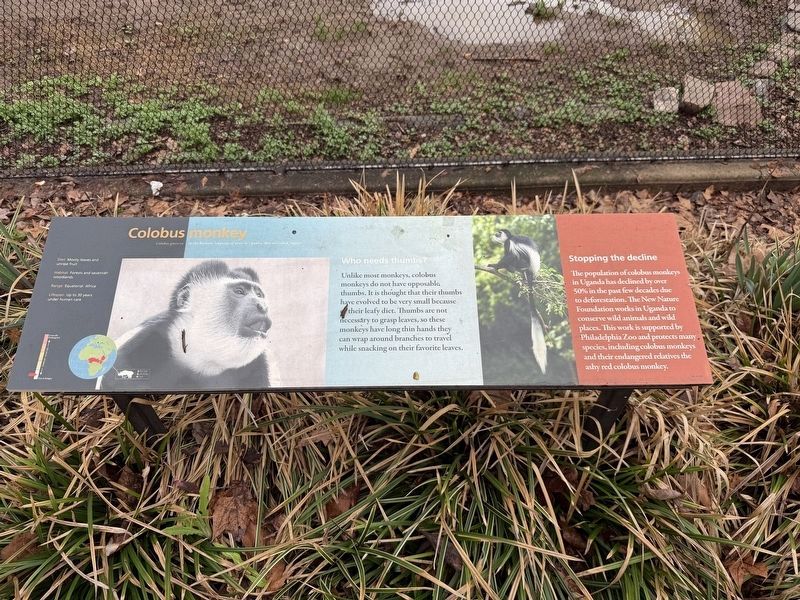
Diet Mostly leaves and unripe fruit
Habitat Forests and savannah woodlands
Range Equatorial Africa
Lifespan Up to 30 years under human care
Who needs thumbs?
Unlike most monkeys, colobus monkeys do not have opposable thumbs. It is thought that their thumbs have evolved to be very small because of their leafy diet. Thumbs are not necessary to grasp leaves, so these monkeys have long thin hands they can wrap around branches to travel while snacking on their favorite leaves.
Stopping the decline
The population of colobus monkeys in Uganda has declined by over 50% in the past few decades due to deforestation. The New Nature Foundation works in Uganda to conserve wild animals and wild places. This work is supported by Philadelphia Zoo and protects many species, including colobus monkeys and their endangered relatives the ashy red colobus monkey.
Erected by Philadelphia Zoo.
Topics. This historical marker is listed in these topic lists: Animals • Environment • Horticulture & Forestry • Industry & Commerce.
Location. 39° 58.446′ N, 75° 11.764′ W.
this page online

Regionally, this marker is in Southeast Pennsylvania. It is also in the American Northeast and in the Mid-Atlantic. Globally, it is in North America, the Western Hemisphere, the Western World, and the Anglosphere. Historically, it finds itself in what was once the Haudenosaunee (Iroquois) Confederacy, New Netherland, and one of the original Thirteen Colonies.
Other nearby markers. At least 8 other markers are within walking distance of this marker: Dr. Andrew Jackson Baker IV (within shouting distance of this marker); A Bright Future (within shouting distance of this marker); Historic Architecture (within shouting distance of this marker); America's First Zoo (within shouting distance of this marker); The Philadelphia Zoo (about 300 feet away, measured in a direct line); Ossabaw Island hog
Another marker is no longer nearby. Welcome back! (was within shouting distance of this marker but has been permanently removed).
Additional commentary.
1. About the marker
This sign serves as a historical marker because it includes information about how the history of human interaction has affected the population of the species for better and worse.
— Submitted April 6, 2025, by Devry Becker Jones of Washington, District of Columbia.
Credits. This page was last revised on April 6, 2025. It was originally submitted on April 6, 2025, by Devry Becker Jones of Washington, District of Columbia. This page has been viewed 125 times since then and 10 times this year. Photos: 1, 2. submitted on April 6, 2025, by Devry Becker Jones of Washington, District of Columbia.
