Green Township near Perrysville in Ashland County, Ohio — The American Midwest (Great Lakes)
Mohican Fire Tower
Mohican-Memorial State Forest

Photographed by Craig Doda, April 5, 2025
1. Mohican Fire Tower Marker
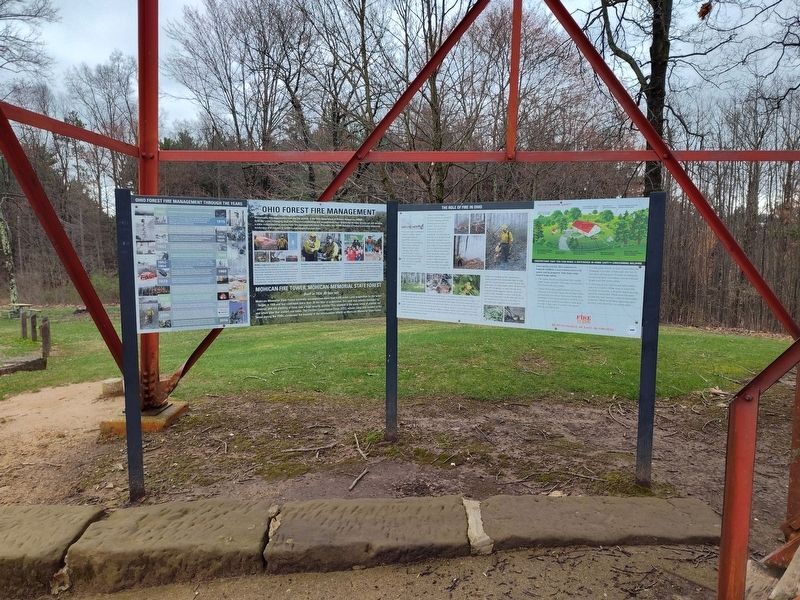
Ohio Forest Fire Management Through The Years
1885 - The Ohio General Assembly established the State Forestry Bureau.
1915 - The General Assembly appropriated $10,000 for the purchase of two forested areas in southern Ohio: Waterloo State Forest in Athens County and Dean State Forest in Lawrence County. This began Ohio's state forest system.
1922 - Ohio's first fire tower was erected on Copperhead Hill in Shawnee State Forest in Scioto County. A total of 39 fire tovers were erected in Ohio, and the last fire tower was constructed in 1970.
1933-1935 - The Civilian Conservation Corps (CCC) crews participated in forest fire suppression, as well as construction of fire towers and an expansive forest fire control telephone network.
1942 - To supplement fire towers, the Division of Forestry begins using Civil Air Patrol aircraft for fire detection. Ohio becomes one of the first states to use aircraft for forest fire detection on a regular basis.
1949- The Ohio Department of Natural Resources (ODNR) is formed, with the ODNR Division of Forestry as one of the seven charter divisions.
1952-1954 - Extreme drought conditions
this page online
1969 - That spring, a total of 1,803 forest fires were reported, burning nearly 13,000 acres. The last of the 39 Ohio fire towers was contracted to be built, and three fire stations were completed.
1978 - Changes in land use and advances in air detection of forest fires resulted in the discontinuation of fire tower use. Green Ridge Tower in Pike State Forest was the last tower to be manned.
1986 - The ODNR Division of Forestry sends its first inter-agency fire crew to assist on Western wildfires. The crew worked on the Ace Creek fire in Washington state. Many Ohio resources, including crews and fire engines, have helped on Western wildfires since then.
1988 - Legislation passed in March repealed the use of burning permits and instituted the current 6 a.m. to 5 p.m. burn ban in the fire season months - March, April, May, October and November.
2000

Photographed by Craig Doda, April 5, 2025
2. Mohican Fire Tower Marker
2005 - The Smokey Bear specialty license plate for passenger vehicles became available through the Ohio Bureau of Motor Vehicles. Ohio's Smekey Bear license plate was the first, and is to date, the only Smokey Bear license plate for registered vehicles in the country. A portion of sale proceeds is returned to the ODNR Division of Forestry to support wildfire prevention and education.
2016 - The Armintrout Firetower was relocated from Pike County to the state fairgrounds in Columbus. The restored fire tower is used for educating the public about Ohio's rich history of forest protection.
Ohio Forest Fire Management
Historically, fire suppression was the top priority of the Ohio Department of Natural Resources (ODNR).
Over the years, changing land use, resource availability and amendments have helped the division branch out and develop a more comprehensive and holistic fire management vision. Presently, the ODNR Division of Forestry provides statewide leadership and support in wildfire management

Photographed by Craig Doda, April 5, 2025
3. Mohican Fire Tower Marker
Wildfire Suppression: Each year, Ohio records hundreds of wildfires that burn thousands of acres. Local fire departments and the ODNR Division of Forestry personnel are the first responders to these fires. Equipment such as chainsaws, leaf blowers, rakes and shovels are used to create control lines around the fires to stop the spread. Occasionally, heavy equipment such as bulldozers and helicopters are required to contain large, intense blazes.
Assistance to Fire Departments: The ODNR Division of Forestry provides leadership in protecting Ohio's private and public forest lands from wildfire. The division partners with rural fire departments to accomplish this mission, providing support to Ohio's rural fire departments through wildfire suppression, prevention, grant opportunities and firefighter training.
Prevention and Education: Safety is always a top priority. The ODNR Division of Forestry continues to spread the word about the importance of wildfire safety to kids and adults across Ohio. Smokey Bear continues to help in this effort, showing his friendly face at various public events and in schools across the state.

Photographed by Craig Doda, April 5, 2025
4. Mohican Fire Tower Marker
Mohican Fire Tower, Mohican-Memorial State Forest
Built in 1934. 80 feet tall.
Mohican-Memorial State Forest currently encompasses more than 4,520 acres. Land acquisition for the forest began in 1928 and has continued since then. At the time of acquisition, this land was heavily damaged by erosion, and the planting of trees was a high-priority activity. This resulted in the many areas of planted red and white pine that visitors see today. The Civilian Conservation Corps (CCC), whose camp was located in the forest during the 1930s, conducted the majority of the reforestation efforts on Mohican-Memorial State Forest.
The Role Of Fire In Ohio
Prior to European settlement in the Ohio Valley, Native Americans frequently burned the understory of their forests and woodlands. This practice facilitated easier travel and aided in hunting. The settlers used fire to clear land for homesteads and to eliminate brush and vegetation from areas. Fire was a valuable and powerful tool in both cultures.
Today, forest managers practice
Photographed by Craig Doda, April 5, 2025
5. Mohican Fire Tower Marker
Fire has helped shape Ohio's oak-dominated forest type for hundreds of years. Fire in the ecosystem has allowed oak species to become dominant over other species, such as maple. This is because oak species have certain physical adaptations that make them more resistant to fire. These adaptations include thicker bark to insulate and protect the tree from heat and flames, and better food stores in roots and dormant underground buds to assist in re-sprouting after a fire event. Oak-dominated forests are valued as excellent wildlife habitat, provide forage for many animals and produce excellent timber for the

Photographed by Craig Doda, April 5, 2025
6. Mohican Fire Tower Marker
Aside from facilitating oak regeneration, forests benefit from prescribed fires through post-fire soil enrichment, nutrient cycling and elimination of accumulated debris on the forest floor. At first glance, an area that has been recently burned appears charred, black and unattractive. However, a return visit to the same site a few short months later will reveal the benefits of the practice in the form of abundant, lush vegetation and re-growth.
Focus On Home Safety
Keep fire tools available: shovel, rake and ladder.
Clear flammable vegetation away from propane tanks.
Keep landscaping near the house well maintained and trimmed.
Keep the chimney clean and install a spark arrester.
Keep the roof clear of leaves, needles and other debris.
Keep 100 feet of garden hose attached.
Keep the woodpile 25 feet from structures and fuel tanks.
Keep driveways accessible for fire trucks and provide a turn-around area.
Trim and prune any coniferous trees.
Keep the grass green and mowed 100 feet from any structure.
Rake leaves away from home and outbuildings.
Avoid outdoor burning. Recycle, mulch and compost whenever possible.
Understand That You Can Make A Difference In Home Safety Concerning Wildfire.
Every spring and fall, Ohio experiences frequent wildfires. Local citizens need to be aware and be prepared. Take these steps toward home safety:
• The home should be identified with visible, clear street numbers. This helps responders find the house more easily.
• Create defensible space around the house-- the most critical part being the 30-foot buffer surrounding the house. Reducing flammable materials in this space prevents wildfire from spreading and gives firefighters a safe area to work if they need to protect the house from an oncoming fire.
• Provide good vehicle access. Ensure that the driveway is at least 12 feet wide and has 15 feet vertical clearance. Provide an adequate turnaround area. This allows rescue vehicles to approach the home safely.
• If choosing to burn debris and yard waste, use a burn barrel. Make sure to cover the top with wire mesh, and never leave burning material unattended. Make sure the area around the burn barrel is clear of flammable materials. Observe all laws regarding open burning, and never burn on windy days.
Topics. This historical marker is listed in these topic lists: Horticulture & Forestry • Natural Resources • Parks & Recreational Areas. A significant historical year for this entry is 1885.
Location. 40° 36.279′ N, 82° 18.28′ W. Marker is near Perrysville, Ohio, in Ashland County. It is in Green Township. It is at the intersection of O D N R Mohican Road 51 and Hog Hollow Trail, on the right when traveling east on O D N R Mohican Road 51. Touch for map. Marker is at or near this postal address: O D N R Mohican Rd 51, Perrysville OH 44864, United States of America. Touch for directions.

Regionally, this marker is in Amish Country. It is also in the American Midwest. Globally, it is in North America, the Western Hemisphere, the Western World, and the Anglosphere. Historically, it finds itself in what was once the Haudenosaunee (Iroquois) Confederacy, the territory of the Mississippian Culture, and the Northwest Territory.
Other nearby markers. At least 8 other markers are within walking distance of this marker: A different marker also named Mohican Fire Tower (here, next to this marker); Ohio Department of Natural Resources 75th Anniversary (within shouting distance of this marker); Above and Beneath (approx. half a mile away); Discover (approx. ¾ mile away); Ohio Memorial Shrine (approx. 0.9 miles away); Mohican Covered Bridge (approx. 0.9 miles away); a different marker also named Discover (approx. 0.9 miles away); The All-Importaint Hemlock (approx. 0.9 miles away). Touch for a list and map of all markers in Perrysville.
Credits. This page was last revised on April 15, 2025. It was originally submitted on April 11, 2025, by Craig Doda of Napoleon, Ohio. This page has been viewed 176 times since then and 38 times this year. Photos: 1, 2, 3, 4, 5, 6. submitted on April 11, 2025, by Craig Doda of Napoleon, Ohio. • Andrew Ruppenstein was the editor who published this page.
