Montmartre in Paris in Département de Paris, Île-de-France, France — Western Europe
Clos Montmartre (1933)

Photographed by Andrew Ruppenstein, April 11, 2025
1. Clos Montmartre (1933) Marker

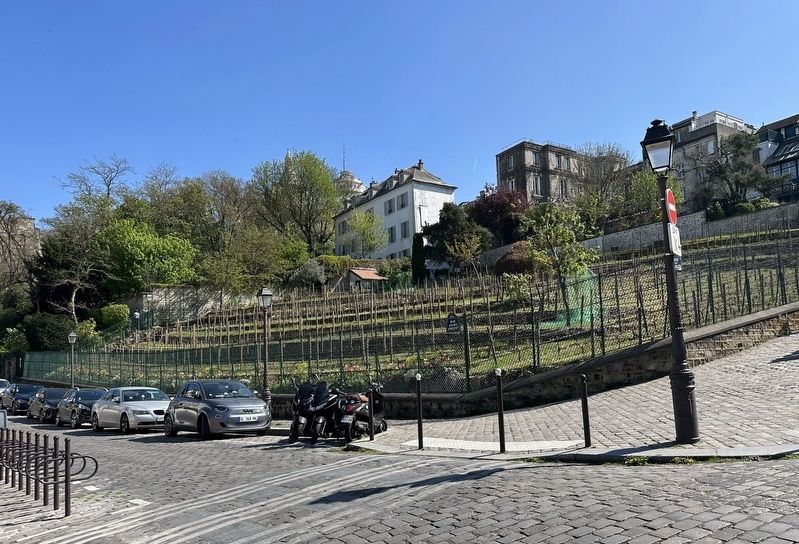
The Montmartre vineyard, the oldest in Paris, has 2,000 vines. The first vine was said to have been planted by Adelaide of Savoy, the first abbess of the Montmartre Abbey. In the 16th century, Montmartre was located outside Paris. Its inhabitants were mainly laborers. The memory of certain vineyard appellations, such as La Goutte d'Or, lives on in the street names of a neighborhood in the 18th arrondissement.
Erected by Ville de Paris.
Topics and series. This historical marker is listed in this topic list: Agriculture. In addition, it is included in the Parks and Squares of Paris series list. A significant historical year for this entry is 2000.
Location. 48° 53.291′ N, 2° 20.391′ E.
this page online

Regionally, it is in the North Atlantic Region, Europe, the European Union, Atlantic Europe, the Schengen Area, Western Europe, a coastal Mediterranean country, and the Western World. Historically, it finds itself in what was once a French colony and also the Roman Empire.
Other nearby markers. At least 8 other markers are within walking distance of this marker: Henry Lachouque (within shouting distance of this marker); Le Lapin Agile (within shouting distance of this marker); Musée de Montmartre (within shouting distance of this marker); Erik Satie (about 90 meters away, measured in a direct line); La Bonne Franquette (about 120 meters away); The Republic of Montmartre and Skadarlija - Twinning (about 120 meters away); Le Consulat (about 120 meters away); La Folie Sandrin (about 120 meters away). Touch for a list and map of all markers in Paris.
Other

Photographed by Andrew Ruppenstein, April 11, 2025
2. Clos Montmartre (1933) Marker - wide view
Also see . . .
1. Vigne de Montmartre (Wikipedia, in French). Excerpt (in translation):
The existence of vineyards in Montmartre is documented as early as 944. In the 12th century, vines were planted by the ladies of the Montmartre Abbey founded by Adelaide of Savoy. The abbey's impoverishment led it to sell its vineyard plots. In the 16th century, the inhabitants of Montmartre were mainly laborers and winegrowers. The vines were cultivated from the summit of the hill to the surrounding plains.(Submitted on April 11, 2025.)
Alternatively a white and then a red wine, Montmartre wine was known by various appellations: "Le Clos Berthaud," "La Goutte d'Or," "Le Sacalie," "La Sauvageonne," and later, "Le Picolo". In the 17th century, Montmartre wine was a small wine reserved for local consumption. A popular saying of the time mocks its quality, which seems to be exclusively diuretic:
«C'est du vin de Montmartre, Qui en boit pinte en pissequarte.»Photographed by Andrew Ruppenstein, April 11, 20253. View of Clos Montmartre (marker site is out of the picture, on the right)
("It's Montmartre wine. Whoever drinks a pint of it pisses off a quart.")
At the beginning of the 17th century, a country open-air tavern (guinguette) stood on the current site of Clos-Montmartre. Its name, Le Parc de la Belle Gabrielle, comes from the proximity of a house said to have belonged to Gabrielle d'Estrées, mistress of King Henry IV. In the 18th century, three-quarters of the hill was covered with vines, and the wine, not subject to excise duties because it was outside Paris, encouraged the opening of taverns and cabarets.
Later, the site was transformed mainly into a wasteland, a haven for tramps and a playground for local children. When Montmartre was annexed to Paris in 1860, housing developed to the detriment of the remaining vineyards.
2. A Hidden Vineyard in the Heart of Paris: Clos Montmartre (YouTube, 8:27). Explore Clos Montmartre, one of Paris’s best-kept secrets—a working vineyard tucked away in the charming streets of Montmartre. On this exclusive tour, Laurence Debart-Johner takes you through a place rarely open to the public. Learn how Vigne du Clos Montmartre survived urban development due to the work of a cartoonist, Francisco Poulbot. Clos Montmartre continues to this day, making wine with grape varieties you won’t find anywhere else—some even banned for commercial production. (Submitted on April 11, 2025.)
Additional keywords. Viticulture
Credits. This page was last revised on April 11, 2025. It was originally submitted on April 11, 2025, by Andrew Ruppenstein of Lamorinda, California. This page has been viewed 111 times since then and 21 times this year. Photos: 1, 2, 3. submitted on April 11, 2025, by Andrew Ruppenstein of Lamorinda, California.
