Jardin Jeanne d'Arc
⎯⎯⎯
Joan of Arc Garden
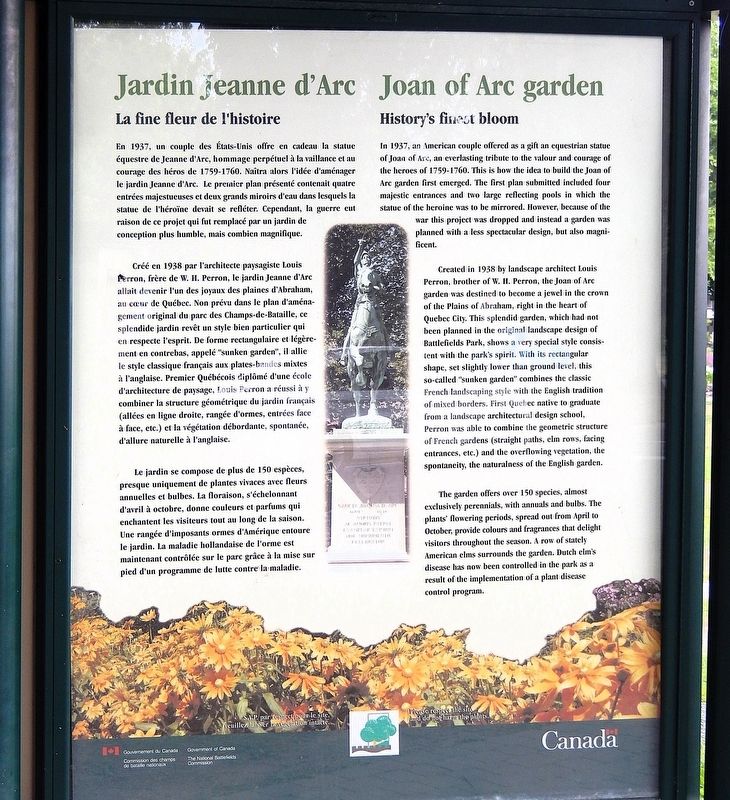

En 1937, un couple des États-Unis offre en cadeau la statue équestre de Jeanne d'Arc, hommage perpétuel à la vaillance et au courage des héros de 1759-1760. Naîtra alors l'idée d'aménager le jardin Jeanne d'Arc. Le premier plan présenté contenait quatre entrées majestueuses et deux grands miroirs d'eau dans lesquels la statue de l'héroïne devait se refléter. Cependant, la guerre eut raison de ce projet qui fut remplacé par un jardin de conception plus humble, mais combien magnifique.
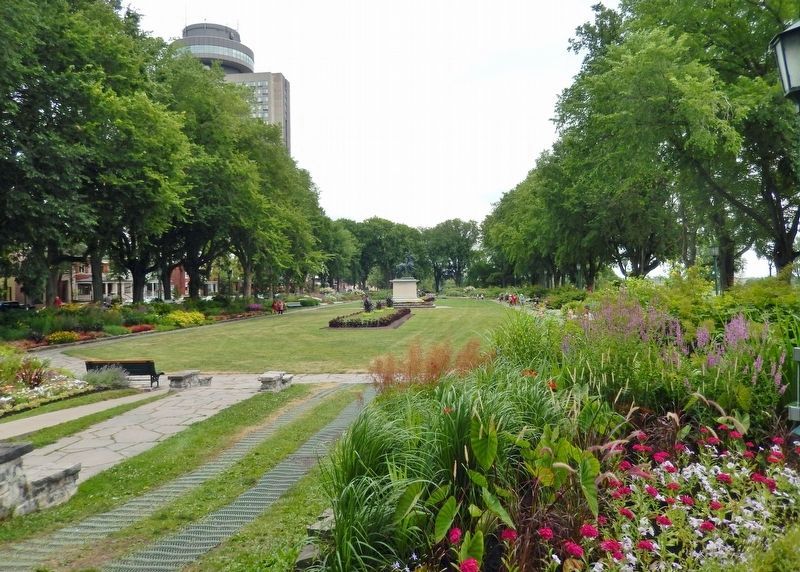
Créé en 1938 par l'architecte paysagiste Louis Perron, frère de W. H. Perron, le jardin Jeanne d'Arc allait devenir l'un des joyaux des plaines d'Abraham, au cœur de Québec. Non prévu dans le plan d'aménagement original du parc des Champs-de-Bataille, ce splendide jardin revêt un style bien particulier qui en respecte l'esprit. De forme rectangulaire et légèrement en contrebas, appelé "sunken garden", il allie le style classique français aux plates-bandes mixtes à l'anglaise. Premier Québécois diplômé d'une école d'architecture de paysage, Louis Perron a réussi à y combiner la structure géométrique
this page online
Le jardin se compose de plus de 150 espèces, presque uniquement de plantes vivaces avec fleurs annuelles et bulbes. La floraison, s'échelonnant d'avril à octobre, donne couleurs et parfums qui enchantent les visiteurs tout au long de la saison. Une rangée d'imposants ormes d'Amérique entoure le jardin. La maladie hollandaise de l'orme est maintenant contrôlée sur le parc grâce à la mise sur pied d'un programme de lutte contre la maladie.
In 1937, an American couple offered as a gift an equestrian statue of Joan of Arc, an everlasting tribute to the valour and courage of the heroes of 1759-1760. This is how the idea to build the Joan of Arc garden first emerged. The first plan submitted included four majestic entrances and two large reflecting pools in which the statue of the heroine was to be mirrored. However, because of the war this project was dropped and instead a garden was planned with a less spectacular design, but also magnificent.
Created
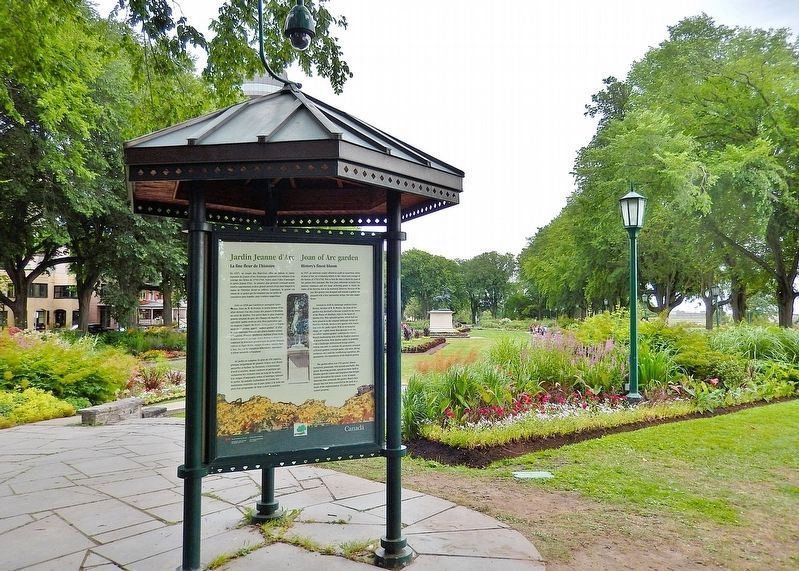
Interpretive Kiosk
The garden offers over 150 species, almost exclusively perennials, with annuals and bulbs. The plants' flowering periods, spread out from April to October, provide colours and fragrances that delight visitors throughout the season. A row of stately American elms surrounds the garden. Dutch elm's disease has now
Erected by Commission des champs de bataille nationaux / The National Battlefields Commission.
Topics. This historical marker is listed in these topic lists: Architecture • Horticulture & Forestry • Parks & Recreational Areas. A significant historical year for this entry is 1938.
Location. 46° 48.214′ N, 71° 13.113′ W. Marker is in Québec, in Capitale-Nationale. It is in Vieux-Québec-Cap-Blanc-colline Parlementaire. It is on Avenue Taché just north of Avenue George VI, on the right when traveling north. The marker is mounted on an interpretive kiosk at the west end of the Joan of Arc Garden. Touch for map. Marker is in this post office area: Québec G1R 2L7, Canada. Touch for directions.

Regionally, this marker is in Central Canada. Globally, it is in North America, the Western Hemisphere, and the Western World. Historically, it finds itself in what was once a British colony, the Viceroyalty of New France, the Haudenosaunee (Iroquois) Confederacy, and Rupert’s Land.
Other nearby markers. At least 8 other markers
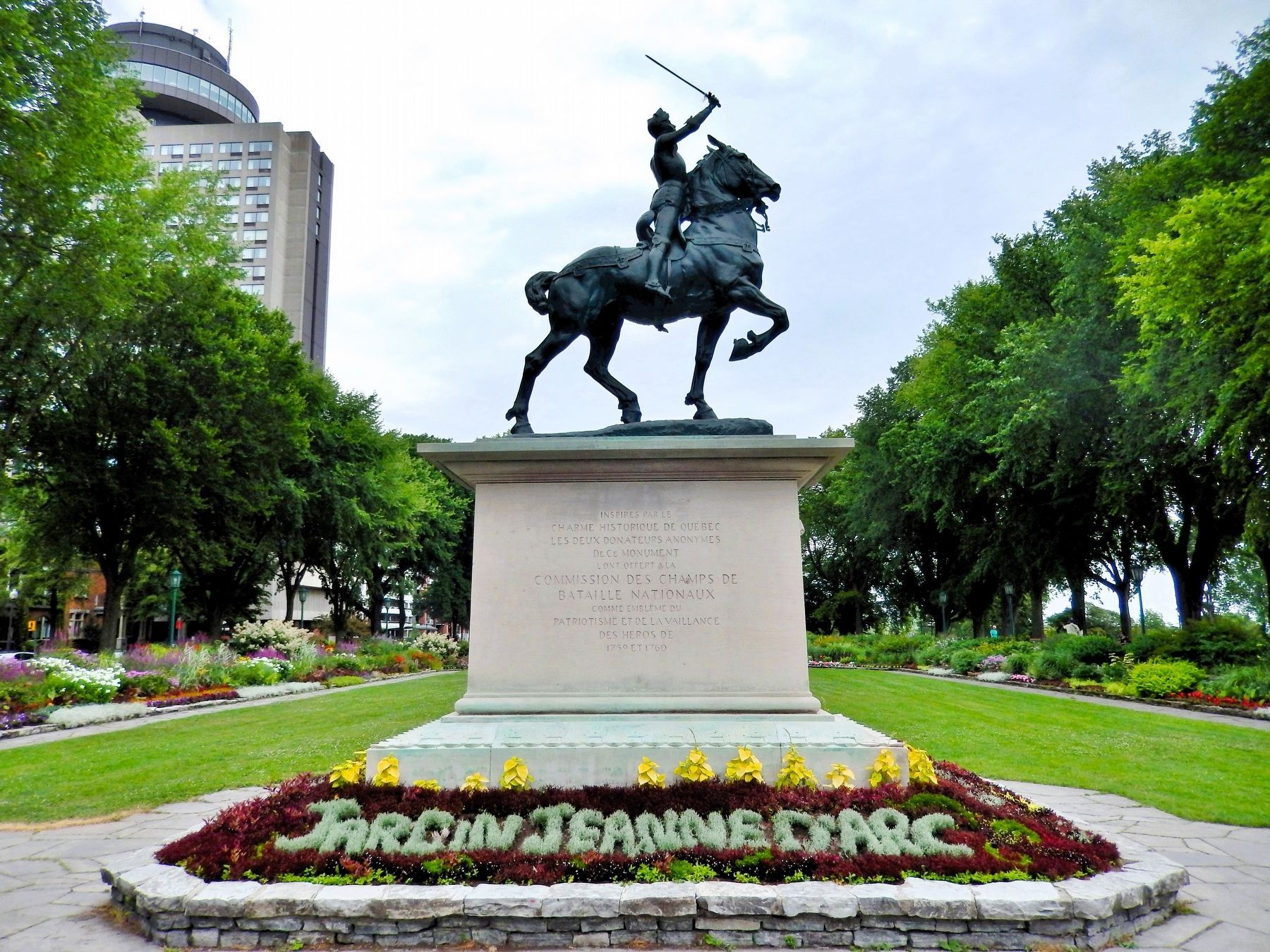
Inspires par le charme historique de Québec les deux donateurs anonymes de ce monument l’ont offert à la Commission des Champs de Bataille Nationaux comme emblème du patriotisme et de la vaillance des héros de 1759 et 1760.
• • •
Inspired by the historical charm of Quebec the two anonymous donors of this monument offered it to the National Battlefields Commission as an emblem of the patriotism and valor of the heroes of 1759 and 1760.
Related markers. Click here for a list of markers that are related to this marker.
Also see . . .
1. Joan of Arc Garden.
Excerpt: During summertime, hundreds of varieties ornate the flowerbeds, beneath the majestic elms' branches. During the Fall season, come and appreciate the warm colors of seasonal perennials and annuals. All October-long, sculptures offering an interpretation of legends associated with the Plains await visitors, in the daytime or in the evening.(Submitted on April 16, 2025, by Cosmos Mariner of Cape Canaveral, Florida.)For the last 100 years or so, the National Battlefields Commission has been growing all
the flowers used to beautify the park. The greenhouses, among the oldest active in Québec, produce some 45,000 annuals, biennials and perennials.
2. Louis Perron (Canadian Society of Landscape Architects).
Excerpt: Louis-Joseph Perron, born the seventeenth of eighteen children to a farming family in Quebec, acquired an extensive knowledge of plants in his early years, by working in his brother Wilfred’s thriving nursery. Wilfred encouraged him to study at Cornell University, where Louis early demonstrated his gifts for design and planning.(Submitted on April 16, 2025, by Cosmos Mariner of Cape Canaveral, Florida.)In 1937, as the first Francophone university-trained landscape architect in the province, Perron first took on garden projects in Montreal. He was, writes Ronald Williams in Landscape Architecture in Canada, “a master of floral composition” who composed with a broad palette, often creating plant lists of a hundred varieties or more. The Jardin Jeanne-d’Arc on the Plains of Abraham in Quebec City is “a masterpiece …an English floral garden within a French composition.”
Credits. This page was last revised on April 16, 2025. It was originally submitted on April 12, 2025, by Cosmos Mariner of Cape Canaveral, Florida. This page has been viewed 214 times since then and 63 times this year. Photos: 1, 2, 3, 4. submitted on April 16, 2025, by Cosmos Mariner of Cape Canaveral, Florida.
