Peterboro in Madison County, New York — The American Northeast (Mid-Atlantic)
The Birdhouse

Photographed by Susan A. Dalaba, April 25, 2022
1. The Birdhouse Marker
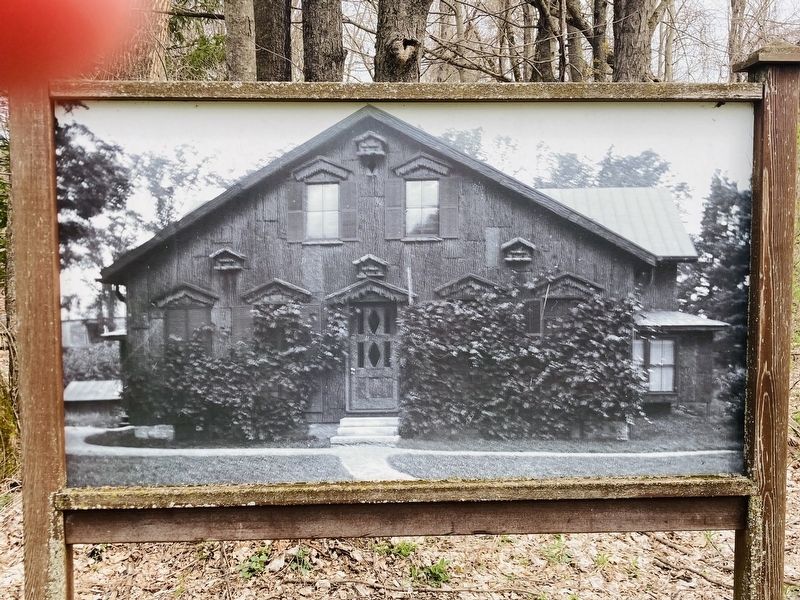
Inside, a fountain holding live fish bubbled at the foot of a magnificent mahogany staircase leading to the second floor atrium, with its miniature duck pond on the right and a running stream on the left. Live songbirds flew beneath banks of skylights from all parts of the globe, ever-changing exhibits showcased thousands of stuffed birds and big game specimens. Other displays indicated further passions; the first guns, fishing tackle, taxidermy equipment and other tools, as well as a kennel, and elite library, and superb artwork. The basement housed Greene’s state-of-the-art taxidermy laboratory.
In addition to Greene’s many personal pals, the Bird House often hosted family and community parties, sportsmen’s meetings, political gatherings, even world-famous visitors. Most would never see anything else like it.
After walking some two or three hundred yards down a
this page online
Photographed by Susan A. Dalaba, April 25, 2022
2. The Birdhouse Marker
The entrance to the main building is about fifteen or twenty feet wide and in the center stands a beautiful fountain of cool water with a few speckled beauties sporting in the crystal flood. A grand wide stairway leads to the upper part of the main building, and on either side are large rustic rooms enclosed with wire screens. The room on the right had a rocky bed, with a stream of water flowing through, and was exclusively
Photographed by Susan A. Dalaba, April 25, 2022
3. The Birdhouse
We turn to the right, and there find a loading table for guns and ammunition, and in a cozy nook, neatly arranged, are ground and plunge traps, and all the paraphernalia for trap shooting, according to the most improved plans of English and American rules. On the left side of this loft or large balcony we find the professional tools of scientific draughtsman and civil engineer, all laid out in order, meant for use, not show, but a rich man’s nevertheless, live for their use being shown by the perfection and finish of his he tools.
In another case are the appliances for taxidermy. A second collection of books is found in this department keeping with this subject; and here we found Wilson’s Ornithology, 9 vols., of 1808; Charles Lucien Bonaparte’s work of 1805, in 4 vol., Audubon’s complete works of 1856; also John Cassin’s Appendix; The Birds of North America, by Spencer F.
Photographed by Susan A. Dalaba, April 25, 2022
4. Map of the Gerrit Estate
The walls throughout the building are covered with engravings and specimens, mostly fine illustrations of birds and sporting scenes, together with trophies of the chase, specimens of horns and other matter. Among it the specimens are the spikes of ibex, hartbeest blessbok, eland, gnu, springbok of Africa, the gazelle and chamois of Switzerland, antelope and buffalo from the plains. Bird cages without number, containing song birds, hang from the timbers. Also a variety of trout and salmon rods, with flies attached, ready for a cast. Trailing arbutas clematis, wisteria and other creepers cover the walls draping all of unoccupied spaces.
- Clipping from newspaper
Topics. This historical marker is listed in these topic lists: Animals • Architecture • Arts, Letters, Music • Science & Medicine. A significant historical year for this entry is 1808.
Location. 42° 58.109′ N, 75° 41.203′ W. Marker is in Peterboro, New York,
Photographed by Susan A. Dalaba, April 25, 2022
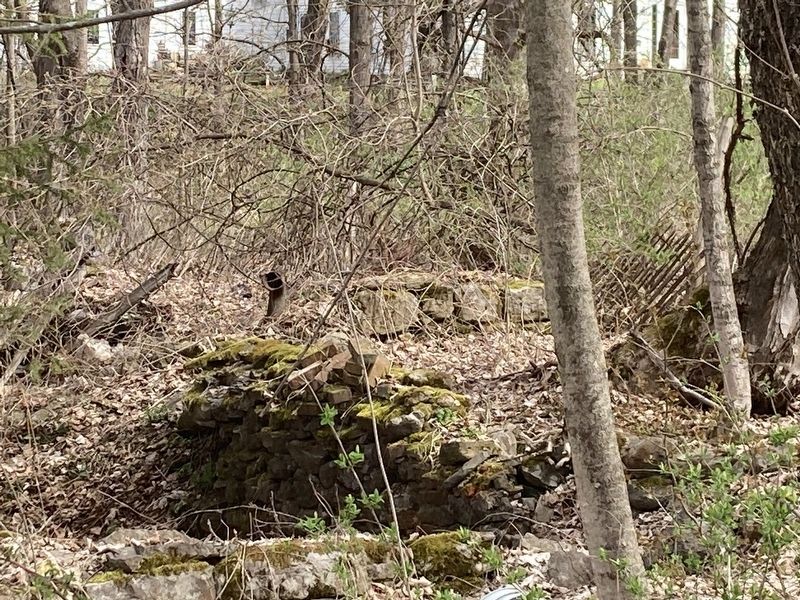
5. Ruins of the Birdhouse

Regionally, this marker is in Upstate New York, specifically in Central New York, and in the Syracuse Metropolitan Area. It is also in the American Northeast and in the Mid-Atlantic. Globally, it is in North America, the Western Hemisphere, the Western World, and the Anglosphere. Historically, it finds itself in what was once the Haudenosaunee (Iroquois) Confederacy, New Netherland, and one of the original Thirteen Colonies.
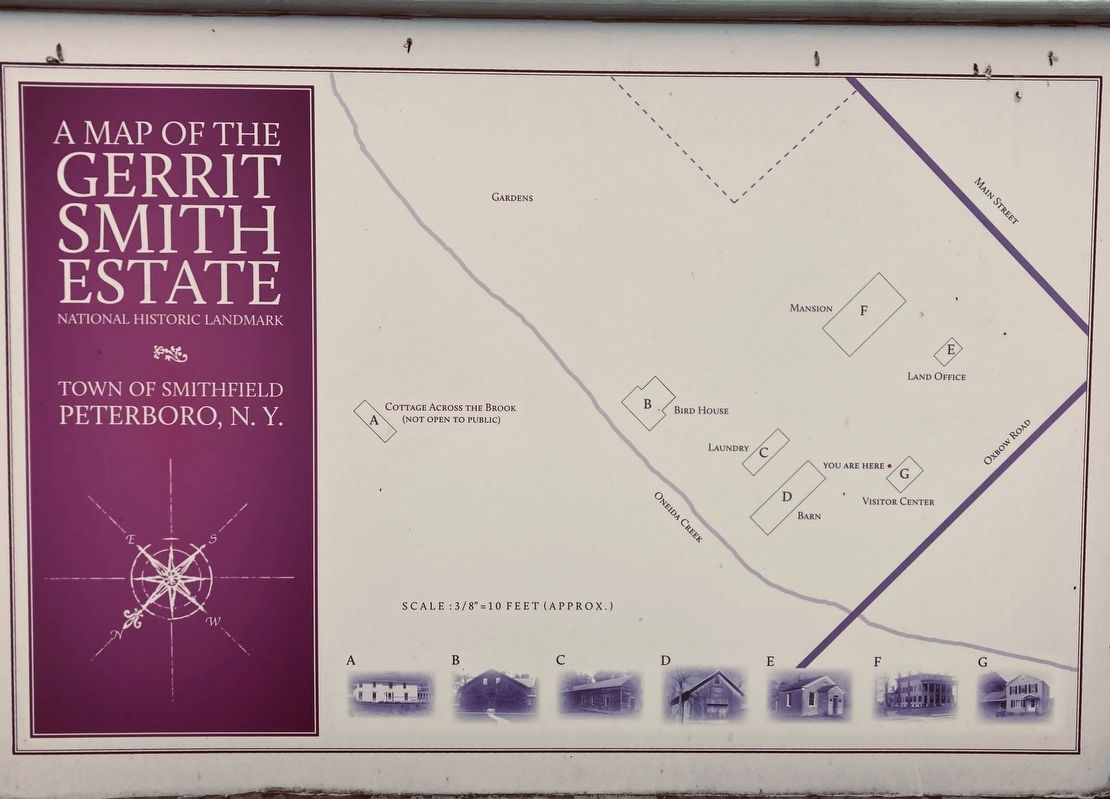
Other nearby markers. At least 8 other markers are within walking distance of this marker: Greene Smith (here, next to this marker); Purchased From Slavery (a few steps from this marker); African American Soldier of the Civil War Buried at Peterboro (a few steps from this marker); Heaven & Peterboro (a few steps from this marker); To Work In The Abolition Movement (a few steps from this marker); The Laundry (within shouting distance of this marker); The Barn (within shouting distance of this marker); Designations (within shouting distance of this marker). Touch for a list and map of all markers in Peterboro.
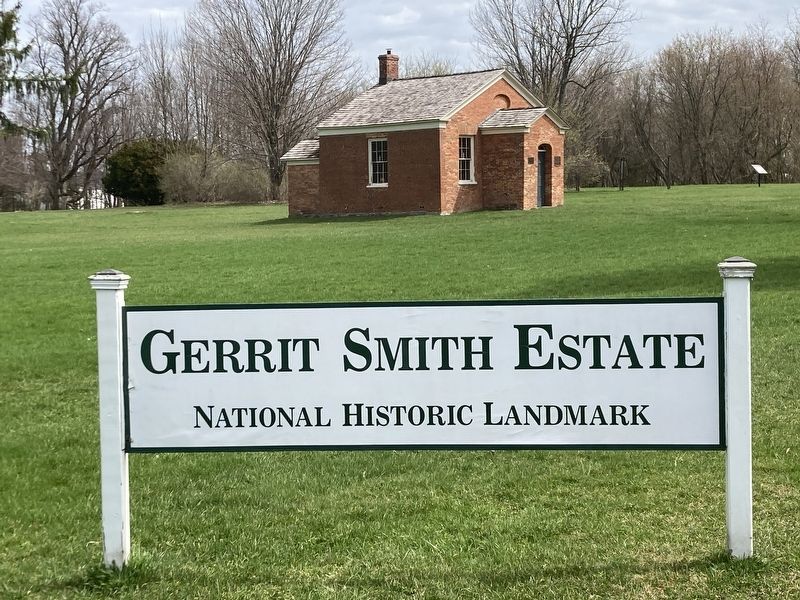
Additional keywords. The marker can be found on the Gerrit Smith Estate National Historic Landmark.
Credits. This page was last revised on April 15, 2025. It was originally submitted on April 12, 2025, by Susan A. Dalaba of Cortland, New York. This page has been viewed 153 times since then and 24 times this year. Photos: 1. submitted on April 12, 2025, by Susan A. Dalaba of Cortland, New York. 2, 3, 4, 5. submitted on April 13, 2025, by Susan A. Dalaba of Cortland, New York. • Andrew Ruppenstein was the editor who published this page.
