Apalachicola in Franklin County, Florida — The American South (South Atlantic)
Historic Gorrie Square
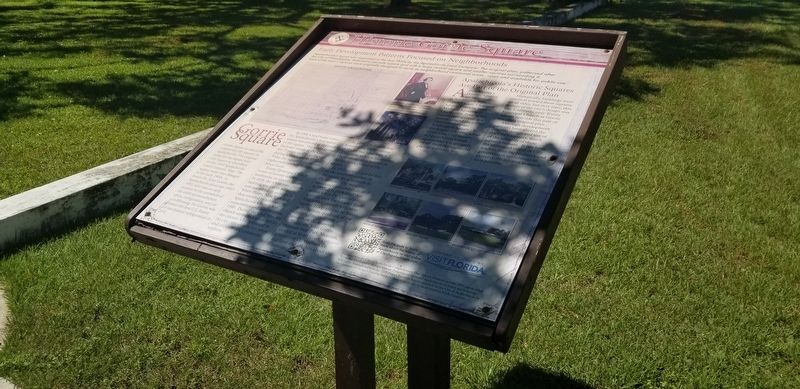
Photographed by Ian Lefkowitz, August 24, 2019
1. Historic Gorrie Square Marker
Apalachicola's layout was organized in the mid 1830s by the Apalachicola Land Company. The original plan, patterned after the City of Philadelphia, featured a one-mile square grid with a large central square and smaller squares surrounding it. Each of the town's squares were originally designed to serve as neighborhood communal areas - open and available for public use.
Apalachicola's Historic Squares Are Part of the Original Plan
Apalachicola's Historic squares are identified as Washington Square, Gorrie Square, Chapman Square, Franklin Square, Madison Square, and City Square. Four of the squares are arrayed in a square around the center. The central square - Washington Square - is the largest, covering a four block area. City Square is Apalachicola's sixth square, and it is uniquely set off from the organized plan of the other five.
Historically, buildings were oriented toward these squares on all sides, but over time, this feature of the city's design was lost. Currently, only Trinity Episcopal Church at Gorrie Square upholds this part of the city's original
this page online
Although development patterns have altered the original design and use of the City's squares, much of the integrity of these squares remain. It has been the expressed intent of City leaders, historic planners and preservation enthusiasts to preserve the squares as much as is possible.
Gorrie Square
Gorrie Square is one of the original six city squares in Apalachicola. The original name for the square was City Square as identified on the 1834 Apalachicola Land Company Map. The square name was changed in the early 1900s- to honor Dr. John Gorrie, the Apalachicola physician (1803-1855) who was an early pioneer in the invention of the artificial manufacture office, refrigeration, and air conditioning. Dr. Gorrie was granted the first U.S. Patent for mechanical refrigeration in 1851.
In 1906 a steel water tower for Apalachicola's first water system was erected at the center of the square. The tower served the water needs of the City for 79 years until it collapsed during a hurricane in 1985. Today the square features two eighteenth-century British Naval Guns.
Trinity Episcopal Church is one of several notable landmarks on Gorrie Square. In 1838, the white pine church building was cut to measure and assembled in sections in White Plains, New York and then traveled by schooner to Apalachicola where it was reassembled and completed in 1840. During the Civil War, the church served as a sanctuary to the citizens who remained in the city - the elderly, the wives and children of Confederate soldiers.
In 1899, Dr. Gorrie was honored for his invention of the ice machine with a monument to his achievement. The monument is located in the northern corner of the square.
In 1956 ground was broken on the southern corner of the square for a museum to Dr. Gorrie. The museum was completed and dedicated in 1957. It is presumed that is also when Dr. Gorrie's remains were transferred from Magnolia Cemetery to Gorrie Square. His grave can be found in the eastern quadrant of the square - directly across 6th Street from the museum.
Today, the John Gorrie Museum State Park Museum, located at 46 6th Street, contains a replica of Dr. Gorrie's ice machine and exhibits about the community.
Excerpted from the City of Apalachicola Comprehensive Plan Historic Element and the 1975 report titled "Economic Development through Historic Preservation" by noted Apalachicola architect and historian Willoughby Marshall and from the 2008 Project Riverway Report prepared for the City of Apalachicola by the University of Georgia's Fanning Institute. Appreciation also to local historian Mark Curenton.
Topics. This historical marker is listed in these topic lists: Architecture • Parks & Recreational Areas. A significant historical year for this entry is 1834.
Location. Marker has been reported missing. It was located near 29° 43.516′ N, 84° 59.13′ W. Marker was in Apalachicola, Florida, in Franklin County. It was on 6th Street. Touch for map. Marker was at or near this postal address: 79 6th St, Apalachicola FL 32320, United States of America. Touch for directions.

Regionally, this marker was on the Florida Panhandle. It was also in the American South, specifically in the Deep South, and on the Gulf Coast. Globally, it was in the North Atlantic Region, North America, a Gulf of Mexico state, the Western Hemisphere, the Western World, and the Anglosphere. Historically, it found itself in what was once New Spain, the territory of the Mississippian Culture, one of the Confederate States of America, and the Antebellum South.
Other nearby markers. At least 8 other markers are within walking distance of this location: Dr. John Gorrie (a few steps from this marker); Birthplace of Air Conditioning. (a few steps from this marker); Trinity Episcopal Church (within shouting distance of this marker); Methodist Episcopal Church South (about 500 feet away, measured in a direct line); The Dr. Alvan W. Chapman House (about 500 feet away); a different marker also named The Dr. Alvan W. Chapman House (about 500 feet away); Fort Coombs - Franklin Guards (about 500 feet away); Chestnut Street Cemetery of Early Apalachicola (about 700 feet away). Touch for a list and map of all markers in Apalachicola.
Credits. This page was last revised on April 27, 2025. It was originally submitted on April 13, 2025, by Ian Lefkowitz of New York, New York. This page has been viewed 155 times since then and 26 times this year. Photo 1. submitted on April 13, 2025, by Ian Lefkowitz of New York, New York. • Bernard Fisher was the editor who published this page.
