Apalachicola in Franklin County, Florida — The American South (South Atlantic)
Trinity Episcopal Church
Photographed by Tim Carr, July 28, 2008
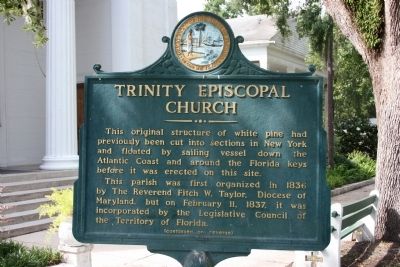
1. Trinity Episcopal Church Marker
This parish was first organized in 1836 by The Reverend Fitch W. Taylor, Diocese of Maryland, but on February 11, 1837, it was incorporated by the Legislative Council of the Territory of Florida.
(continued on reverse)
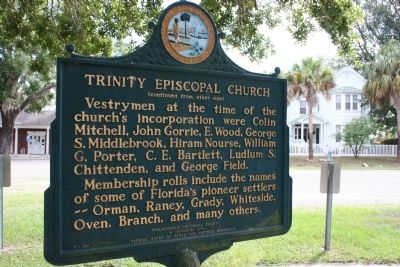
(continued from other side)
Vestrymen at the time of the church's incorporation were Colin Mitchell, John Gorrie, E. Wood, George S. Middlebrook, Hiram Nourse, William G. Porter, C.E. Bartlett, Ludlum S. Chittenden, and George Field.
Membership rolls include the names of some of Florida's pioneer settlers -- Orman, Raney, Grady, Whiteside, Oven, Branch, and many others.
Erected 1966 by Apalachicola Historical Society / Florida Board of Parks and Historic Memorials. (Marker Number F-134.)
Topics. This historical marker is listed in these topic lists: Agriculture • Religion & Religious Structures. A significant historical month for this entry is February 1840.
Location. 29° 43.536′ N, 84° 59.166′ W.
this page online

Regionally, this marker is on the Florida Panhandle. It is also in the American South, specifically in the Deep South, and on the Gulf Coast. Globally, it is in the North Atlantic Region, North America, a Gulf of Mexico state, the Western Hemisphere, the Western World, and the Anglosphere. Historically, it finds itself in what was once New Spain, the territory of the Mississippian Culture, one of the Confederate States of America, and the Antebellum South.
Other nearby markers. At least 8 other markers are within walking distance of this marker: Birthplace of Air Conditioning. (within shouting distance of this marker); The Dr. Alvan W. Chapman House (within shouting distance of this marker); Dr. John Gorrie (about 300 feet away, measured in a direct line); a different marker also named The Dr. Alvan W. Chapman House (about
Photographed by Tim Carr, July 28, 2008
2. Trinity Episcopal Church Marker Reverse
Another marker is no longer nearby. Historic Gorrie Square (was within shouting distance of this marker but has been confirmed missing).
Photographed by Tim Carr, July 28, 2008
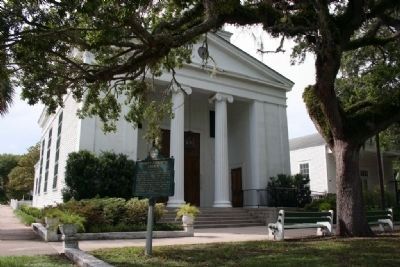
3. Trinity Episcopal Church Marker
Photographed by Tim Carr, July 28, 2008
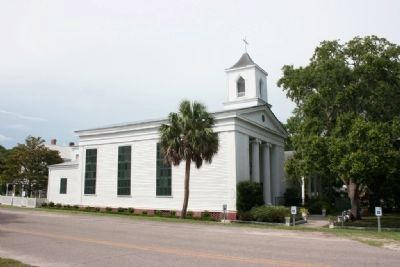
4. Trinity Episcopal Church
Credits. This page was last revised on November 10, 2019. It was originally submitted on January 31, 2010, by Timothy Carr of Birmingham, Alabama. This page has been viewed 1,132 times since then and 20 times this year. Photos: 1, 2, 3, 4. submitted on January 31, 2010, by Timothy Carr of Birmingham, Alabama. • Bill Pfingsten was the editor who published this page.
