Wilmington in New Hanover County, North Carolina — The American South (South Atlantic)
5-Inch 38 Caliber Twin Gun Mount
U.S.S. North Carolina

Photographed by Brandon D Cross
1. 5-Inch 38 Caliber Twin Gun Mount Marker
1. the gun house (top) with a crew of 13 men and where the actual firing took place
2. the upper handling room (one level below the gun house) with a crew of 15 men and where the ready service ammunition was stored.
3. the lower handling room (several decks below) with a crew of 9 men and where the projectiles and gun powder were stored.
The guns were normally aimed and fired by either the fire control director or the secondary battery plotting room. The fire control director was normally used for aircraft and ship targets. The plotting room was used for shore bombardments. Optical and/or radar equipment in the fire control directors tracked targets. The equipment constantly generated range and bearing information
this page online
If necessary, the guns could be placed in manual or local control. Manual control meant that the gun crew controlled the mount and were responsible for tracking the target and firing the gun. During the war, four mounts were connected to the Mark 51 directors to speed up the change of direction needed to combat the kamikazes.
Climb inside a 5-inch gun mount on the starboard side, 01 level
Crew Memories
On August 24, 1942, we had our first air attack. I was in Mount #3, Gun Captain on right gun. My crew was a shell man, powder man and hot case man all under the direction of the Mount Captain. The routine was a powder can was placed in the tray, then a shell and then rammed. The gun would fire and the hot case would be ejected and (sent out) the scuttle. I would drop the spade and the gun was ready to load and fire again. The powder came up through the deck with a primer protector on it. The powder man pulled the protector off then loaded. This time he didn't remove the protector and when rammed, the breech couldn't close. My job was to open the hatch, remove the powder can and get rid of it.
My hot case man had a tough job when the cases didn't go out. They would bounce and he would have to catch it and throw it out. Usually the first or second case would catch him under the nose and he would be a bloody mess.
— William Taylor, Boatswain's Mate 1/c
It got a little smoky in there. It was enough noise to almost obscure other outside noises. You had your two rammer motors, two hoist motors, trainer and pointer motors going.
— Paul Wieser, Boatswain's Mate 1/c
We would work for hours on the coordination of the directors and fire control with the computers. One of the most difficult problems to solve was that of what we called dead time. That is the time between when the projectile is taken out of the fuse pot and put into the gun and fired. That depended upon the ability of the loading crew and on the elevation of the guns. If you varied it by two seconds that would allow a difference of two seconds of motion of your target. —Commander John Kirkpatrick, Air Defense Officer

Photographed by Brandon D Cross
2. 5-Inch 38 Caliber Twin Gun Mount Marker
weight of projectile: 54 pounds • weight of powder charge: 15 pounds + 13 pounds brass casing • effective range: 37,000 feet (antiaircraft) and 8-10 miles (surface target) • rate of fire (each barrel): 15-22 rounds per minute 13 men
Erected by Friends of the Battleship North Carolina.
Topics. This memorial is listed in these topic lists: War, World II • Waterways & Vessels.
Location. 34° 14.182′ N, 77° 57.246′ W. Memorial is in Wilmington, North Carolina, in New Hanover County. It can be reached from 1 Battleship Road NE 0.2 miles south of U.S.S. North Carolina Road, on the left when traveling north. Touch for map. Memorial is at or near this postal address: 1 Battleship Road NE, Wilmington NC 28401, United States of America. Touch for directions.

Regionally, this memorial is in the Coastal Plain and on the Cape Fear Coast. It is also in the American South, specifically in the Upper South, in the Tidewater, and on the Eastern Seaboard. Globally, it is in the North Atlantic Region, North America, the Western Hemisphere, the Western World, and the Anglosphere.

Public Domain
3. 5-Inch 38 Caliber Twin Gun Mount
Other nearby markers. At least 8 other markers are within walking distance of this marker: 40MM Anti-Aircraft Guns (a few steps from this marker); Boats on the Move: Large Boat Cranes (a few steps from this marker); 26-foot Motor Whaleboat, Mark II (a few steps from this marker); U.S.S. North Carolina Battleship Memorial (a few steps from this marker); Admiral’s Cabin (a few steps from this marker); In the Beginning: 15 Boats (a few steps from this marker); Magnetic Compass (within shouting distance of this marker); Sky II (within shouting distance of this marker). Touch for a list and map of all markers in Wilmington.
Also see . . .
1. The 5 Inch / 38 Caliber Twin Mark 38 Gun Mount. Tin Can Sailors website entry (Submitted on April 14, 2025, by Brandon D Cross of Flagler Beach, Florida.)
2. Armaments and Innovations - The Ubiquitous 5-inch/38. Naval History Magazine website entry (Submitted on April 14, 2025, by Brandon D Cross of Flagler Beach, Florida.)
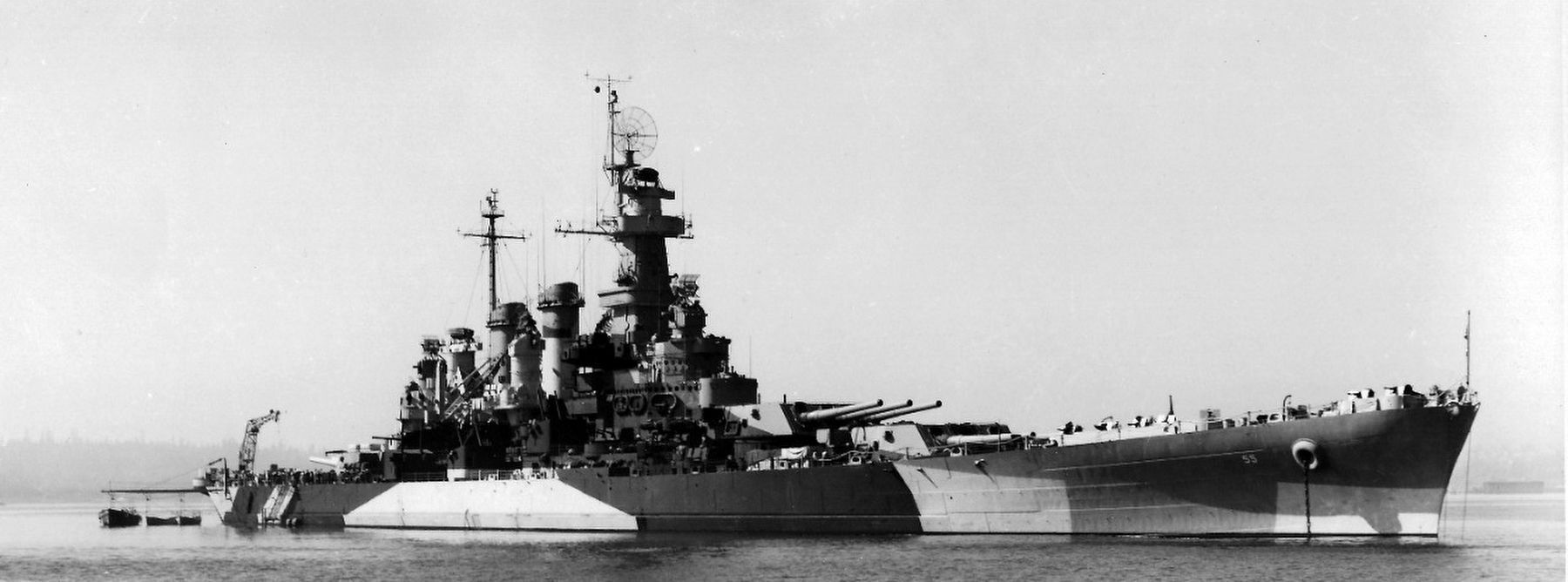
via Naval History and Heritage Command, 1944
4. USS North Carolina (BB-55), 1941-1961
Naval History and Heritage Command website entry
Click for more information.
Click for more information.
Credits. This page was last revised on August 9, 2025. It was originally submitted on April 14, 2025, by Brandon D Cross of Flagler Beach, Florida. This page has been viewed 320 times since then and 109 times this year. Photos: 1, 2, 3. submitted on April 14, 2025, by Brandon D Cross of Flagler Beach, Florida. 4. submitted on June 27, 2025, by Larry Gertner of New York, New York. • Andrew Ruppenstein was the editor who published this page.
