Near Helen in Benton County, Washington — The American West (Northwest)
B Reactor
1944-1968
| — | The World's First Full Scale Nuclear Reactor | — |

Photographed by Loren Skaggs
1. B Reactor 1944-1968 Marker
2008
National Park Service
United States
Department of the Interior
Mechanical Engineering Landmark
Hanford B Reactor
Construction Begun: June 1943
Reactor Loaded: September 1944
This nuclear reactor was the first to demonstrate the practicality of producing large quantities of plutonium and was a major milestone in the United States Atomic Entergy Program.
Constructed by: E.I. du Pont de Nemours Co.
Designed by: Enrico Fermi, John A. Wheeler, Eugene Wigner and staff
by the American Nuclear Society
Civil Engineering Landmark
Hanford B Reactor, Manhattan Project
World's first full scale nuclear reactor
Designated 1994
Erected 1992 by American Nuclear Society.
Topics. This historical marker is listed in these topic lists: Industry & Commerce • Landmarks
this page online
Location. 46° 37.833′ N, 119° 38.849′ W. Marker is near Helen, Washington, in Benton County. It can be reached from State Highway 24 south of State Highway 243, on the right when traveling north. This marker is in a restricted area, and access is only available via a public tour, which is free to the public and may be booked online. Touch for map. Marker is in this post office area: Sunnyside WA 98944, United States of America. Touch for directions.

Regionally, this marker is in the Columbia Basin and in Yakima Valley. It is also in the American Mountain West and in the Lewis & Clark Corridor. Globally, it is in North America, on the Pacific Rim, in the Western Hemisphere, in the Western World, and in the Anglosphere.
More about this marker. Marker is located at the entrance to the reactor building.
Regarding B Reactor. From the Department of Energy website about this location:
The B Reactor National Historic Landmark at the Hanford Site in Washington state was the world’s first full-scale plutonium production reactor.

Photographed by Loren Skaggs, June 15, 2024
2. Hanford B Reactor
The reactor was designed and built by the DuPont company based on experimental designs tested by Dr. Enrico Fermi at the University of Chicago and tests from the X-10 Graphite Reactor at Oak Ridge, TN. B Reactor was graphite moderated and water cooled. It consisted of a 28 by 36-foot, 1,200-ton graphite pile, penetrated through its entire length horizontally by 2,004 aluminum process tubes containing uranium fuel slugs. Cooling water from the nearby Columbia River was pumped through the aluminum tubes around the uranium slugs. This design allowed the reactor to produce plutonium-239 by irradiating naturally occurring uranium with neutrons.
Construction of B Reactor began in October 1943, and fuel was loaded into B Reactor on Sept. 13, 1944—just 11 months later. B Reactor went “critical” (started up) at 10:48 p.m. on Sept. 26, 1944 and reached full power in February 1945.
Its mission thought complete after the end of World War
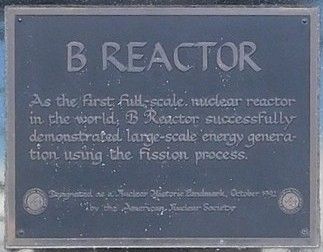
Photographed by Loren Skaggs, June 15, 2024
3. B Reactor Marker
Additional keywords. nuclear, atomic, reactor

Photographed by Loren Skaggs, June 15, 2024
4. Hanford B Reactor Mechanical Engineering Landmark marker

Photographed by Loren Skaggs, June 15, 2024
5. National Historic Civil Engineering Landmard marker

Photographed by Loren Skaggs, June 15, 2024
6. Hanford B Reactor interior (facing the reactor itself)
Credits. This page was last revised on May 11, 2025. It was originally submitted on April 14, 2025, by Loren Skaggs of Tacoma, Washington. This page has been viewed 196 times since then and 64 times this year. Photos: 1, 2, 3, 4, 5, 6. submitted on April 14, 2025, by Loren Skaggs of Tacoma, Washington. • Devry Becker Jones was the editor who published this page.
