
Montmartre in Paris in Département de Paris, Île-de-France, France — Western Europe
Louise Michel
| — | Histoire de Paris | — |
Photographed by Andrew Ruppenstein, April 11, 2025
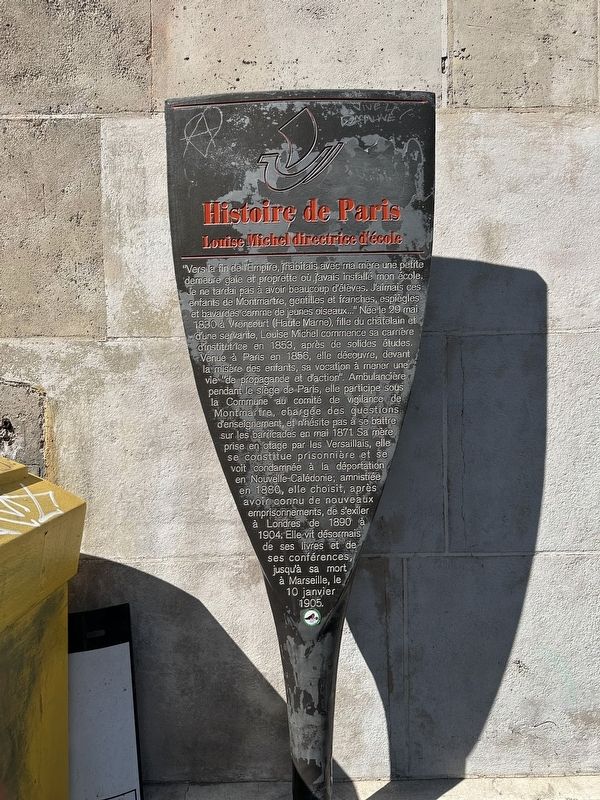
1. Louise Michel Marker

"Vers la fin de l'Empire, j’habitais avec ma mère une petite demeure gale et proprette où j’avais installé mon école. Je ne tardai pas à avoir beaucoup d'élèves. J'aimais cest enfants de Montmartre, gentilles et franches, espiègles et bavardes comme de jeunes oiseaux..." Née le 29 mai 1830 Vencourt (Haute Marne), fille du chatelain et d’une servante, Louise Michel commence sa carrière d’institutice en 1853, après de solides études. Venue à Paris en 1856, elle découvre, devant la misère des enfants, sa vocation à mener une vie “de propagande et d'action”. Ambulancière pendant le siège de Paris, elle participe sous la Commune au comité de vigilance del Montmartre, chargée des questions d'enseignement, of n'hésite pas à se battre sur les barricades en mai 1871. Sa mère, prise en otage par les Versaillais, elle se constitue prisonnière et se voit condamnée à la déportation en Nouvelle-Calédonie; amnistiée en 1880, elle choisit, après avoir connu de nouveaux emprisonnements, de s'exiler à Londres de 1890 a 1904. Elle vit désormais de ses livres et de ses conférences, jusqu'à
this page online
Louise Michel, School Principal
"Towards the end of the Empire, I lived with my mother in a small, shabby, and clean house where I had set up my school. I soon had many students. I loved these children from Montmartre, kind and frank, mischievous and talkative like young birds..." Born on May 29, 1830, in Vencourt (Haute Marne), the daughter of a lord of the manor and a servant, Louise Michel began her career as a teacher in 1853, after a solid education. Coming to Paris in 1856, she discovered, faced with the children's poverty, her vocation to lead a life of "propaganda and action." An ambulance driver during the siege of Paris, she participated under the Commune in the Montmartre vigilance committee, responsible for educational issues, and did not hesitate to fight on the barricades in May 1871. Her mother, taken hostage by the Versailles troops, she surrendered and was sentenced to deportation to New Caledonia; amnestied in 1880, she chose, after experiencing further imprisonment, to go into exile in London from 1890 to 1904. She lived from her books and lectures
Photographed by Andrew Ruppenstein, April 11, 2025
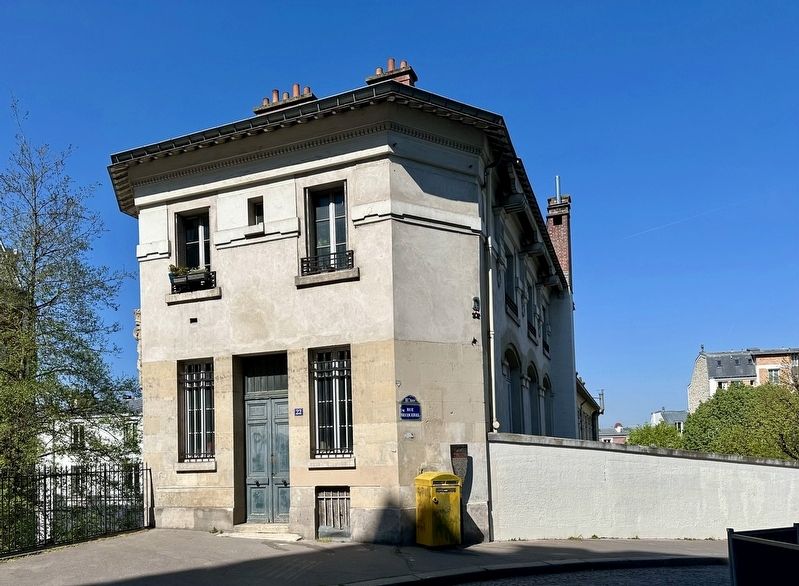
2. Louise Michel Marker - wide view
Topics and series. This historical marker is listed in these topic lists: Charity & Public Work • Education • Women. In addition, it is included in the Histoire de Paris series list. A significant historical date for this entry is May 29, 1830.
Location. 48° 53.308′ N, 2° 20.532′ E. Marker is in Paris, Île-de-France, in Département de Paris. It is in Montmartre. It is at the intersection of Rue Becquerel and Rue Saint- Vincent, on the right when traveling west on Rue Becquerel. Touch for map. Marker is at or near this postal address: 22 Rue Becquerel, Paris, Île-de-France 75018, France. Touch for directions.

Regionally, it is in the North Atlantic Region, Europe, the European Union, Atlantic Europe, the Schengen Area, Western Europe, a coastal Mediterranean country, and the Western World. Historically, it finds itself in what was once a French colony and also the Roman Empire.
Other nearby markers. At least 8 other markers are within walking distance of this marker: École Élémentaire Publique Mont-Cenis Deported Jewish Students Memorial (a few steps from this marker in Ile-de-France);
Photographed by J.M. Lopez (via Wikimedia Commons), circa 1880s
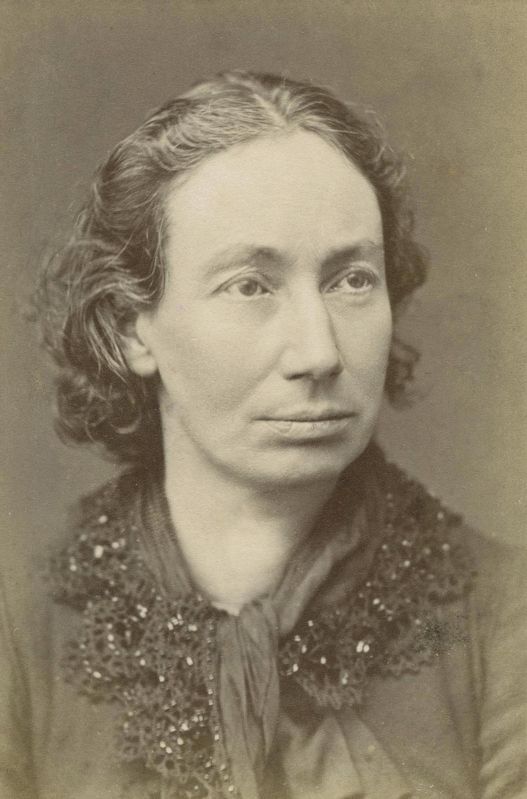
3. Louise Michel
Another marker is no longer nearby. La maison de Rose de Rosimond (was about 150 meters away but has been confirmed missing).
Also see . . . Louise Michel (Wikipedia). Overview:
Louise Michel (29 May 1830 – 9 January 1905) was a teacher and prominent figure during the Paris Commune. Following her penal transportation to New Caledonia she began to embrace anarchism, and upon her return to France she emerged as an important French anarchist, and went on speaking tours across Europe. The journalist Brian Doherty has called her the "French grande dame of anarchy." Her use of a black flag at a demonstration in Paris in March 1883 was the earliest known instance of what would become known as the anarchy black flag.(Submitted on April 15, 2025.)
Additional keywords. panneau, anarchist
Credits. This page was last revised on April 15, 2025. It was originally submitted on April 15, 2025, by Andrew Ruppenstein of Lamorinda, California. This page has been viewed 159 times since then and 32 times this year. Photos: 1, 2, 3. submitted on April 15, 2025, by Andrew Ruppenstein of Lamorinda, California.
