Wilmington in New Hanover County, North Carolina — The American South (South Atlantic)
Admiral’s Cabin
U.S.S. North Carolina
Photographed by Brandon D Cross
1. Admiral’s Cabin Marker
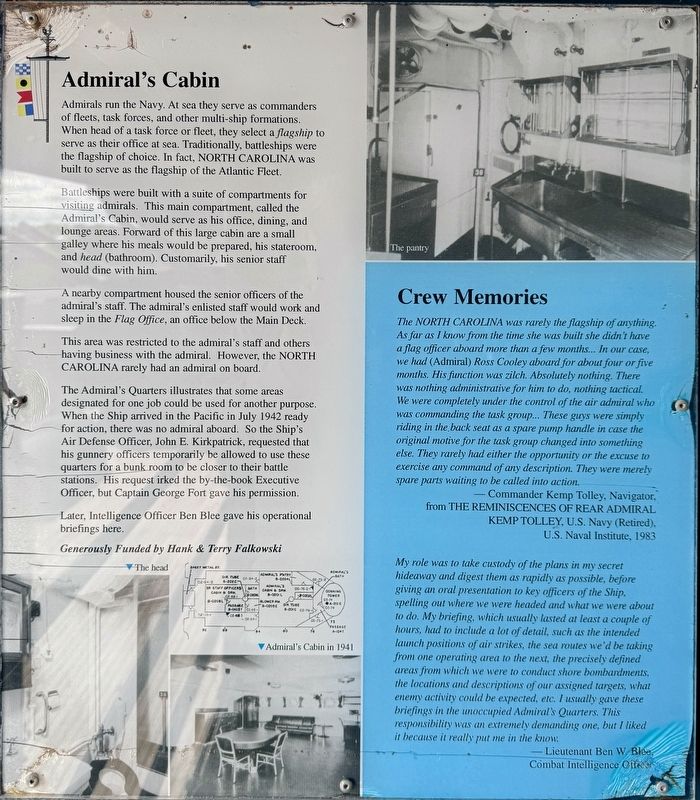
Battleships were built with a suite of compartments for visiting admirals. This main compartment, called the Admiral's Cabin, would serve as his office, dining, and lounge areas. Forward of this large cabin are a small galley where his meals would be prepared, his stateroom, and head (bathroom). Customarily, his senior staff would dine with him.
A nearby compartment housed the senior officers of the admiral's staff. The admiral's enlisted staff would work and sleep in the Flag Office, an office below the Main Deck.
This area was restricted to the admiral's staff and others having business with the admiral. However, the North Carolina rarely had an admiral on board.
The Admiral's Quarters illustrates that some areas designated for one job could be used for another
this page online
Later, Intelligence Officer Ben Blee gave his operational briefings here.
Generously donated by Hank & Terry Falkowski
Crew Memories
The North Carolina was rarely the flagship of anything. As far as I know from the time she was built she didn't have a flag officer aboard more than a few months... In our case, we had (Admiral) Ross Cooley aboard for about four or five months. His function was zilch. Absolutely nothing. There was nothing administrative for him to do, nothing tactical. We were completely under the control of the air admiral who was commanding the task group... These guys were simply riding in the back seat as a spare pump handle in case the original motive for the task group changed into something else. They rarely

Photographed by Brandon D Cross
2. Admiral’s Cabin Marker
— Commander Kemp Tolley, Navigator, from “The Reminances of Rear Admiral Kemp Tilley, U.S. Navy (Retired) “ U.S. Naval Institute, 1983
My role was to take custody of the plans in my secret hideaway and digest them as rapidly as possible, before giving an oral presentation to key officers of the Ship, spelling out where we were headed and what we were about to do. My briefing, which usually lasted at least a couple of hours, had to include a lot of detail, such as the intended launch positions of air strikes, the sea routes we'd be taking from one operating area to the next, the precisely defined areas from which we were to conduct shore bombardments, the locations and descriptions of our assigned targets, what enemy activity could be expected, etc. I usually gave these briefings in the unoccupied Admiral's Quarters. This responsibility was an extremely demanding one, but I liked it because it really put me in the know.
— Lieutenant Ben W. Blee, Combat Intelligence Officer.
(captions)
The Head
Admiral’s Cabin in 1941
The pantry
Erected by Friends
via Naval History and Heritage Command, 1944
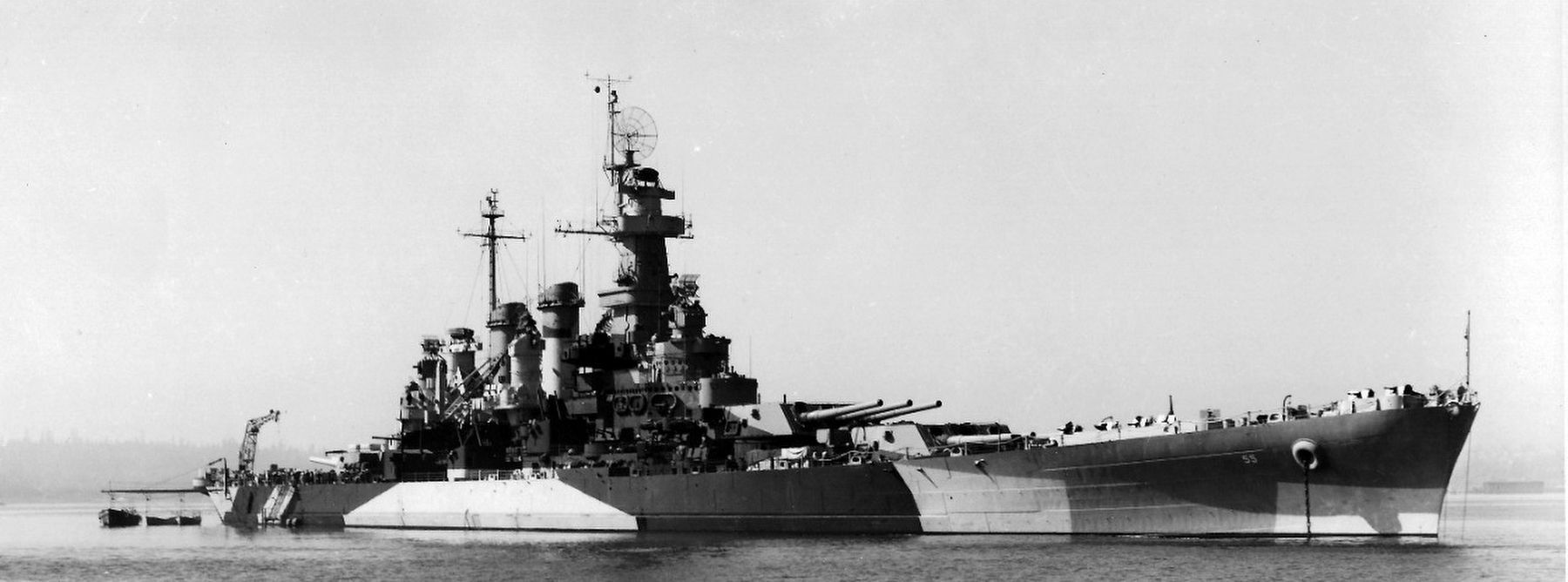
3. USS North Carolina (BB-55), 1941-1961
Naval History and Heritage Command website entry
Click for more information.
Click for more information.
Topics. This memorial is listed in these topic lists: War, World II • Waterways & Vessels.
Location. 34° 14.178′ N, 77° 57.257′ W. Memorial is in Wilmington, North Carolina, in New Hanover County. It can be reached from Battleship Road NE 0.2 miles south of U.S.S. North Carolina Road, on the left when traveling north. Touch for map. Memorial is at or near this postal address: 1 Battleship Road NE, Wilmington NC 28401, United States of America. Touch for directions.

Regionally, this memorial is in North Carolina’s Coastal Plain and on the Cape Fear Coast. It is also in the American South, specifically in the Upper South, in the Tidewater, and on the Eastern Seaboard. Globally, it is in the North Atlantic Region, North America, the Western Hemisphere, the Western World, and the Anglosphere. Historically, it finds itself in what was once the territory of the Mississippian Culture, one of the original Thirteen Colonies, one of the Confederate States of America, and the Antebellum South.
Other nearby markers. At least 8 other markers are within walking distance of this marker: Friendly Fire (a few steps from this marker); Flag Plot (a few steps from this marker); U.S.S. North Carolina Battleship Memorial (a few steps from this marker); 5-Inch 38 Caliber Twin Gun Mount (a few steps from this marker); Sky II (a few steps from this marker); Magnetic Compass (a few steps from this marker); In the Beginning: 15 Boats (a few steps from this marker); Boats on the Move: Large Boat Cranes (a few steps from this marker). Touch for a list and map of all markers in Wilmington.
Credits. This page was last revised on April 29, 2025. It was originally submitted on April 15, 2025, by Brandon D Cross of Flagler Beach, Florida. This page has been viewed 289 times since then and 96 times this year. Photos: 1, 2. submitted on April 15, 2025, by Brandon D Cross of Flagler Beach, Florida. 3. submitted on April 29, 2025, by Larry Gertner of New York, New York. • Andrew Ruppenstein was the editor who published this page.
