Old Town in Toronto, Ontario — Central Canada (North America)
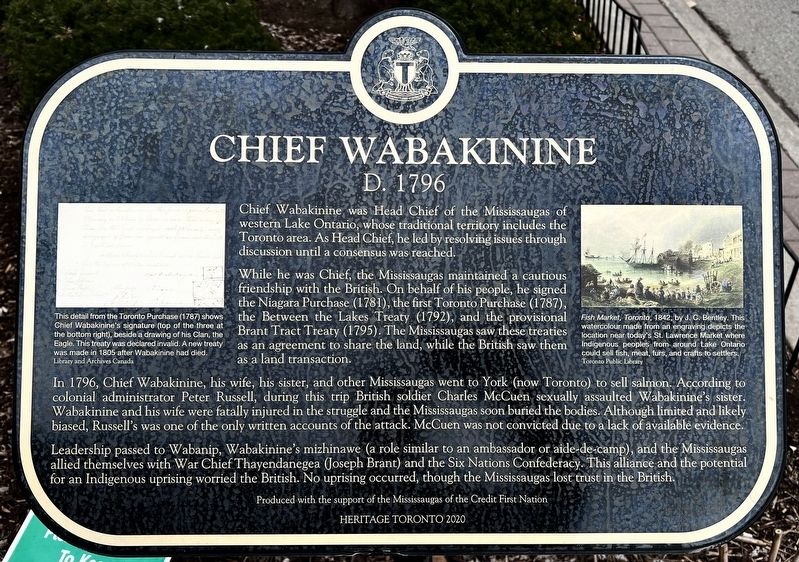
Chief Wabakinine
D. 1796
Photographed by Tim Boyd, April 12, 2025
1. Chief Wabakinine Marker
While he was Chief, the Mississaugas maintained a cautious friendship with the British. On behalf of his people, he signed the Niagara Purchase (1781), the first Toronto Purchase (1787), the Between the Lakes Treaty (1792), and the provisional Brant Tract Treaty (1795). The Mississaugas saw these treaties as an agreement to share the land, while the British saw them as a land transaction.
In 1796, Chief Wabakinine, his wife, his sister, and other Mississaugas went to York (now Toronto) to sell salmon. According to colonial administrator Peter Russell, during this trip British soldier Charles McCuen sexually assaulted Wabakinine's sister.
Wabakinine and his wife were fatally injured in the struggle and the Mississaugas soon buried the bodies. Although limited and likely biased, Russell's was one of the only written accounts of the attack. McCuen was not convicted due to a lack of available evidence.
Leadership
this page online
Erected 2020 by Heritage Toronto.
Topics and series. This historical marker is listed in these topic lists: Indigenous Peoples and Communities • Settlements & Settlers. In addition, it is included in the Canada, Toronto Heritage series list. A significant historical year for this entry is 1796.
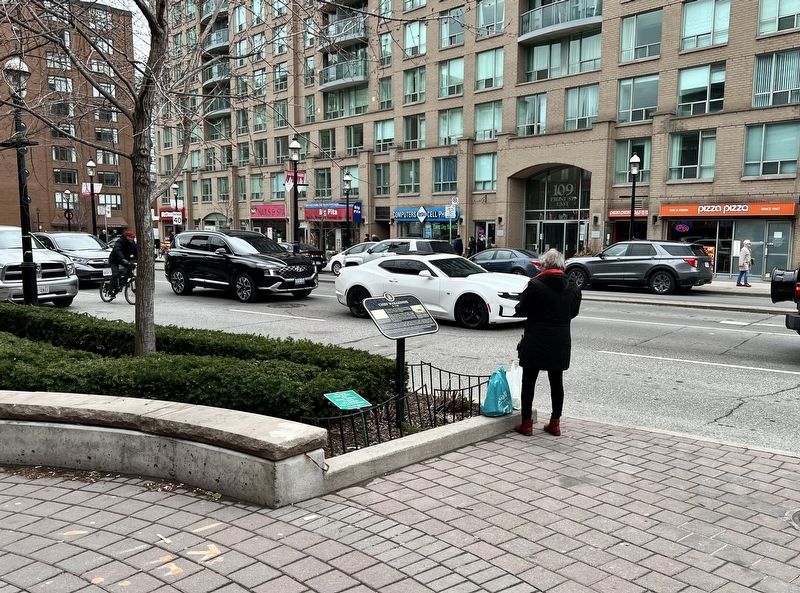
Location. 43° 38.975′ N, 79° 22.279′ W. Marker is in Toronto, Ontario. It is in Old Town. It is at the intersection of Jarvis Street and Front Street East, on the right when traveling south on Jarvis Street. Touch for map. Marker is at or near this postal address: 85 Jarvis Street, Toronto ON M5E 1N3, Canada. Touch for directions.

Regionally, this marker is in Greater Toronto and on the Golden Horseshoe. It is also in Central Canada. Globally, it is in North America,
Photographed by Tim Boyd, April 12, 2025
2. Chief Wabakinine Marker
Other nearby markers. At least 8 other markers are within walking distance of this marker: Canada’s First Electric Telegraph / Premier Télégraphe Électrique Canadien (within shouting distance of this marker); The First Ten Blocks of York (about 90 meters away, measured in a direct line); St. Lawrence Hall (about 90 meters away); The Great Fire of 1849 (about 120 meters away); York Council Chambers (about 120 meters away); The Daniel Brooke Building (about 120 meters away); Cholera Epidemics of 1832 & 1834 (about 120 meters away); Little York Hotel (about 120 meters away). Touch for a list and map of all markers in Toronto.
Also see . . .
1. Chief Wabakinine (Heritage Toronto).
The life and death of Chief Wabakinine exposes the violence and injustice inherent in the British colonial system with respect to Indigenous communities. It also offers an example as to how colonial(Submitted on April 16, 2025, by Tim Boyd of Hamilton, Ontario.)institutions did not value Indigenous voices, land rights, or methods of record keeping (such as through oral histories). Although the Mississaugas did not pursue revenge against the colonial government for the death of Chief Wabakinine, the injustice behind the treaty system led the Mississaugas to initiate a claim against the Government of Canada in 1986, which resulted in a cash payment of $145 million to the Mississaugas of the Credit First Nation in 2010.courtesy Library and Archives Canada3. Chief Wabakinine marker photo detail and caption (left)
2. The Toronto Purchase of 1787 (Talking Treaties).
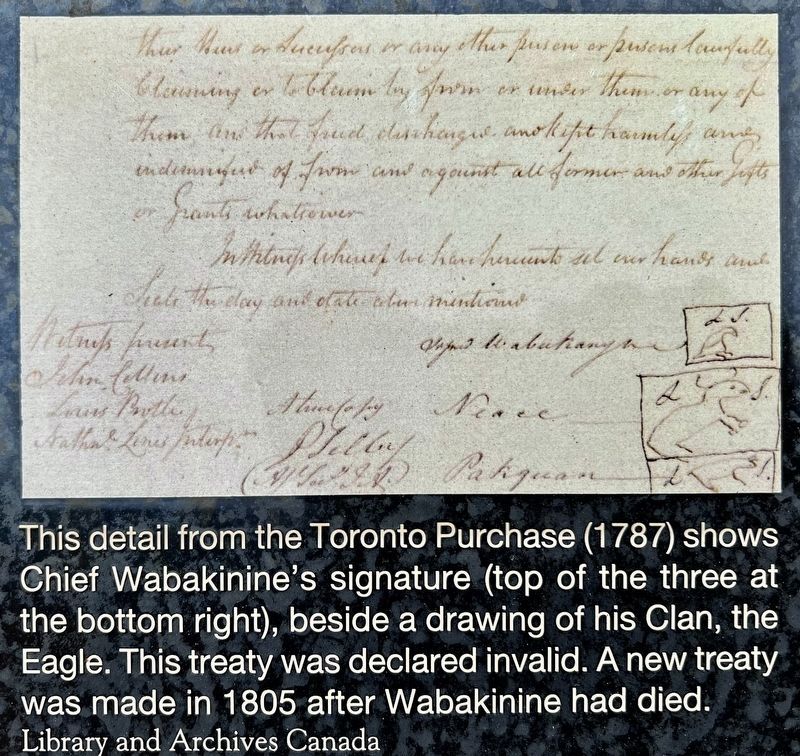
Only one text of the 1787 agreement has ever been found, but it is a blank deed that includes Doodem marks of three Mississauga Chiefs from the Toronto area on separate pieces of paper. The papers were presumably affixed to the deed drawn up after the in-person meeting. One of the Toronto-area Chiefs present at the Council at the Bay of Quinte is Wabakinine, who signs with the image of his Eagle Doodem. The boundaries of the ceded land are not recorded in the document. There is also no record of Wampum being exchanged or other treaty-making Protocol.
J.C. Bentley, courtesy Toronto Library, circa 1842
4. Chief Wabakinine marker photo and caption detail (right)
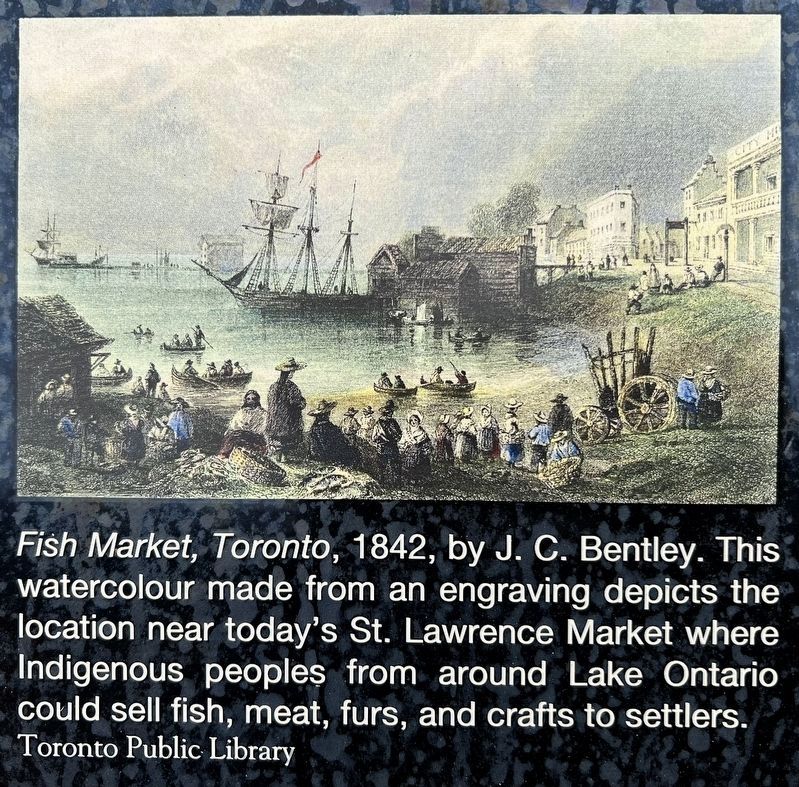
Toronto Fish Market, c.1842
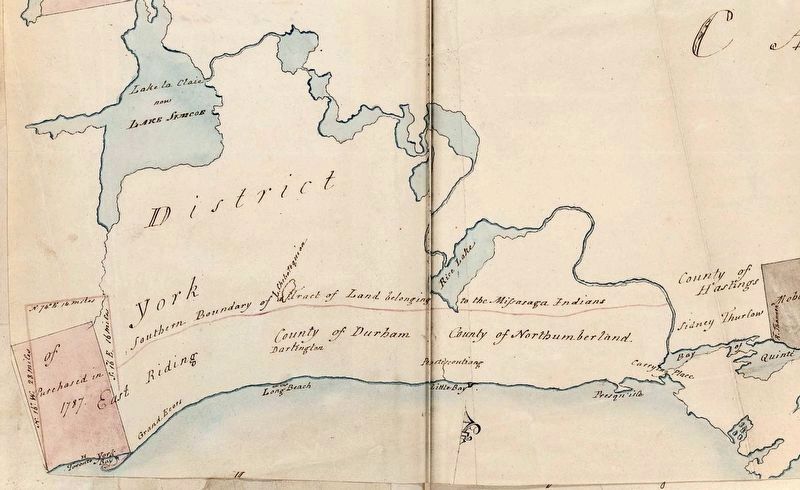
5. Lands purchased from the Missisauga’s in 1787, the Toronto Purchase is on the far left
Toronto Public Library (public domain)
Credits. This page was last revised on April 18, 2025. It was originally submitted on April 16, 2025, by Tim Boyd of Hamilton, Ontario. This page has been viewed 491 times since then and 82 times this year. Photos: 1, 2, 3, 4, 5. submitted on April 16, 2025, by Tim Boyd of Hamilton, Ontario. • Andrew Ruppenstein was the editor who published this page.
