Blanding in San Juan County, Utah — The American Mountains (Southwest)
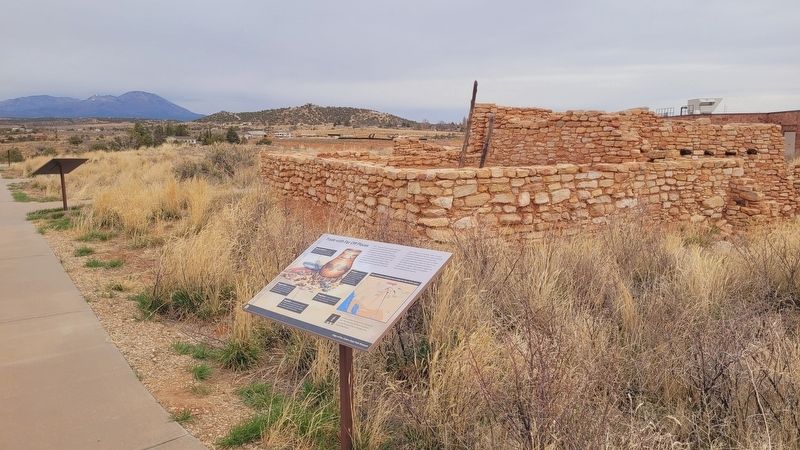
Trade with Far Off Places

Photographed by James Hulse, March 28, 2025
1. Trade with Far Off Places Marker
Macaw feathers were traded into this area from present-day Mexico, indicating a far-reaching exchange network.
Copper bells from present-day northwestern Mexico likely adorned dancers. These bells are almost always associated with the locations of great houses and great kivas.
Seashells from the Pacific Coast and Gulf of California arrived in the Four Corners region over 2,000
this page online
Pottery was produced and traded by local and distant Pueblo communities. Prior to 1100 CE, red ware pottery was made in southeastern Utah and exported to other regions.
Turquoise and other locally sourced stones, like obsidian and jet, were traded among Pueblo communities.
Map of movement of goods from outside the Mesa Verde region. A macaw feather was found in an alcove site just a few miles south of here. The site was in use at the same time as the Edge of the Cedars great house.
Erected by Edge of the Cedars State Park Museum.
Topics. This historical marker is listed in these topic lists: Indigenous Peoples and Communities • Industry & Commerce.
Location. 37° 37.866′ N, 109° 29.447′ W. Marker is in Blanding, Utah, in San Juan County. It is at the intersection of West 400 North and 600 W on West 400 North. The marker is located on the grounds of the Edge of the Cedars State Park Museum. Touch for map. Marker is at or near this postal address: 660 W 400 N, Blanding UT 84511, United
Photographed by James Hulse, March 28, 2025
2. Trade with Far Off Places Marker

Regionally, this marker is in Canyon Country. It is also in the American Mountain West, on the Colorado Plateau, and at the Four Corners. Globally, it is in North America, the Western Hemisphere, the Western World, and the Anglosphere. Historically, it finds itself in what was once New Spain, the territory of the Ancestral Puebloans, and Mexico’s Alta California.

Other nearby markers. At least 8 other markers are within walking distance of this marker: Living in the Earth: A Look Inside a Kiva (a few steps from this marker); Drought, Frost, and Migration in the 1200s (within shouting distance of this marker); A Great House and a Great Kiva (within shouting distance of this marker); Exposure and Safe Keeping (within shouting distance of this marker); Leaving the Pieces In Place (within shouting distance of this marker); Explore the Edge Of the Cedars Chacoan Great House Site (within shouting distance of this marker); Can a Sliver of Light Have Meaning? (within shouting distance of this marker); C.C.C. (approx. 0.3 miles away). Touch for a list and map of all markers in Blanding.
Credits. This page was last revised on April 18, 2025. It was originally submitted on April 17, 2025, by James Hulse of Medina, Texas. This page has been viewed 109 times since then and 18 times this year. Photos: 1, 2. submitted on April 18, 2025, by James Hulse of Medina, Texas.
