Geneva in Ashtabula County, Ohio — The American Midwest (Great Lakes)
Spencerian Monument for American Handwrighting

Photographed by Craig Doda, April 12, 2025
1. Spencerian Monument for American Handwrighting Marker
Origin of Spencerian Penmanship
Evolved 'mid nature's unpruned scenes, On Erie's wild and woody shore, The rolling wave, the dancing stream, The wild-rose haunts in days of yore.
The opal, quartz and ammonite, Gleaming beneath the wavelet's flow, Each gave its lesson - how to write - In the loved years of long ago.
I seized the forms I loved so well- Compounded them as meaning signs, And to the music of the swell Blent them with undulating vines.
Thanks, Nature, for the impress pure, Those tracings in the sand are gone; But while love shall for thee endure, Their grace and ease will still live on.
- Platt Rogers Spencer
Spencerian Monument for American Handwrighting
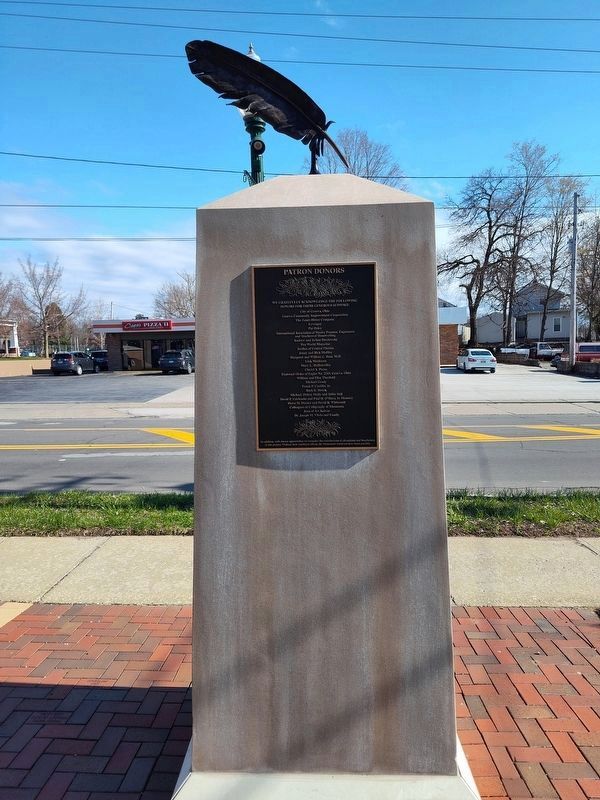
This monument is gratefully donated to the citizens of Geneva and Geneva Township, Ohio, by all participants and friends of the Spencerian Saga, in recognition of a quarter-century of learning, sharing, and celebrating our rich heritage of Platt Rogers Spencer's handwriting legacy.
And thus it is for us who write as in the days of old, We pause to hear our Teacher speak, as he himself was told: "Someday we will see ourselves within the art
this page online
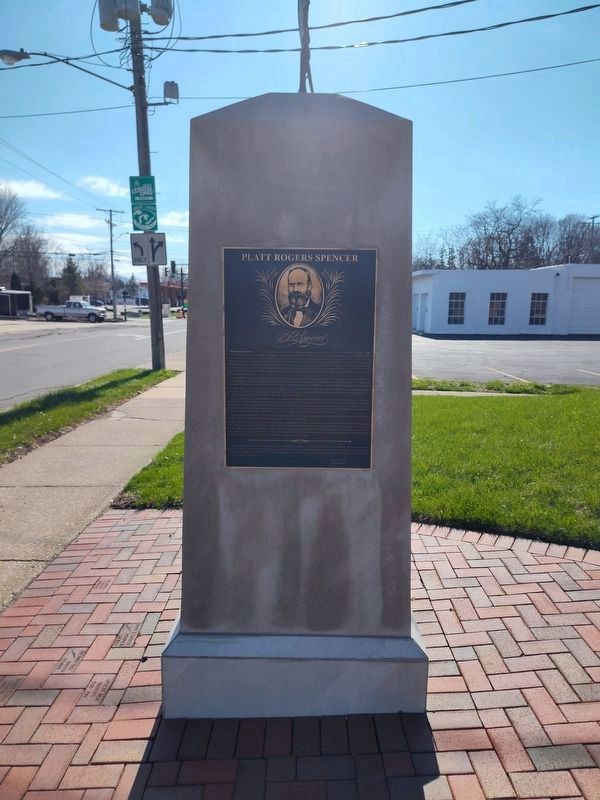
Platt Rogers Spencer
Platt Rogers Spencer, (1800 - 1864), known as the Father of American Handwriting, was born in East Fishkill New York on November 7. 1800. Several years after the death of his father. Revolutionary War veteran Caleb Spencer. in 1806, his mother, Jerusha Covell Spencer, moved the family west to the new state of Ohio. The journey lasted 51 days by wagon until they reached the town of Jefferson in Ashtabula County on December 5. 1810. Soon the family dispersed. settling in the towns of Conneaut, Kingsville. Ashtabula and Geneva. The youngest of 11 children. Platt became fascinated with the art of handwriting at an early age, and as a boy. practiced making letters using a stick in the beach sand on Lake Erie. He began teaching penmanship to his classmates at age 12. and continued to develop his ideas of an improved handwriting method as he grew to manhood. In the early 1830's he perfected a writing style based on principles found in

Photographed by Craig Doda, April 12, 2025
2. Spencerian Monument for American Handwrighting Marker
A gifted educator, he published his first books on Spencerian writing in the 1840's. He traveled extensively in Pennsylvania. New York and Ohio as an itinerant penman. promoting his method of penmanship as a natural means of human expression and personal communication. In the 1850's Spencerian Penmanship was adopted as the standardized form of handwriting taught throughout the United States, and continued until the first decade of the 20th century.
In addition to his work in handwriting. Platt Rogers Spencer served as Ashtabula County's Treasurer from 1838-1850, and also founded The Ashtabula County Historical and Philosophical Society, and Geneva's first free public library. He married Persis Warren Duty in 1828 and lived in the northern area of Geneva that became known as Geneva-On-The-Lake. The couple had 11 children.
In the realm of business education. Mr. Spencer was an innovator in the field. He established the first Spencerian Commercial College in Pittsburgh. Pennsylvania, in 1852.

Photographed by Craig Doda, April 12, 2025
3. Spencerian Monument for American Handwrighting Marker
In his personal beliefs. Spencer was a patriot for an individual's rights of self-expression. liberty and freedom. He became an early advocate of slavery's abolition, often referring to the practice of forced servitude as "America's greatest sin."
During the last 20 years of his life he taught his system of penmanship to countless students at his log cabin seminary, located on Jericho Road (now Myers Road), near his home. In 1862. his wife Persis, passed away: Platt followed her in death on May 16. 1864. They are buried in Geneva's Evergreen Cemetery. His legacy remains to this

Photographed by Craig Doda, April 12, 2025
4. Spencerian Monument for American Handwrighting Marker
"It is honorable to undertake any worthy work, and accomplish it successfully: it is great to become the first in any such work, and it is unquestionably true that Mr. Spencer made himself the foremost penman of the world. To the thousands of young men and women who enjoyed the benefit of his brilliant instruction. to the still larger circle of his friends and acquaintances, and to all who love a gifted, noble, and true-hearted man, the memory of his life will become a perpetual benediction."
James A. Garfield. Washington, D.C.
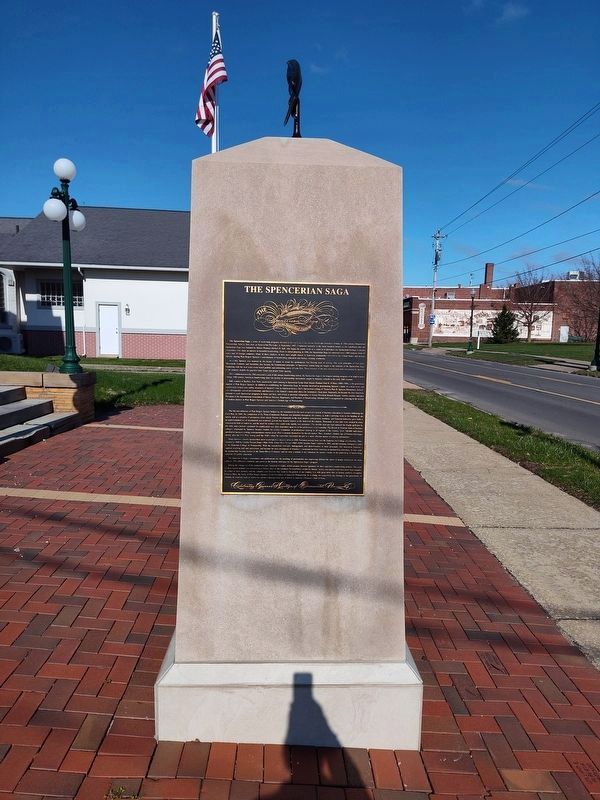
The Spencerian Saga
The Spencerian Saga, a series of week-long programs devoted to the teaching of Spencerian Script and America's history of 19th century Ornamental Penmanship, held its first class at Geneva-On-The-Lake. in September 1987. Conducted annually

Photographed by Craig Doda, April 12, 2025
5. Spencerian Monument for American Handwrighting Marker
As a boy. Spencer was inspired by the beauty of nature to create his spontaneous free-flowing style of writing. The same principles of Curvature, Movement. Contrast, and Variability that became the fundamental principles of Spencerian handwriting are taught to the students of the Spencerian Saga, beginning with the oval water-worn beach pebbles and undulating waves of Lake Erie. These features of the lake environment were envisioned by Spencer as the primary models for graceful letter forms and proper letter spacing.
2011

Photographed by Craig Doda, April 12, 2025
6. Ashtabula County Court - Western Area (Ashtabula Free Public Library Association)
Sull, a native of Buffalo, New York, received his adult training in Spencerian Script from Master Penman Paul H. O'Hara (1889-1990), a 4th-generation student of Platt Rogers Spencer. In addition to establishing the Spencerian Saga, he became involved in perpetuating Spencer's name on a local level, and significantly helped raise public awareness of Spencer's role in American history. Sull's Spencerian writing of "Geneva Platt R. Spencer Elementary School" was subsequently carved into limestone, and functions as the School's name plate above the institution's front door. Nationally, he became the first American penman to teach Spencerian programs in Japan and Italy, and served as personal calligrapher to former President Ronald Reagan. Author, teacher, and past President of the International Association of Master Penmen. Engrossers, and Teachers of Handwriting.

Photographed by Craig Doda, April 12, 2025
7. Spencerian Monument for American Handwrighting Marker
The life and influence of Platt Rogers Spencer helped lay the foundation for the most progressive period of business education in America following the Civil War. In 1869, the completion of the Trans-Continental Railroad was heralded throughout the country as both a unifying event in the healing of our nation, and as a promise of prosperous times ahead. Further developments in the steel, lumber, construction, maritime, and financial industries gave birth to an unprecedented era of mechanical and economic growth that became known as the Industrial Revolution. Thousands of new jobs were created in every commercial field of endeavor, and the need for workers who could write rapidly was enormous. The durable steel pen had replaced the fragile quill pen by this time, and a person's potential for employment was often dependent upon his or her proficiency in penmanship. The Bryant & Stratton chain of business colleges, originated by Spencer, became models for similar institutions of professional training
Photographed by Craig Doda, April 12, 2025
8. Spencerian Monument for American Handwrighting Marker
Many business schools opened their doors to prospective students prior to 1900. Foremost among these was the Zanerian Art College of Columbus, Ohio, founded in 1888 by Charles Paxton Zaner (1864-1918). Elmer Ward Bloser (1865-1929), became Zaner's partner in 1891, and the company changed its name to the Zanerian College of Penmanship. With the exceptional foresight, management, and determination of these principals, this institution featured a superior teaching staff and curriculum, and became the most prestigious of America's vocational facilities focusing on penmanship education. In later years the partnership became known as the Zaner-Bloser Company, and for over a century it has remained the nation's leader in the publishing of handwriting materials for public education.
The Zanerian
Photographed by Craig Doda, April 12, 2025
9. Spencerian Monument for American Handwrighting Marker
During the vintage era of the penmanship arts, hundreds of highly-skilled penmen became legendary for their superlative handwriting abilities. The work of these master penmen was astonishing to behold: they set the standards for excellence, creativity, beauty, variety, and purpose that have never been equaled. In tribute to their memory and the valuable contributions they made to the growth of our country, it is with great pride that we hereby publicly recognize Geneva. Ohio, the home of Platt Rogers Spencer, as the birthplace of American Penmanship. In so doing, we respectfully pay homage to the generations of students he inspired. each of whom has earned a distinguished seat of honor in America's Penman's Hall of Fame.
Topics. This historical marker is listed in these topic lists: Communications • Education • Women. A significant historical date for this entry is May 16, 1864.
Location. 41° 48.276′ N, 80° 56.988′ W.
Photographed by Craig Doda, April 12, 2025
10. Spencerian Monument for American Handwrighting Marker

Regionally, this marker is on the Lake Erie Shore and in the Western Reserve. It is also in the American Midwest. Globally, it is in North America, on the Great Lakes, in the Western Hemisphere, in the Western World, and in the Anglosphere. Historically, it finds itself in what was once the Haudenosaunee (Iroquois) Confederacy, the territory of the Mississippian Culture, and the Northwest Territory.
Other nearby markers. At least 8 other markers are within 2 miles of this marker, measured as the crow flies: The Cradle of Her Systems of Penmanship, Platt R. Spencer's Log Seminary (here, next to this marker); Ransom E. Olds-Birthplace (about 500 feet away, measured in a direct line); Geneva Veterans Memorial (about 500 feet away); Geneva's First City Manager (about 500 feet away); Soldiers and Sailors Monument (about 600 feet away); The First Church Bell (about 700 feet away); Liberty Street Covered Bridge (approx. 0.4 miles away); Harpersfield (approx. 1½ miles away). Touch for a list and map of all markers in Geneva.
Credits. This page was last revised on May 18, 2025. It was originally submitted on April 18, 2025, by Craig Doda of Napoleon, Ohio. This page has been viewed 404 times since then and 122 times this year. Photos: 1, 2, 3, 4, 5, 6. submitted on April 18, 2025, by Craig Doda of Napoleon, Ohio. 7, 8, 9. submitted on May 11, 2025, by Craig Doda of Napoleon, Ohio. 10. submitted on May 17, 2025, by Craig Doda of Napoleon, Ohio. • Devry Becker Jones was the editor who published this page.
