Laurinburg in Scotland County, North Carolina — The American South (South Atlantic)
Laurinburg
"Burning Depot"
| — | Carolina's Campaign | — |
Photographed by Michael C. Wilcox, June 8, 2012
1. Laurinburg Marker
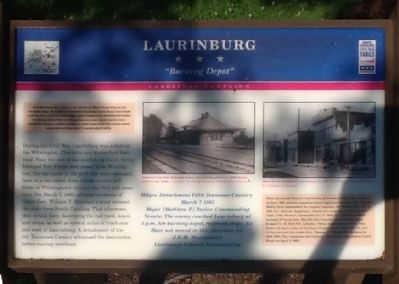
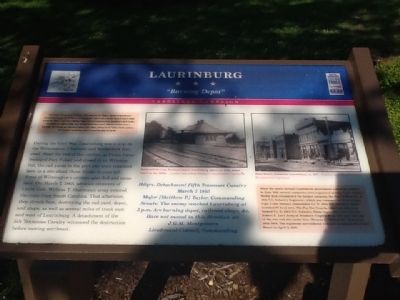
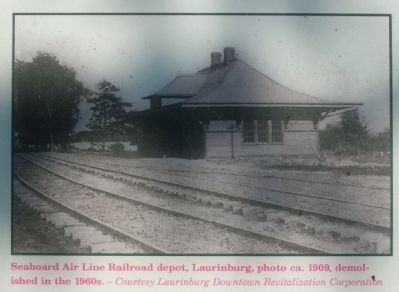
During the Civil War, Laurinburg was a stop on the Wilmington, Charlotte and Rutherford Railroad. Near the end of the conflict, as Union forces besieged Fort Fisher and closed in on Wilmington, the railyards in the port city were relocated here to a site about three blocks to your left. Some of Wilmington's citizens also fled and came here. On March 7, 1865, advance elements of Union Gen. William T. Sherman's army entered the state from South Carolina. That afternoon, they struck here, destroying
this page online
March 7 1865
Major [Matthew P.] Taylor Commanding
Scouts: The enemy reached Laurinburg at 3 p.m. Are burning depot, railroad shops, &c. Have not moved in this direction yet.
J.G.M. Montgomery
Lieutenant-Colonel, Commanding
(right inset)
When the newly formed Confederate government called for soldiers in June 1861, several companies were organized nearby. Capt. Charles Malloy first commanded the largest company, the Scotch Boys (Co. F, 18th N.C. Infantry Regiment), which was composed of 96 local men. Capt. Colin Stewart commanded Co. D, 46th Infantry, which included 87 local men. The Pee Dee Guards, also from this area, formed Co. D, 23rd N.C. Infantry. These regiments served in Gen. Robert E. Lee's Army of Northern Virginia from 1862 until the end of the war and also under Gen. Thomas J. "Stonewall" Jackson in 1862-1863. The regiments surrendered with Lee at Appomattox Court House on April 9, 1865.
(captions)
Seaboard Air Line Railroad depot, Laurinburg, photo ca. 1909, demolished in the 1960s. - Courtesy Laurinburg Downtown Revitalization Corporation
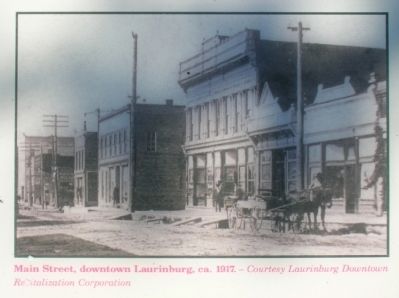
Main Street, downtown Laurinburg, ca. 1917. - Courtesy Laurinburg Downtown Revitalization Corporation
Erected by North
Photographed by Michael C. Wilcox, June 8, 2012
2. Laurinburg Marker
Topics and series. This historical marker is listed in this topic list: War, US Civil. In addition, it is included in the North Carolina Civil War Trails series list. A significant historical date for this entry is February 1, 1865.
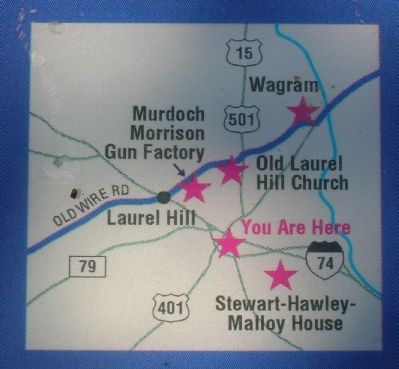
Location. This marker has been replaced by another marker nearby. It was located near 34° 46.463′ N, 79° 27.77′ W. Marker was in Laurinburg, North Carolina, in Scotland County. It was at the intersection of West Church Street (Business U.S. 74) and Main Street (Business U.S. 501), on the right when traveling west on West Church Street. Touch for map. Marker was in this post office area: Laurinburg NC 28352, United States of America. Touch for directions.

Regionally, this marker was in the Piedmont. It was also in the American South and specifically in the Upper South. Globally, it was in North America, the Western Hemisphere, the Western World, and the Anglosphere. Historically, it found itself in what was once the territory of the Mississippian Culture, one of the original Thirteen Colonies, one of the Confederate States of America, and the Antebellum South.
Other nearby markers. At
Photographed by Michael C. Wilcox, June 8, 2012
3. Laurinburg Marker
Related marker. Click here for another marker that is related to this marker. New Replacement CWT Marker At This Location also titled "Laurinburg"
Photographed by Michael C. Wilcox, June 8, 2012
4. Laurinburg Marker
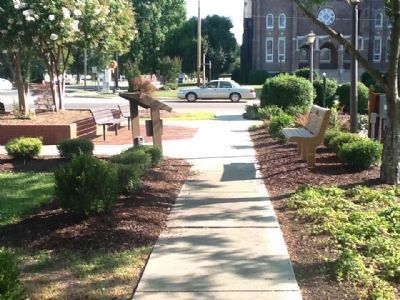
Photographed by Michael C. Wilcox, June 8, 2012
5. Laurinburg Marker
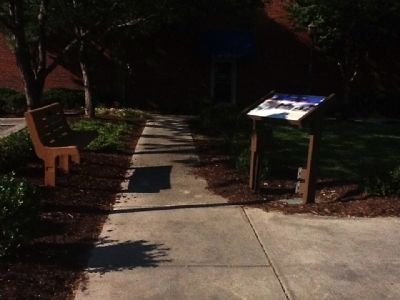
Photographed by Michael C. Wilcox, June 8, 2012
6. Laurinburg Marker (facing Church St)
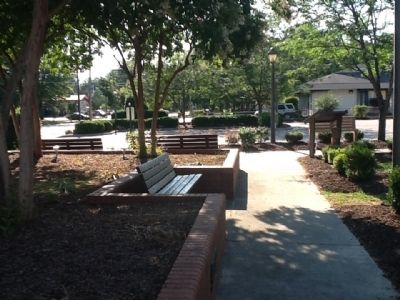
Photographed by Michael C. Wilcox, June 8, 2012
7. Laurinburg Marker (from Church St)
Photographed by Michael C. Wilcox, June 8, 2012
8. Laurinburg Marker (from Main St)
Credits. This page was last revised on April 24, 2025. It was originally submitted on June 9, 2012, by Michael C. Wilcox of Winston-Salem, North Carolina. This page has been viewed 1,369 times since then and 53 times this year. Last updated on April 19, 2025, by Mark Parker of Hickory, North Carolina. Photos: 1, 2, 3, 4, 5, 6, 7, 8. submitted on June 9, 2012, by Michael C. Wilcox of Winston-Salem, North Carolina. • Bernard Fisher was the editor who published this page.
