Fort Snelling in Hennepin County, Minnesota — The American Midwest (Upper Plains)
Military Intelligence Service Language School
1944-1946
Photographed by McGhiever, October 21, 2024
1. Military Intelligence Service Language School Marker
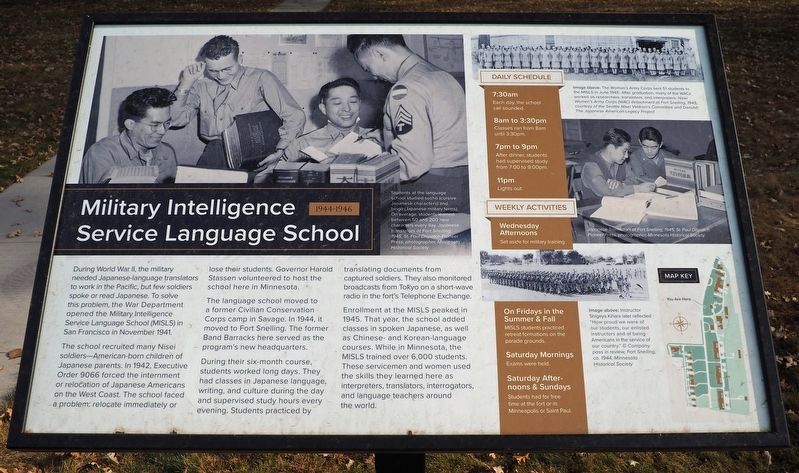
Students at the language school studied sosho (cursive Japanese characters) and beigo (Japanese military terms). On average, students learned between 50 and 200 new characters every day. Japanese translators at Fort Snelling, 1945, St. Paul Dispatch-Pioneer Press, photographer, Minnesota Historical Society
During World War II, the military needed Japanese-language translators to work in the Pacific, but few soldiers spoke or read Japanese. To solve this problem, the War Department opened the Military Intelligence Service Language School (MISLS) in San Francisco in November 1941.
The school recruited many Nisei soldiers—American-born children of Japanese parents. In 1942, Executive Order 9066 forced the internment or relocation of Japanese Americans on the West Coast. The school faced a problem: relocate immediately or lose their students. Governor Harold Stassen volunteered to host the school here in Minnesota.
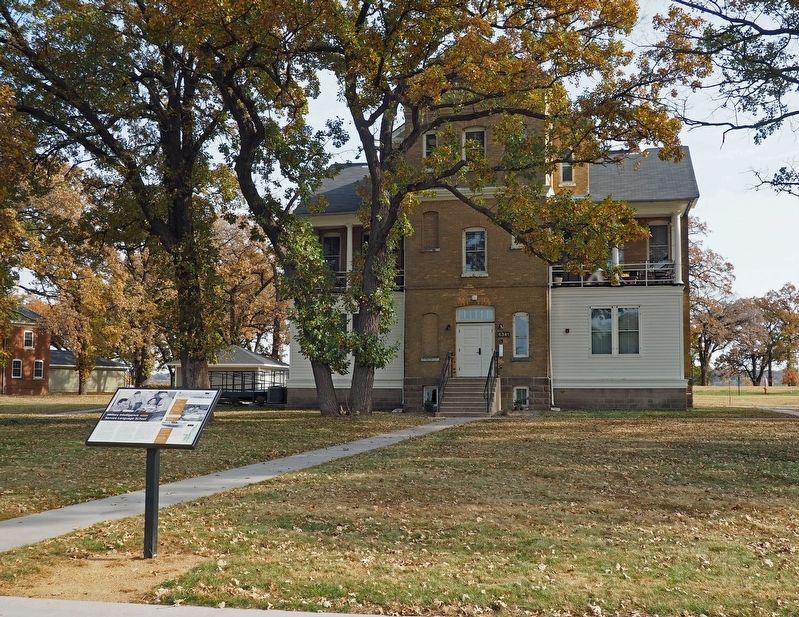
The language school moved to a former Civilian Conservation Corps camp in Savage. In 1944, it moved to Fort Snelling. The former Band Barracks here served as the program's new headquarters.
During their
this page online
Enrollment at the MISLS peaked in 1945. That year, the school added classes in spoken Japanese, as well as Chinese- and Korean-language courses. While in Minnesota, the MISLS trained over 6,000 students. These servicemen and women used the skills they learned here as interpreters, translators, interrogators, and language teachers around the world.
Daily Schedule
7:30am
Each day, the school call sounded.
8am to 3:30pm
Classes ran from 8am until 3:30pm.
7pm to 9pm
After dinner, students had supervised study from 7:00 to 9:00pm.
11pm
Lights out.
Weekly Activities
Wednesday Afternoons
Set aside for military training.
On Fridays in the Summer & Fall
MISLS students practiced retreat formations on the parade grounds.
Saturday Mornings
Exams were held.
Saturday Afternoons & Sundays
Students had for free time at the fort or in Minneapolis or Saint Paul.
The Women's Army Corps sent 51 students to the MISLS in June 1945. After graduation, many of the WACs worked as researchers, translators, and interpreters. Nisei Women's Army Corps (WAC) detachment at Fort Snelling, 1945, courtesy of the Seattle Nisei Veteran's Committee and Denshō: The Japanese American Legacy Project
Japanese translators at Fort Snelling, 1945, St. Paul Dispatch Pioneer Press, photographer, Minnesota Historical Society
Instructor Shigeya Kihara later reflected "How proud we were of our students, our enlisted instructors and of being Americans in the service of our country." G Company pass in review, Fort Snelling, ca. 1944, Minnesota Historical Society
Topics.
Photographed by McGhiever, October 21, 2024
2. Military Intelligence Service Language School Marker in front of the former MISLS headquarters
Location. 44° 53.267′ N, 93° 11.405′ W. Marker is in Fort Snelling, Minnesota, in Hennepin County. It is on Taylor Avenue east of Minnehaha Avenue, on the right. Touch for map. Marker is at or near this postal address: 6341 Taylor Avenue, Saint Paul MN 55111, United States of America. Touch for directions.

Regionally, this marker is in the Twin Cities Metropolitan Area. It is also in the American Midwest, in the Corn Belt, and in the Great River Road Region. Globally, it is in North America, the Western Hemisphere, the Western World, and the Anglosphere. Historically, it finds itself in what was once Rupert’s Land, the territory of the Mississippian Culture, and the Louisiana Purchase.
Other nearby markers. At least 8 other markers are within walking distance of this marker: The Upper Post at Fort Snelling (within shouting distance of this marker); Women at Work (within shouting distance of this marker); Quartermaster Shops (about 300 feet away, measured in a direct line); Getting Around at the Fort (about 500 feet away); Medicine at the Fort (about 600 feet away); Fun at the Fort (about 700 feet away); Military Units of Fort Snelling (about 800 feet away); Military Training at Fort Snelling (approx. 0.2 miles away). Touch for a list and map of all markers in Fort Snelling.
Credits. This page was last revised on April 22, 2025. It was originally submitted on April 22, 2025, by McGhiever of Minneapolis, Minnesota. This page has been viewed 150 times since then and 37 times this year. Photos: 1, 2. submitted on April 22, 2025, by McGhiever of Minneapolis, Minnesota.
