Golden Square Mile in Montréal, Québec — Central Canada (French-Canadian)
The Church of Saint Andrew and Saint Paul
Photographed by Cosmos Mariner, May 22, 2024
1. The Church of Saint Andrew and Saint Paul Marker

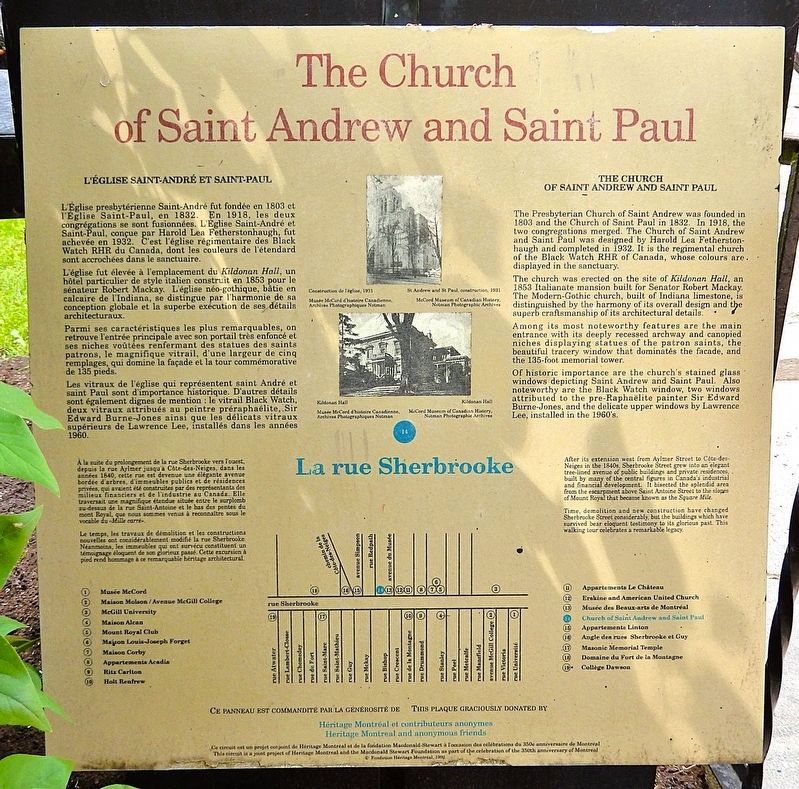
L'Église Saint-André et Saint-Paul
L'Église presbytérienne Saint-André fut fondée en 1803 et l'Eglise Saint-Paul, en 1832. En 1918, les deux congrégations se sont fusionnées. L'Église Saint-André et Saint-Paul, conçue par Harold Lee Fetherstonhaugh, fut achevée en 1932. C'est l'église régimentaire des Black Watch RHR du Canada, dont les couleurs de l'étendard sont accrochées dans le sanctuaire.
L'église fut élevée à l'emplacement du Kildonan Hall, un hôtel particulier de style italien construit en 1853 pour le sénateur Robert Mackay. L'église néo-gothique, bâtie en calcaire de l'Indiana, se distingue par l'harmonie sa conception globale et la superbe exécution de ses détails architecturaux.
Parmi ses caractéristiques les plus remarquables, on retrouve l'entrée principale avec son portail très enfoncé et ses niches voûtées renfermant des statues des saints patrons, le magnifique vitrail, d'une largeur de cinq remplages, qui domine la façade et la tour commémorative de 135 pieds.
Les vitraux de l'église qui représentent saint André et saint Paul sont d'importance historique. D'autres détails sont également
this page online
[légendes d'images]
• Construction de l’église, 1931
• Kildonan Hall
La rue Sherbrook
À la suite du prolongement de la rue Sherbrooke vers l'ouest, depuis la rue Aylmer jusqu'à Côte-des-Neiges, dans les années 1840, cette rue est devenue une élégante avenue bordée d'arbres, d'immeubles publics et de résidences privées, qui avaient été construites par des représentants des milieux financiers et de l'industrie au Canada. Elle traversait une magnifique étendue située entre le surplomb au-dessus de la rue Saint-Antoine et le bas des pentes du mont Royal, que nous sommes venus à reconnaître sous le vocable du « Mille carré ».
Le temps, les travaux de démolition et les constructions nouvelles ont considérablement modifié la rue Sherbrooke. Néanmoins, les immeubles qui ont survécu constituent un témoignage éloquent de son glorieux passé. Cette excursion à pied rend hommage à ce remarquable héritage architectural.
The Church of Saint Andrew and Saint Paul
The
Photographed by Cosmos Mariner, May 22, 2024
2. The Church of Saint Andrew and Saint Paul Marker
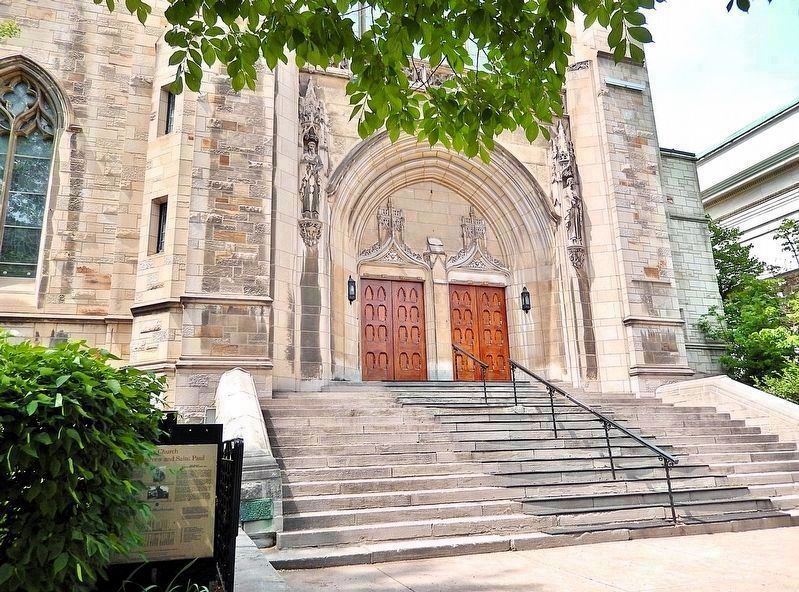
Looking north from Rue Sherbrooke; the marker is located near the sidewalk, on the left side of the front sanctuary entrance. It is partially obscured by the shrubbery in this photo.
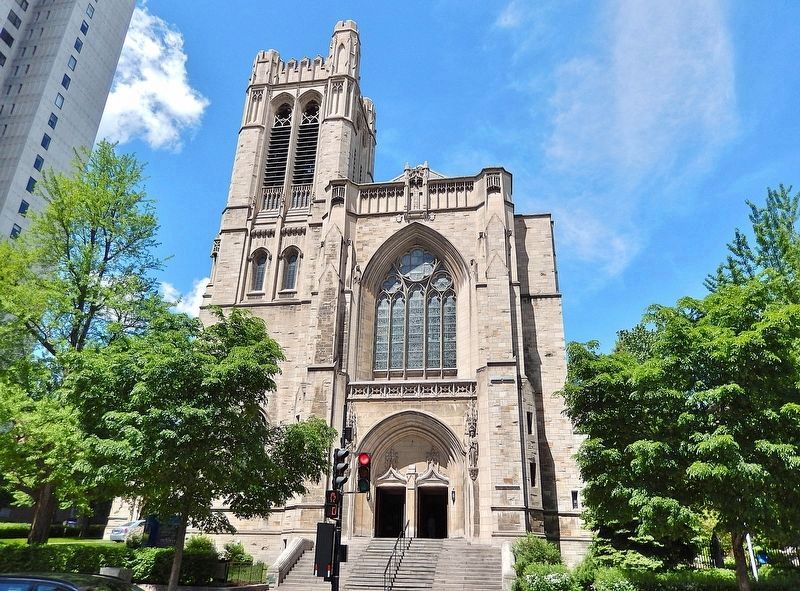
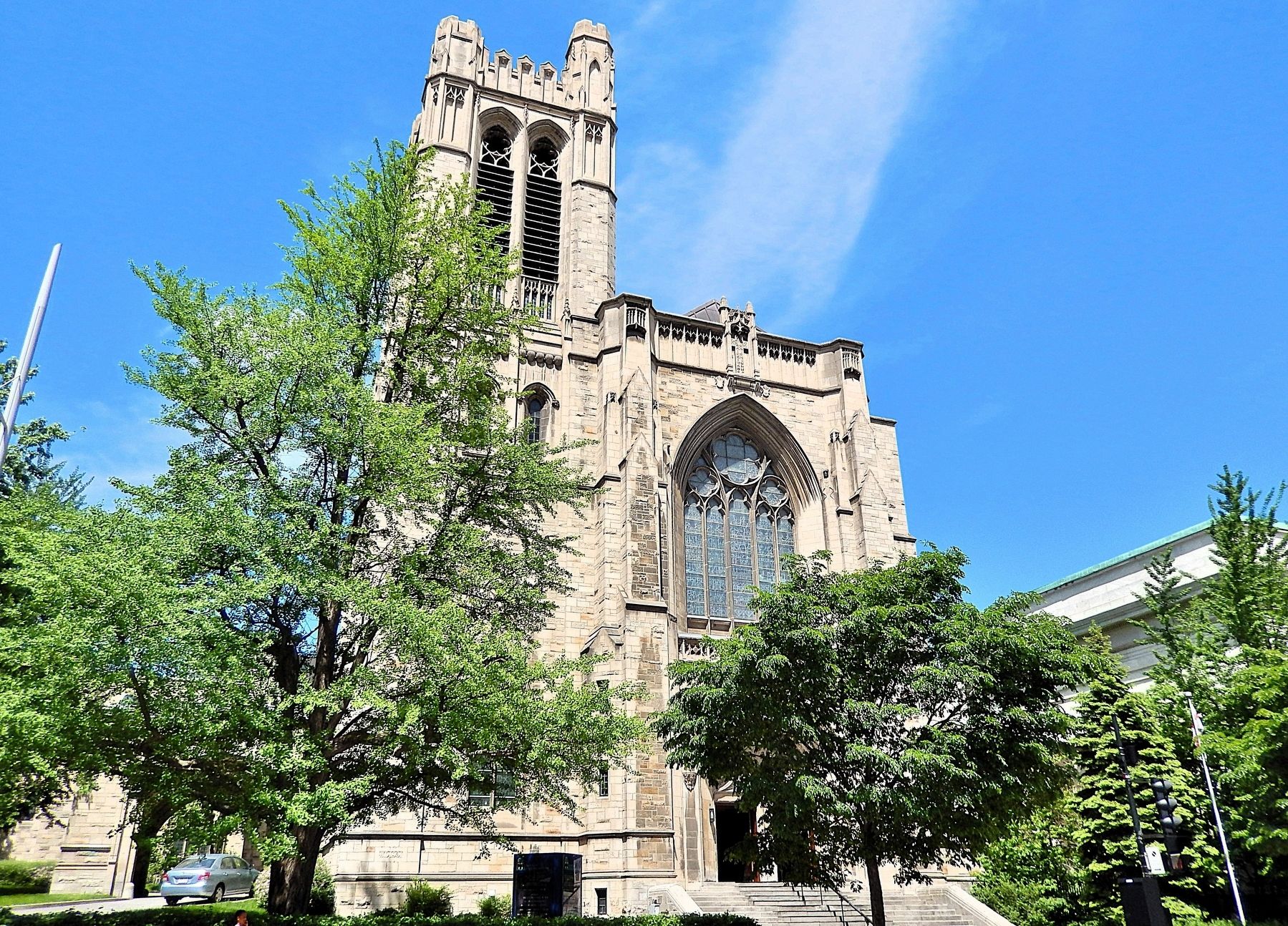
The church was erected on the site of Kildonan Hall, an 1853 Italianate mansion built for Senator Robert Mackay. The Modern-Gothic church, built of Indiana limestone, is distinguished by the harmony of its overall design and the superb craftsmanship of its architectural details.
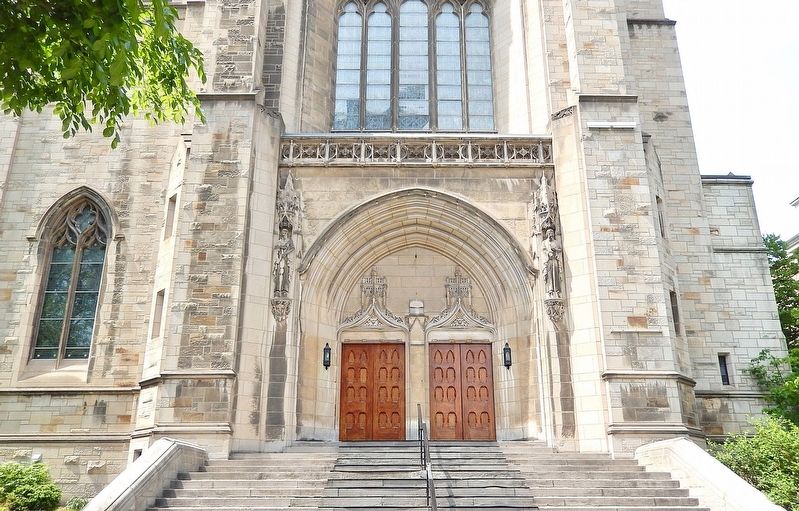
Among its most noteworthy features are the main entrance with its deeply recessed archway and canopied niches displaying statues of the patron saints, the beautiful tracery window that dominates the facade, and the 135-foot memorial tower.
Of historic importance are the church's stained glass windows depicting Saint Andrew and Saint Paul. Also noteworthy are the Black Watch window, two windows attributed to the pre-Raphaelite painter Sir Edward Burne-Jones, and the delicate upper windows by Lawrence Lee, installed in
Photographed by Cosmos Mariner, May 22, 2024
3. The Church of Saint Andrew and Saint Paul Entrance
The main entrance with its deeply recessed archway and canopied niches displaying statues of the patron saints, and the beautiful tracery window that dominates the façade.
[image captions]
• Saint Andrew and Saint Paul Construction, 1931
• Kildonan Hall
Sherbrooke Street
After its extension west from Aylmer Street to Cote-des-Neiges in the 1840s, Sherbrooke Street grew into an elegant tree-lined avenue of public buildings and private residences, built by many of the central figures in Canada's industrial and financial development. It bisected the splendid area from the escarpment above Saint Antoine Street to the slopes of Mount Royal that became known as the Square Mile.
Time, demolition and new construction have changed Sherbrooke Street considerably, but the buildings which have survived bear eloquent testimony to its glorious past. This walking tour celebrates a remarkable legacy.
© Fondation Héritage Montréal, 1992.
Erected 1992
Photographed by Cosmos Mariner, May 22, 2024
4. The Church of Saint Andrew and Saint Paul Sanctuary
Topics. This historical marker is listed in these topic lists: Architecture • Religion & Religious Structures • Roads & Vehicles. A significant historical year for this entry is 1932.
Location. 45° 29.897′ N, 73° 34.817′ W. Marker is in Montréal, Québec. It is in Golden Square Mile. It is on Rue Sherbrooke Ouest (Québec Route 138) just north of Redpath Street, on the left when traveling north. The marker is located near the sidewalk, directly in front of the subject church. Touch for map. Marker is at or near this postal address: 3415 Redpath Street, Montréal QC H3G 2G2, Canada. Touch for directions.

Regionally, this marker is in Central Canada. Globally, it is in North America, the Western Hemisphere, and the Western World. Historically, it finds itself in what was once a British colony, the Viceroyalty of New France, the Haudenosaunee (Iroquois) Confederacy, and Rupert’s Land.
Other nearby markers. At least 8 other markers are within walking distance of this marker: Alexander McFee Memorial (here, next to this marker); Appartements Linton
Photographed by Cosmos Mariner, May 23, 2024
5. The Church of Saint Andrew and Saint Paul
Related markers. Click here for a list of markers that are related to this marker. La Rue Sherbrooke / Sherbrooke Street
Also see . . . The Church of Saint Andrew and Saint Paul (Wikipedia).
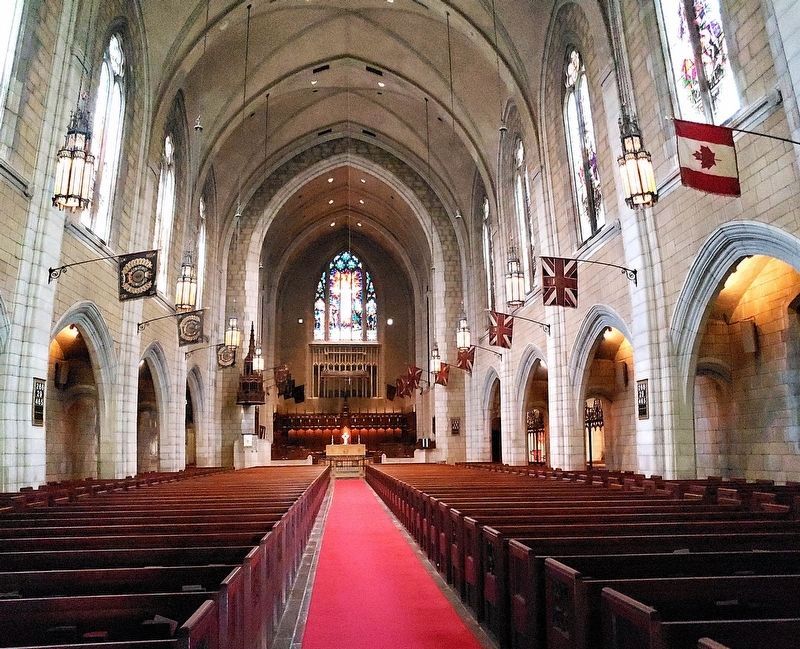
Excerpt: It was designed in the Gothic Revival architecture style largely by Montreal draftsman H. Ross Wiggs who worked for the firm of Harold Lea Fetherstonhaugh. The materials used in construction were steel and reinforced concrete, although the interior is made entirely of stone. Built in the style of a cathedral, the interior of the church has three aisles. A large stained glass window overlooks the main communion table. There are also two windows made by William(Submitted on April 29, 2025, by Cosmos Mariner of Cape Canaveral, Florida.)Morris who was associated with the English Arts and Crafts Movement. The wrought iron screen located in one of the chapels won an award for the architect, Fetherstonhaugh. Many of the commemorative stained glass windows within the church originated from the former St. Paul Church. The church's organ was built in 1932 by Casavant Frères, and is the largest in Montreal with 7000 organ pipes.Photographed by Cosmos Mariner, May 23, 20246. The Church of Saint Andrew and Saint Paul
Credits. This page was last revised on April 30, 2025. It was originally submitted on April 22, 2025, by Cosmos Mariner of Cape Canaveral, Florida. This page has been viewed 109 times since then and 19 times this year. Photos: 1, 2, 3, 4, 5, 6. submitted on April 29, 2025, by Cosmos Mariner of Cape Canaveral, Florida.
