
Downtown Augusta in Richmond County, Georgia — The American South (South Atlantic)
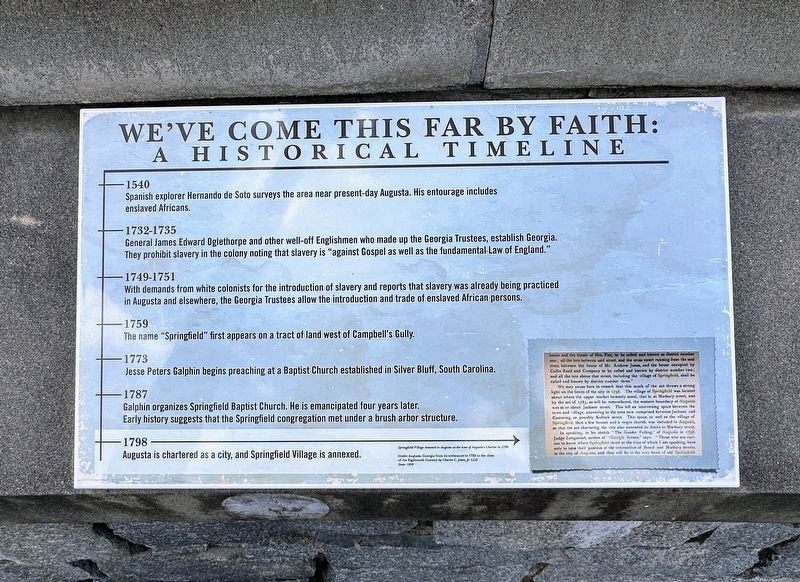
We've Come This Far by Faith:
A Historical Timeline
Photographed by J.T. Lambrou, April 10, 2025
1. We've Come This Far by Faith Marker
1540
Spanish explorer Hernando de Soto surveys the area near present-day Augusta. His entourage includes enslaved Africans.
1732-1735
General James Edward Oglethorpe and other well-off Englishmen who made up the Georgia Trustees, establish Georgia. They prohibit slavery in the colony noting that slavery is "against Gospel as well as the fundamental Law of England."
1749-1751
With demands from white colonists for the introduction of slavery and reports that slavery was already being practiced in Augusta and elsewhere, the Georgia Trustees allow the introduction and trade of enslaved African persons.
1759
The name "Springfield" first appears on a tract of land west of Campbell's Gully.
1773
Jesse Peters Galphin begins preaching at a Baptist Church established in Silver Bluff, South Carolina.
1787
Galphin organizes Springfield Baptist Church. He is emancipated four years later. Early history suggests that the Springfield congregation met under a brush arbor structure.
1798
Augusta is chartered as a city, and Springfield Village is annexed.
Topics. This historical marker is listed in these topic
this page online
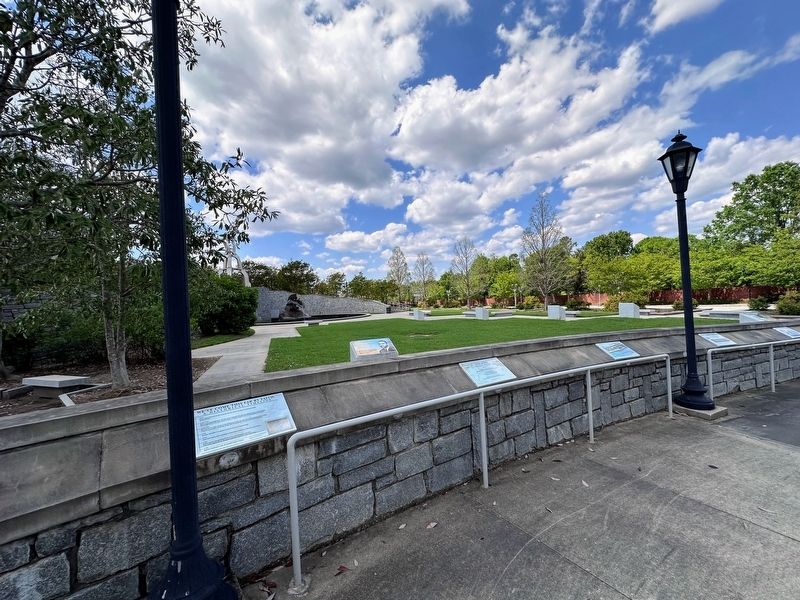
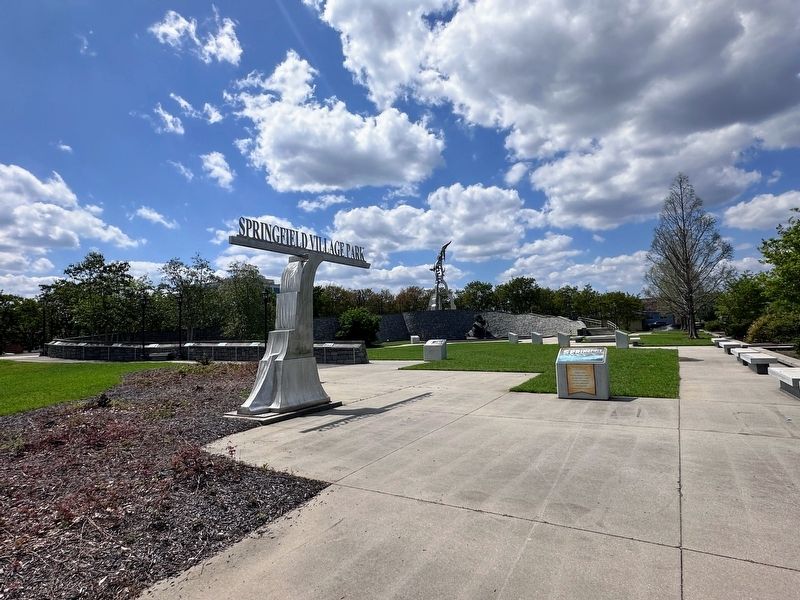
Location. 33° 28.736′ N, 81° 58.343′ W. Marker is in Augusta, Georgia, in Richmond County. It is in Downtown Augusta. It can be reached from the intersection of Reynolds Street and 12th Street, on the right when traveling east. Located in Springfield Village Park. Touch for map. Marker is at or near this postal address: 1211 Jones Street, Augusta GA 30901, United States of America. Touch for directions.

Regionally, this marker is in the American South and specifically in the Deep South. Globally, it is in North America, the Western Hemisphere, the Western World, and the Anglosphere. Historically, it finds itself in what was once the territory of the Mississippian Culture, one of the original Thirteen Colonies, one of the Confederate States of America, and the Antebellum South.
Other nearby markers. At least 8 other markers are within walking distance of this marker: A Historical Timeline of Augusta (here, next to this marker); a different marker
Photographed by J.T. Lambrou, April 10, 2025
2. We've Come This Far by Faith: Marker
Photographed by J.T. Lambrou, April 10, 2025
3. Location
Credits. This page was last revised on April 25, 2025. It was originally submitted on April 24, 2025, by J.T. Lambrou of New Boston, Michigan. This page has been viewed 157 times since then and 14 times this year. Photos: 1, 2, 3. submitted on April 24, 2025, by J.T. Lambrou of New Boston, Michigan. • Bernard Fisher was the editor who published this page.
