Latin Quarter in Galway in County Galway, Connacht, Ireland — Irish West ((Éire) North Atlantic Ocean)
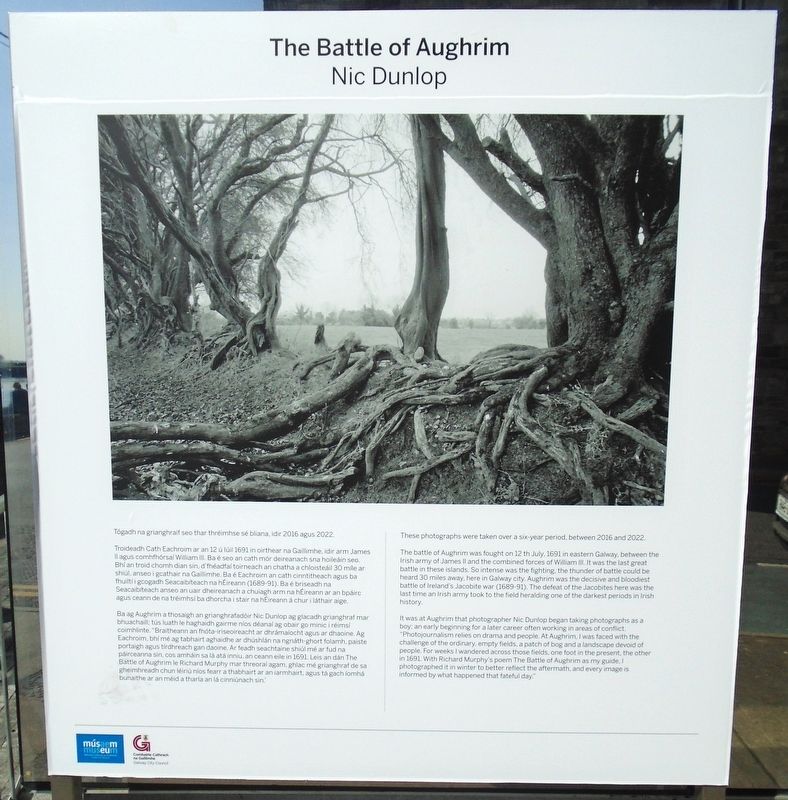
The Battle of Aughrim
Nic Dunlop
Photographed by William Fischer, Jr., April 7, 2025
1. The Battle of Aughrim Marker
Inscription.
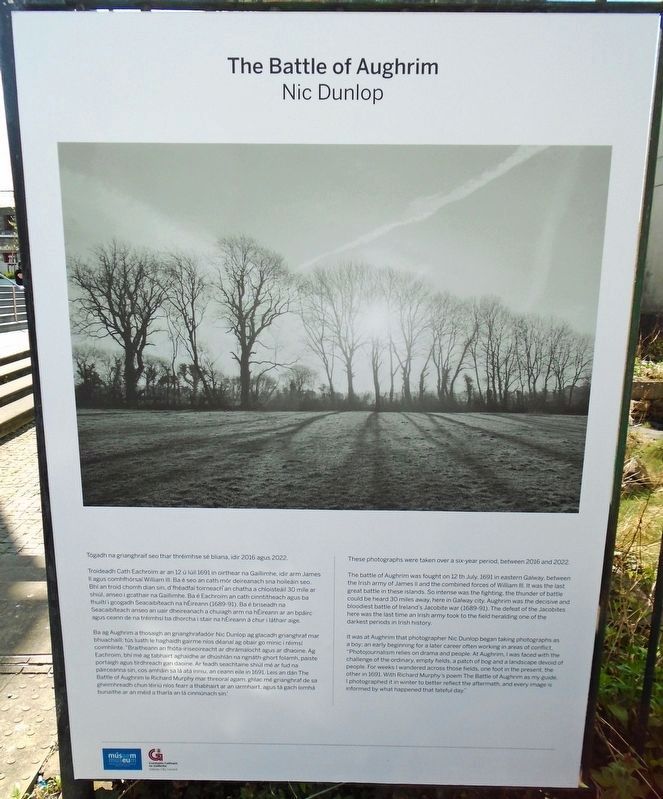
These photographs were taken over a six-year period, between 2016 and 2022.
The battle of Aughrim was fought on 12 th July, 1691 in eastern Galway, between the
Irish army of James II and the combined forces of William III. It was the last great
battle in these islands. So intense was the fighting, the thunder of battle could be
heard 30 miles away, here in Galway city. Aughrim was the decisive and bloodiest
battle of Ireland's Jacobite war (1689-91). The defeat of the Jacobites here was the
last time an Irish army took to the field heralding one of the darkest periods in Irish
history.
It was at Aughrim that photographer Nic Dunlop began taking photographs as a
boy; an early beginning for a later career often working in areas of conflict.
"Photojournalism relies on drama and people. At Aughrim, I was faced with the
challenge of the ordinary, empty fields, a patch of bog and a landscape devoid of
people. For weeks I wandered across those fields, one foot in the present, the other
in 1691. With Richard Murphy's poem The Battle of Aughrim as my guide, I
photographed it in winter to better reflect the
Click or scan to see this page online
aftermath, and every image is
informed by what happened that fateful day."
——————————————————————
Tógadh na grianghraif seo thar thréimhse sé bliana, idir 2016 agus 2022.
Troideadh Cath Eachroim ar an 12 ú lúil 1691 in oirthear na Gaillimhe, idir arm James
Il agus comhfhórsaí William III. Ba é seo an cath mór deireanach sna hoileáin seo.
Bhí an troid chomh dian sin, d'fhéadfaí toirneach an chatha a chloisteáil 30 míle ar
shiúl, anseo i gcathair na Gaillimhe. Ba é Eachroim an cath cinntitheach agus ba
fhuiltí i gcogadh Seacaibíteach na hÉireann (1689-91). Ba é briseadh na
Seacaibíteach anseo an uair dheireanach a chuiagh arm na hÉireann ar an bpáirc
agus ceann de na tréimhsí ba dhorcha i stair na hÉireann á chur i láthair aige.
Ba ag Aughrim a thosaigh an grianghrafadóir Nic Dunlop ag glacadh grianghraf mar
bhuachaill; tús luath le haghaidh gairme níos déanaí ag obair go minic i réimsí
coimhlinte. "Braitheann an fhóta-iriseoireacht ar dhrámaíocht agus ar dhaoine. Ag
Eachroim, bhí mé ag tabhairt aghaidhe ar dhúshlán na ngnáth-ghort folamh, paiste
portaigh agus tírdhreach gan daoine. Ar feadh seachtaine shiúl mé ar fud na
páirceanna
Photographed by William Fischer, Jr., April 7, 2025
2. The Battle of Aughrim Photo Essay Markers (start)
sin, cos amháin sa lá atá inniu, an ceann eile in 1691. Leis an dán The
Battle of Aughrim le Richard Murphy mar threoraí agam, ghlac mé grianghraf de sa
gheimhreadh chun léiriú níos fearr a thabhairt ar an iarmhairt, agus tá gach íomhá
bunaithe ar an méid a tharla an lá cinniúnach sin.'
————————————
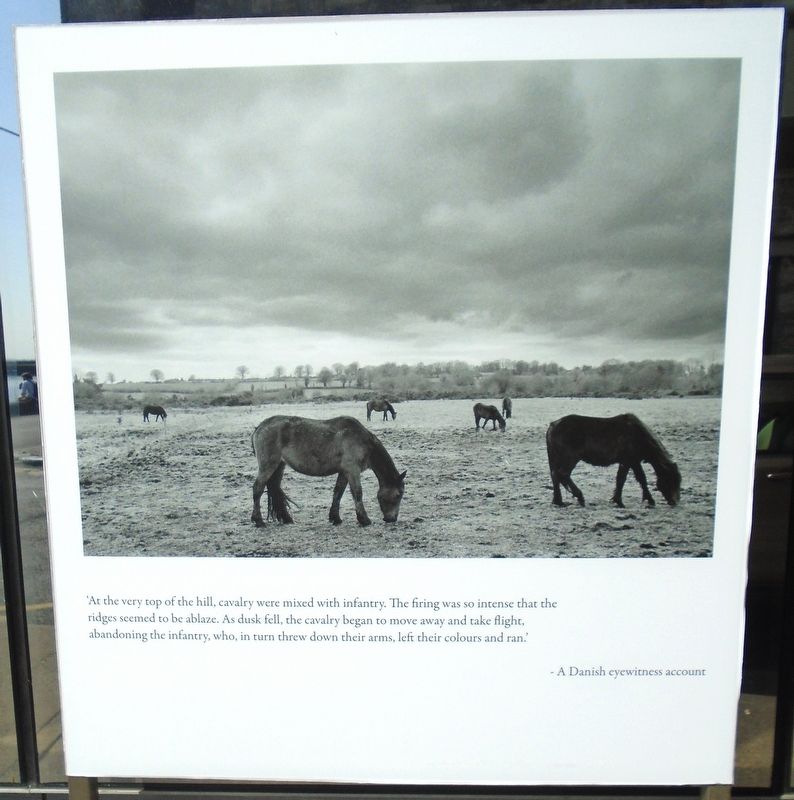
'At the very top of the hill, cavalry were mixed with infantry. The firing was so intense that the ridges seemed to be ablaze. As dusk fell, the cavalry began to move away and take flight, abandoning the infantry, who, in turn threw down their arms, left their colours and ran.'
-A Danish eyewitness account
————————————
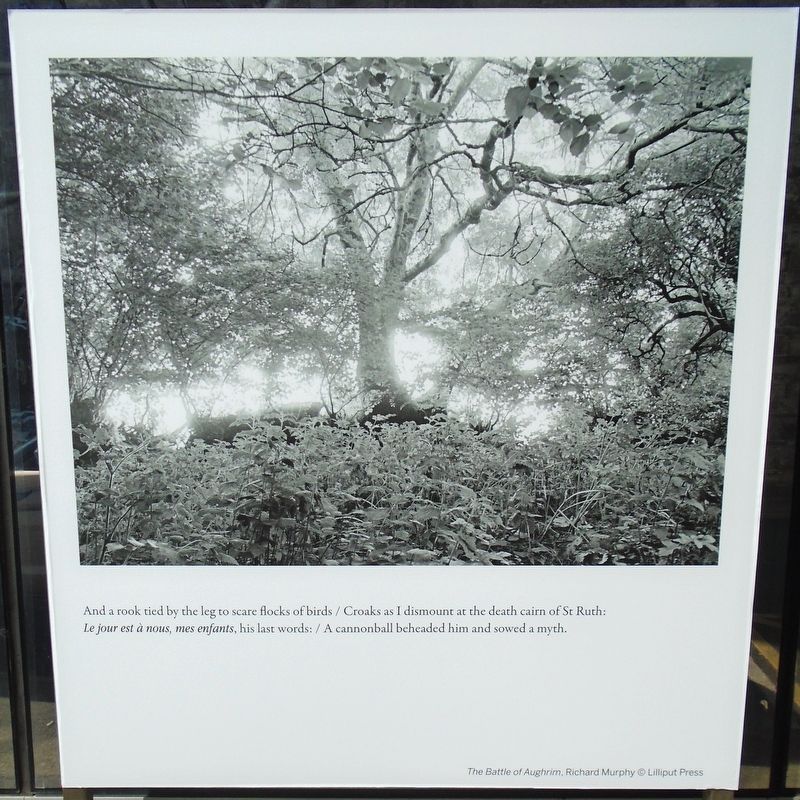
And a rook tied by the leg to scare flocks of birds / Croaks as I dismount at the death cairn of St Ruth: Le jour est à nous, mes enfants, his last words: / A cannonball beheaded him and sowed a myth.
————————————
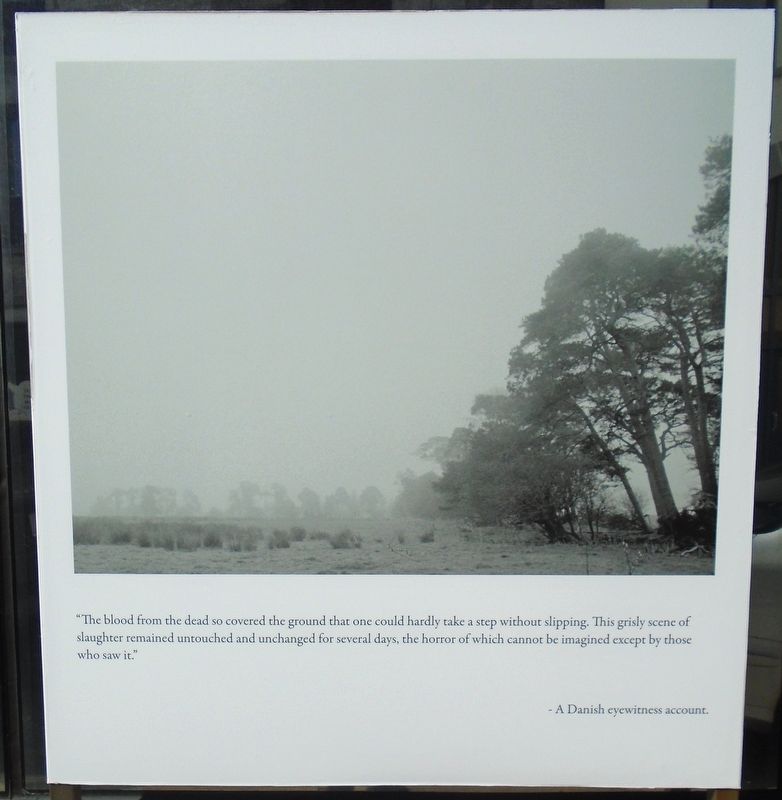
"The blood from the dead so covered the ground that one could hardly take a step without slipping. This grisly scene of slaughter remained untouched and unchanged for several days, the horror of which cannot be imagined except by those who saw it."
-A Danish eyewitness account
————————————
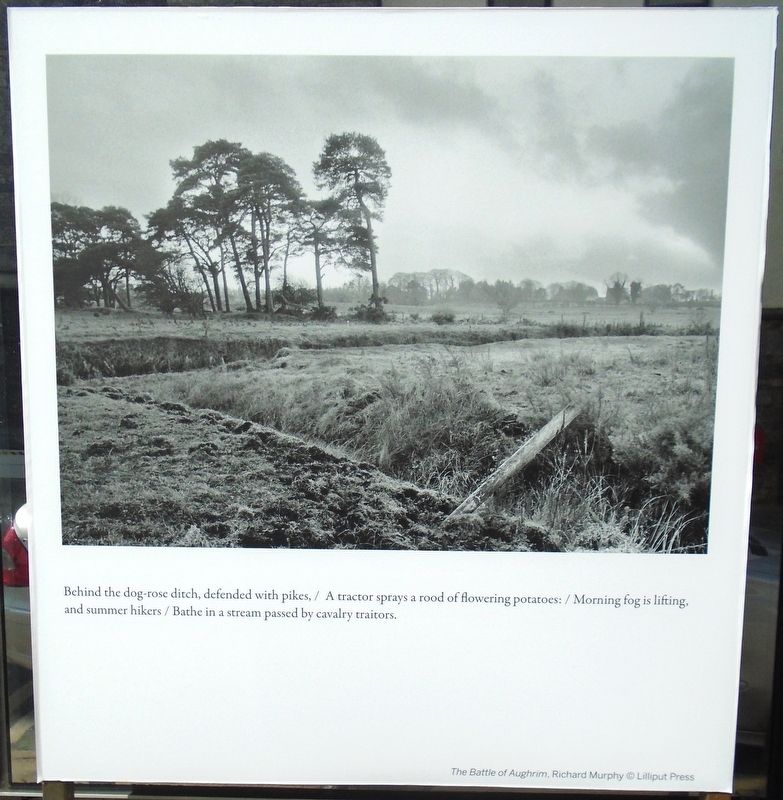
Behind the
Photographed by William Fischer, Jr., April 7, 2025
3. The Battle of Aughrim Marker
dog-rose ditch, defended with pikes, / A tractor sprays a rood of flowering potatoes: / Morning fog is lifting, and summer hikers / Bathe in a stream passed by cavalry traitors.
————————————
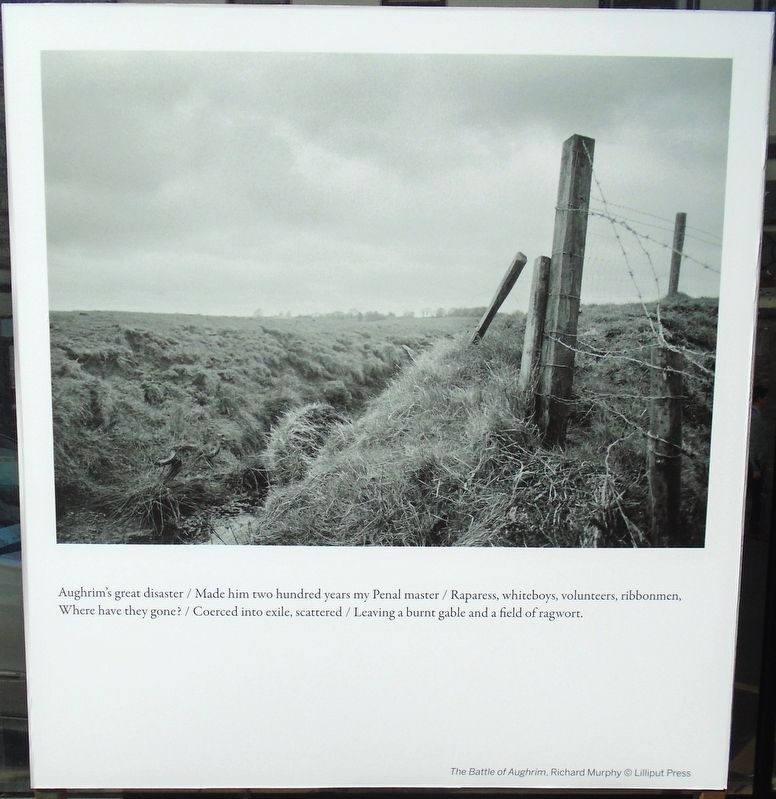
Aughrim's great disaster / Made him two hundred years my Penal master / Raparess, whiteboys, volunteers, ribbonmen, Where have they gone? / Coerced into exile, scattered / Leaving a burnt gable and a field of ragwort.
————————————
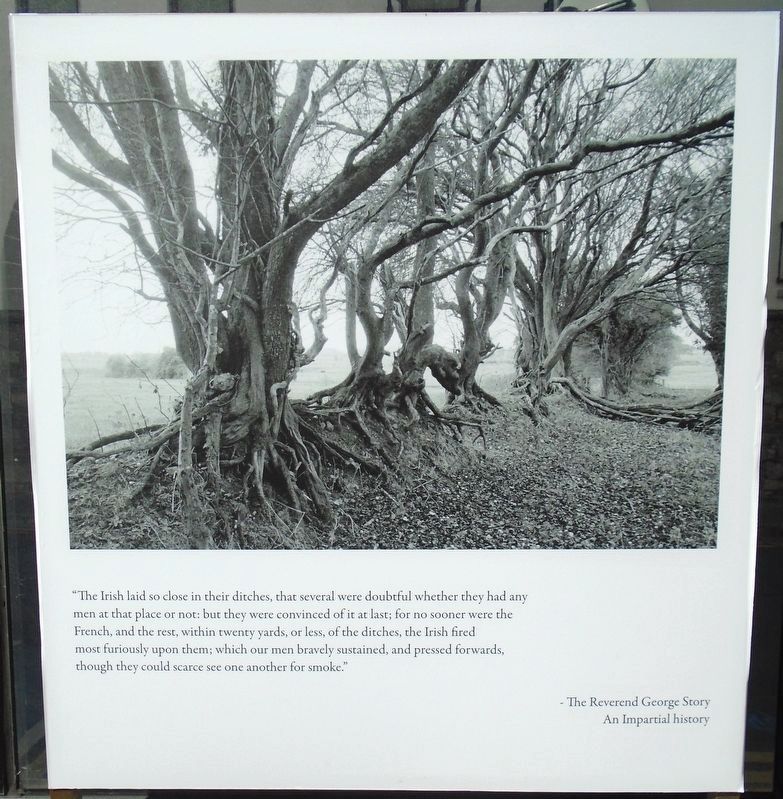
"The Irish laid so close in their ditches, that several were doubtful whether they had any men at that place or not: but they were convinced of it at last; for no sooner were the French, and the rest, within twenty yards, or less, of the ditches, the Irish fired most furiously upon them; which our men bravely sustained, and pressed forwards, though they could scarce see one another for smoke."
-The Reverend George Story
An Impartial history
————————————
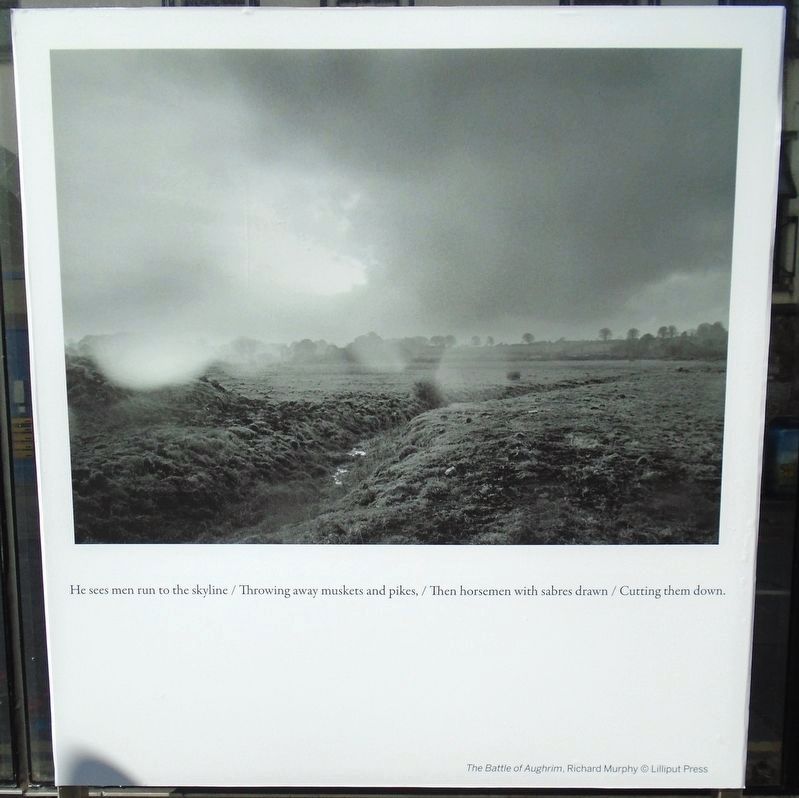
He sees men run to the skyline / Throwing away muskets and pikes, / Then horsemen with sabres drawn / Cutting them down.
————————————
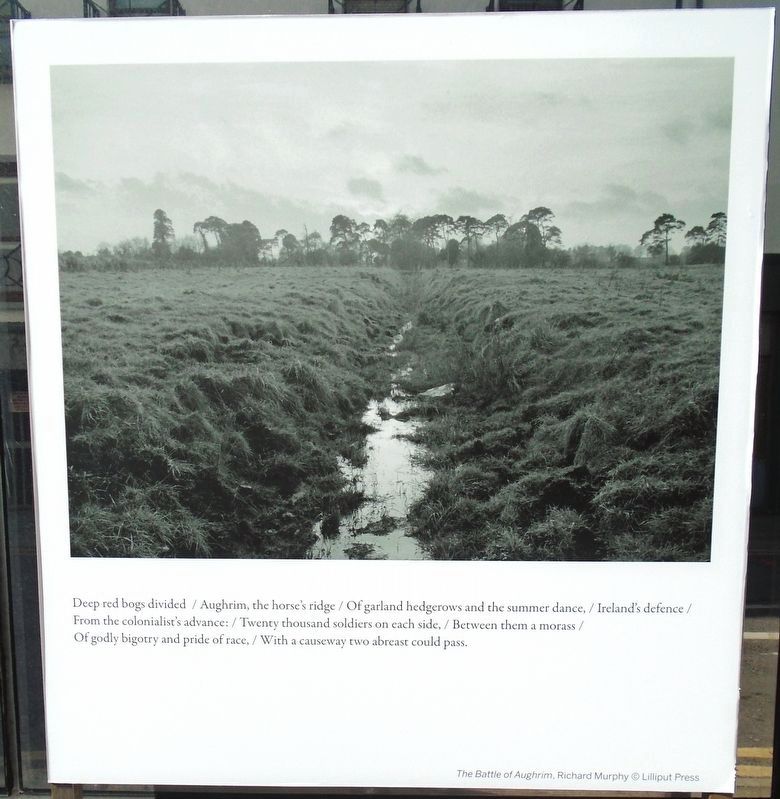
Deep red bogs divided / Aughrim, the horse's ridge / Of garland hedgerows and the summer dance, / Ireland's defence / From the
Photographed by William Fischer, Jr., April 7, 2025
4. The Battle of Aughrim Marker
colonialist's advance: / Twenty thousand soldiers on each side, / Between them a morass / Of godly bigotry and price of race, / With a causeway two abreast could pass.
————————————
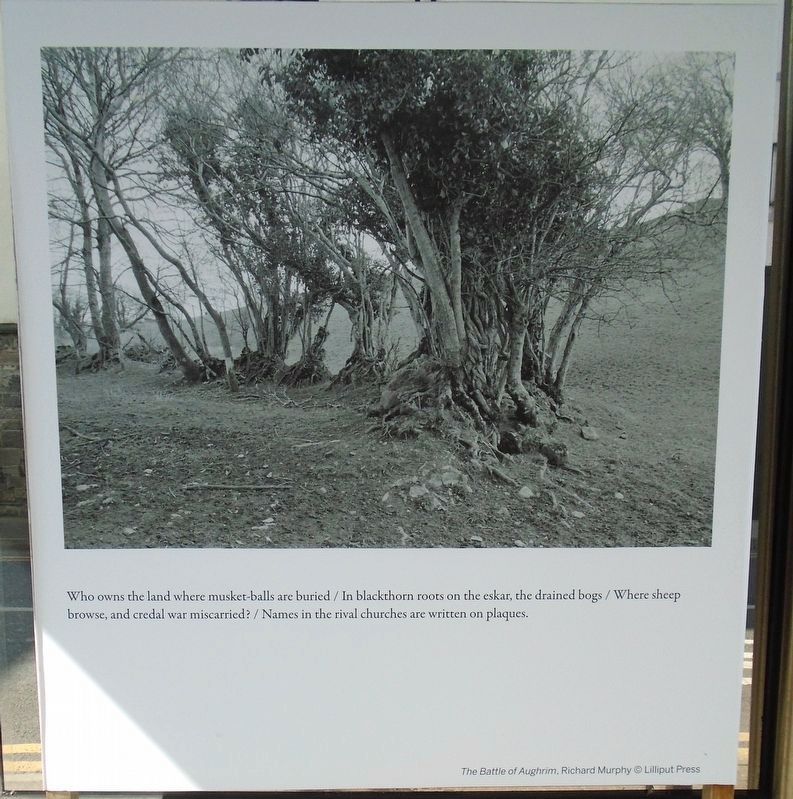
Who owns the land where musket-balls are buried / In blackthorn roots on the eskar, the drained bogs / Where sheep browse, and credal war miscarried? / Names in the rival churches are written on plaques.
————————————
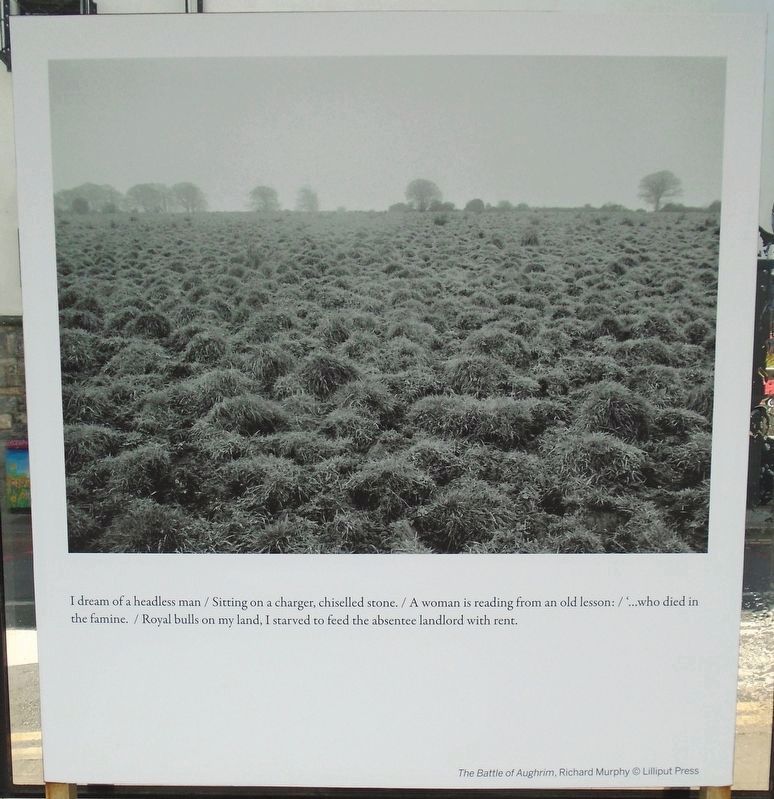
I dream of a headless man / Sitting on a charger, chiselled stone. / A woman is reading from an old lesson: / '...who died in the famine. / Royal bulls on my land, I starved to feed the absentee landlord with rent.
————————————
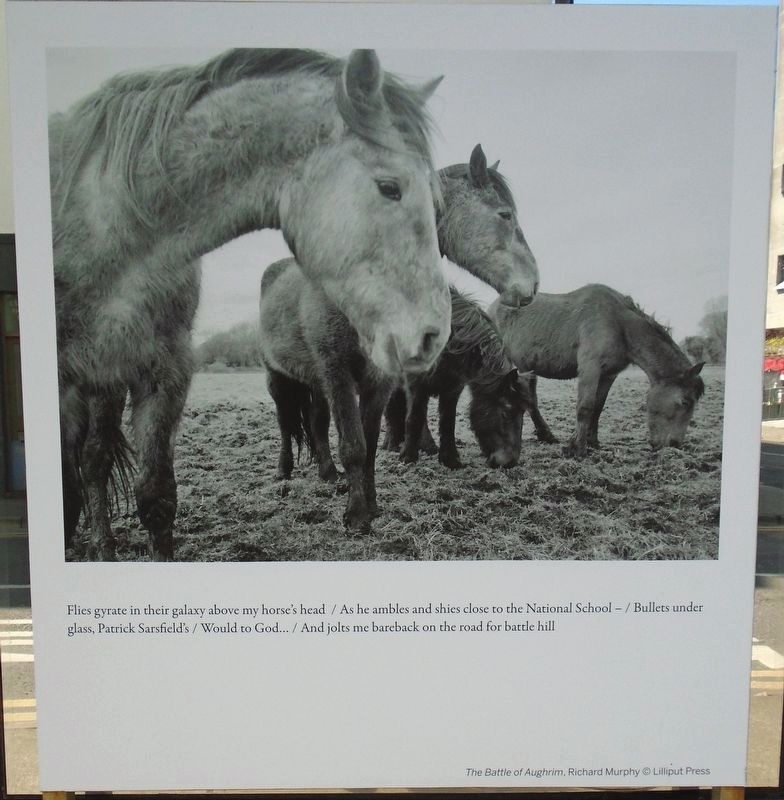
Flies gyrate in their galaxy above my horse's head / As he ambles and shies close to the National School — / Bullets under glass, Patrick Sarfield's / Would to God... / And jolts me bareback on the road for battle hill
————————————
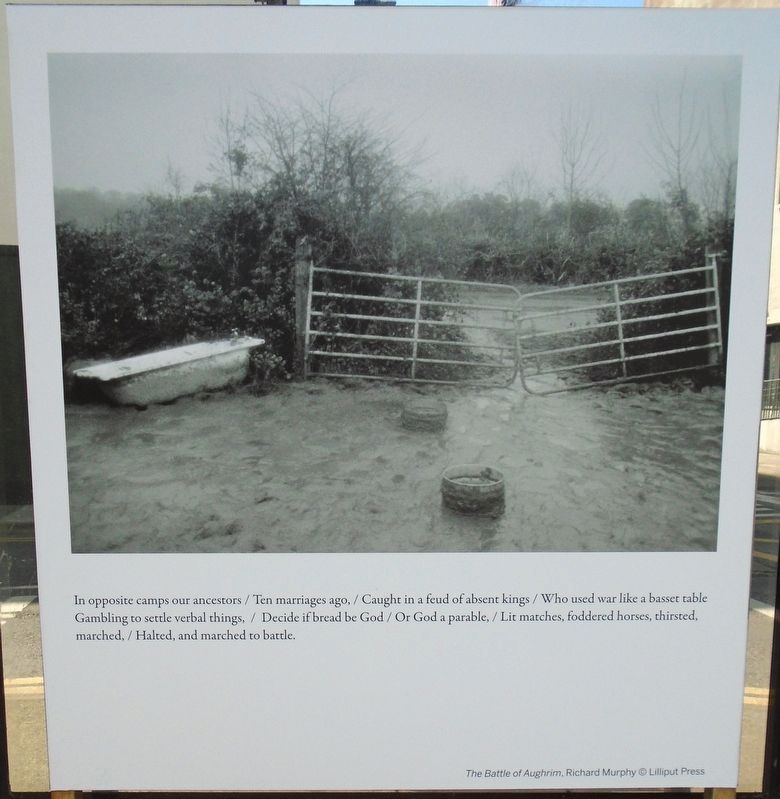
In opposite camps our ancestors / Ten marriages ago, / Caught in a feud of absent kings / Who used war like a basset table Gambling to settle verbal things, / Decide if bread be God / Or God a parable, / Lit matches, foddered horses, thirsted, marched, / Halted, and marched to battle.
————————————
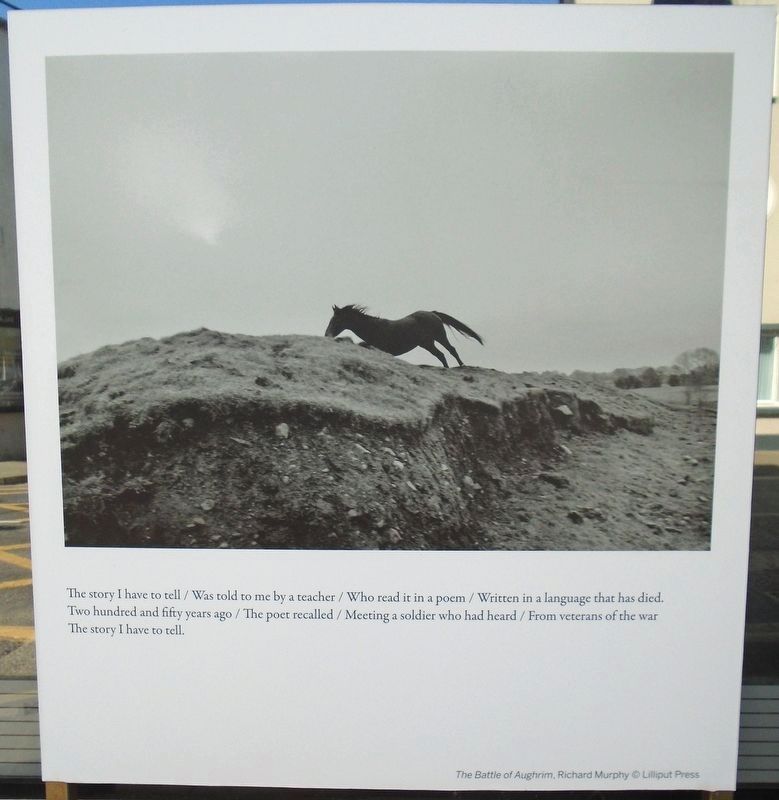
The
Photographed by William Fischer, Jr., April 7, 2025
5. The Battle of Aughrim Marker
story I have to tell / Was told to me by a teacher / Who read it in a poem / Written in a language that has died. Two hundred and fifty years ago / The poet recalled / Meeting a soldier who had heard / From veterans of the war The story I have to tell.
————————————
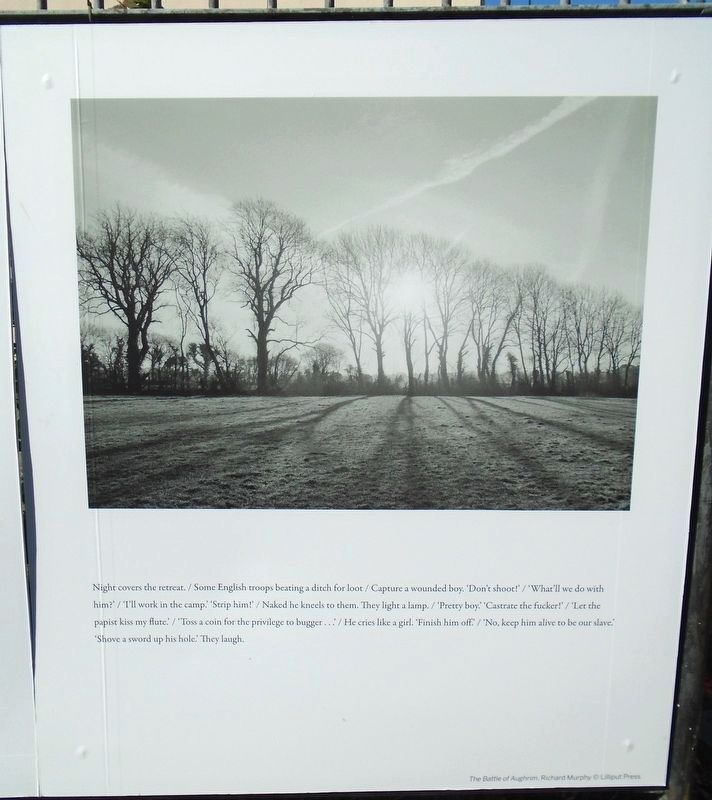
Night covers the retreat. / Some English troops beating a ditch for loot / Capture a wounded boy. 'Don't shoot!' / 'What'll we do with him?' / 'I'll work in the camp.' 'Strip him!' / Naked he kneels to them. They light a lamp. / 'Pretty boy.' 'Castrate the f**ker!' / 'Let the papist kiss my flute.' / 'Toss a coin for the privilege to bugger...' / He cries like a girl. 'Finish him off.' / 'No, keep him alive to be our slave.' 'Shove a sword up his hole.' They laugh.
————————————
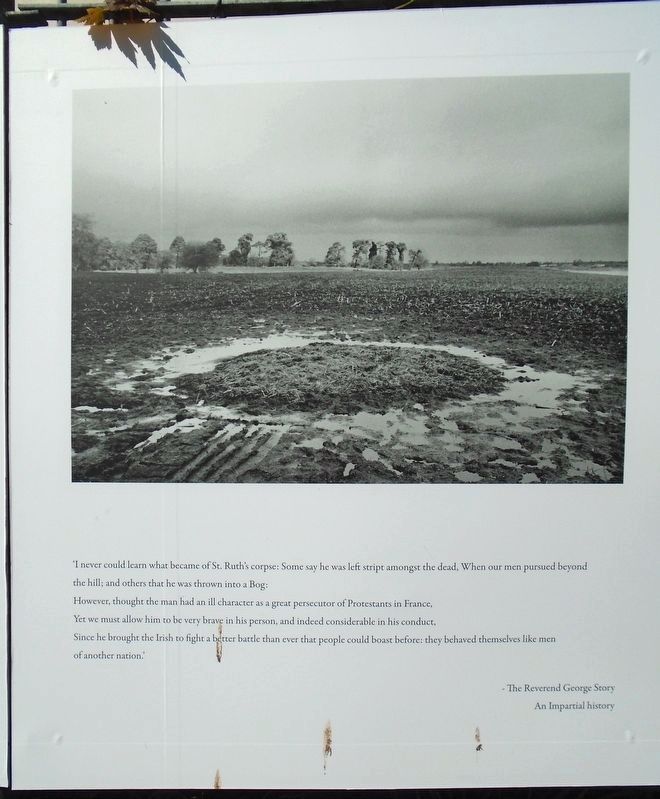
'I never could learn what became of St. Ruth's corpse: Some say he was left stript amongst the dead, When our men pursued beyond the hill; and others that he was thrown into a Bog:
However, thought the man had an ill character as a great persecutor of Protestants in France,
Yet we must allow him to be very brave in his person, and indeed considerable in his conduct,
Since he brought the Irish
Photographed by William Fischer, Jr., April 7, 2025
6. The Battle of Aughrim Marker
to fight a better battle than ever the people could boast before: they behaved themselves like men of another nation.'
—The Reverend George Story
An Impartial History
————————————
A wolfhound sits under a wild ash / Licking the wound of a dead ensign's neck. / When guns cool at night with bugles in fogh / She points over the face.h / All her life a boy's pet. / Prisoners are sabred and the dead are stripped. / Her ear pricks like a crimson leaf on snow, / The horse-carts creak away. / Vermin by moonlight pick / The tongues and sockets of six thousand skulls.
————————————
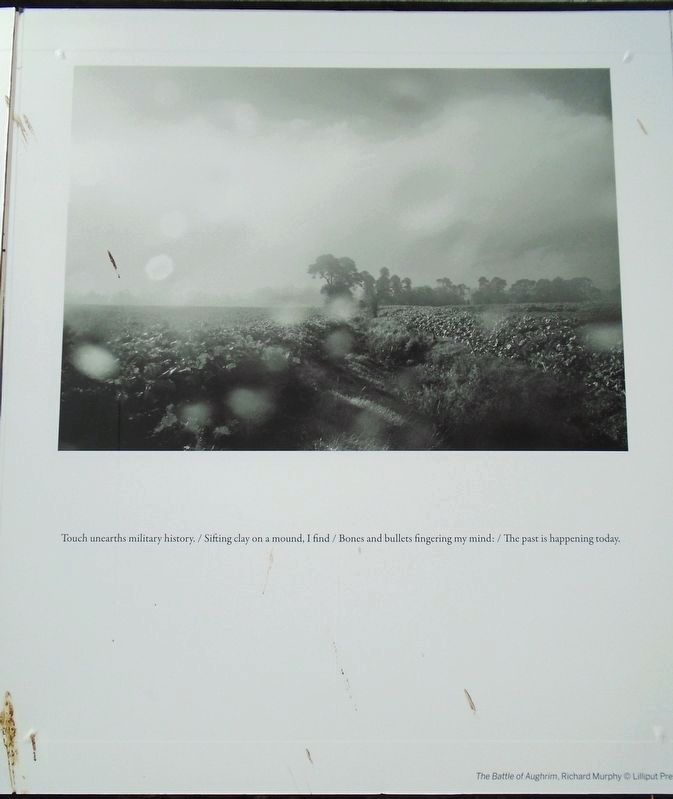
Touch unearths military history. / Sifting clay on a mound, I find / Bones and bullets fingering my mind: / The past is happening today.
————————————
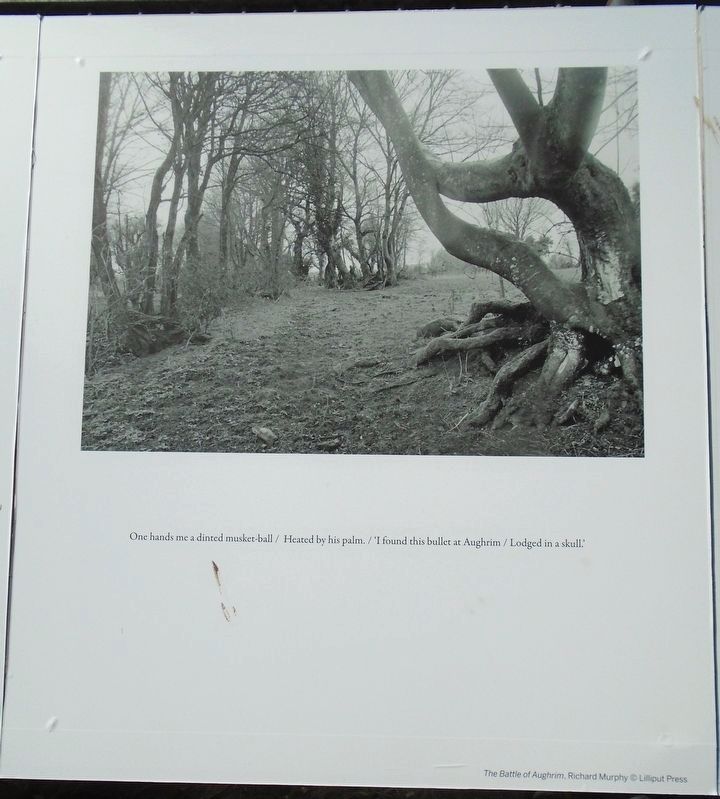
One hands me a dinted musket-ball / Heated by his palm. / 'I found this bullet at Aughrim / Lodged in a skull.'
————————————
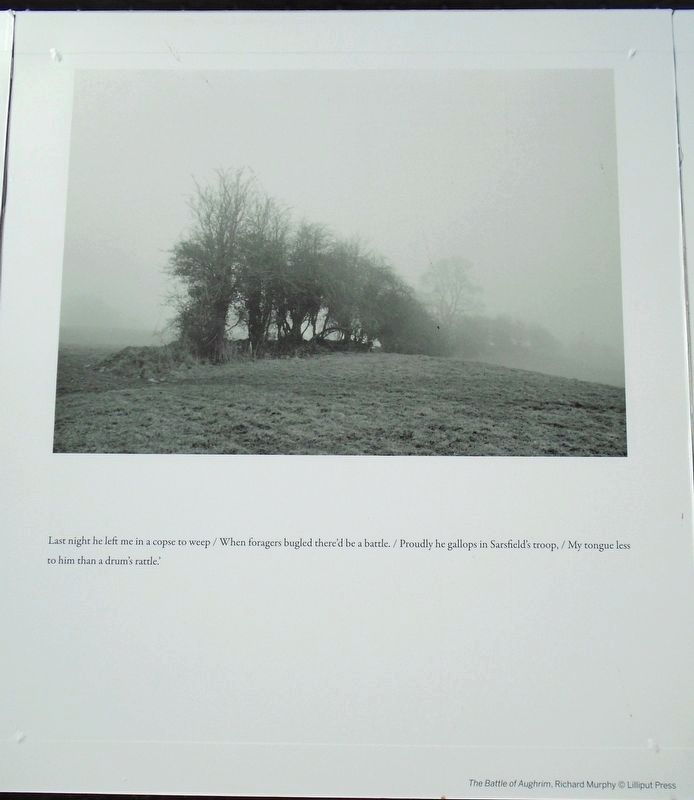
Last night he left me in a copse to weep / When foragers bugled there'd be a battle. / Proudly he gallops in Sarsfield's troop, / My tongue less to him than a drum's rattle.'
————————————
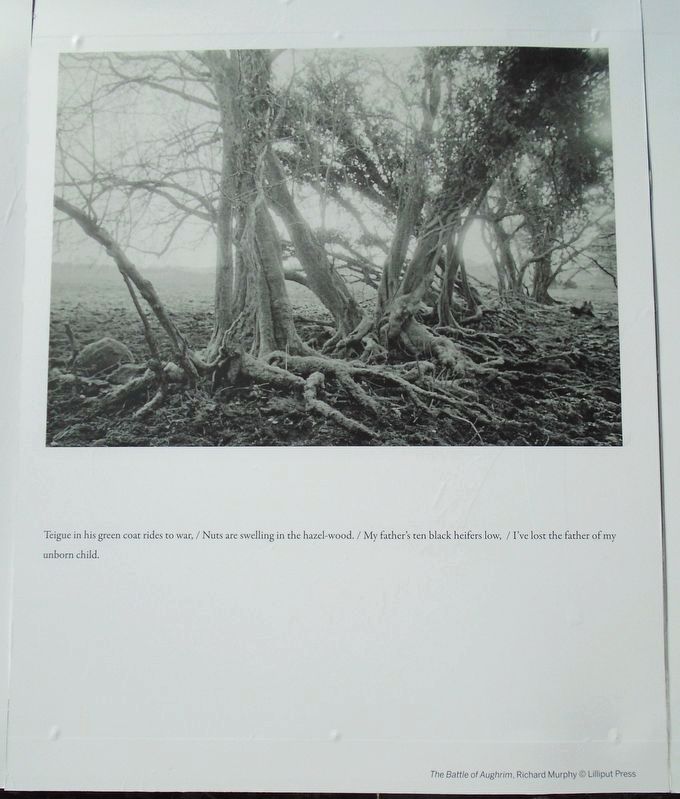
Teigue in his green coat rides to war, / Nuts are swelling in the hazel-wood. / My father's ten black
Photographed by William Fischer, Jr., April 7, 2025
7. The Battle of Aughrim Marker
heifers low, / I've lost the father of my unborn child.
————————————
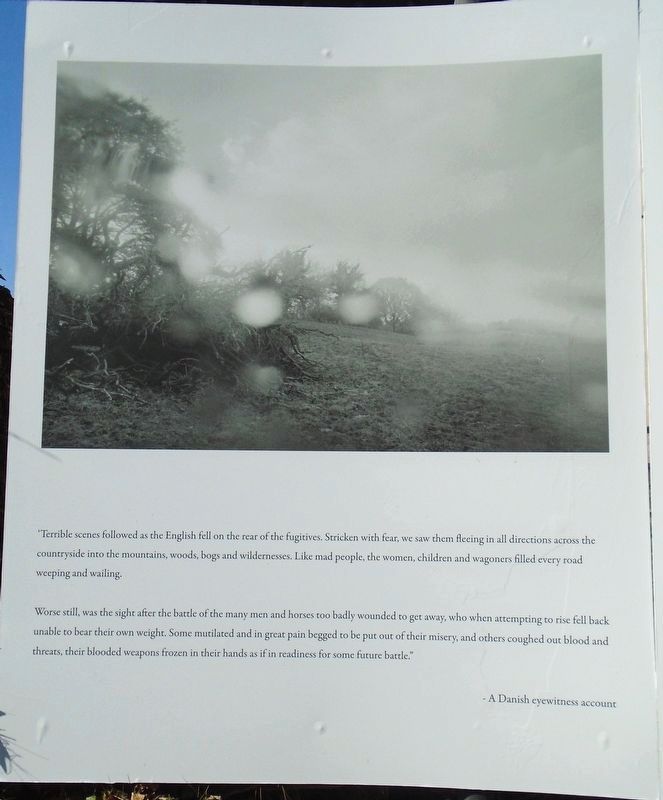
'Terrible scenes followed as the English fell to the rear of the fugitives. Stricken with fear, we saw them fleeing in all directions across the countryside into the mountains, woods, bogs and wilderness. Like made people, the women, children and wagoners filled every road weeping and wailing.
Worse still, was the sight after the battle of the many men and horses too badly wounded to get away, who when attempting to rise fell back unable to bear their own weight. Some mutilated and in great pain begged to be put out of their misery, and others coughed out blood and threats, their blooded weapons froze in their hands as if in readiness for some future battle."
—A Danish eyewitness account
————————————
————————————
Erected by Galway City Museum and Galway County Council.
Location. 53° 16.175′ N, 9° 3.212′ W. Memorial is in Galway, Connacht, in County Galway. It is
Photographed by William Fischer, Jr., April 7, 2025
8. The Battle of Aughrim Marker
in the Latin Quarter. It is at the intersection of Merchants Road Lower and The Long Walk, on the left when traveling north on Merchants Road Lower. Touch for map. Memorial is in this post office area: Galway, Connacht H91 CX5P, Ireland. Touch for directions.
Regionally, it is on the Atlantic Ocean, in the North Atlantic Region, on the Atlantic Arc, in Europe, on the Island of Ireland, on the Celtic Fringe, in the European Union, in Atlantic Europe, on one of the British Isles, in the Western World, and in the Anglosphere.
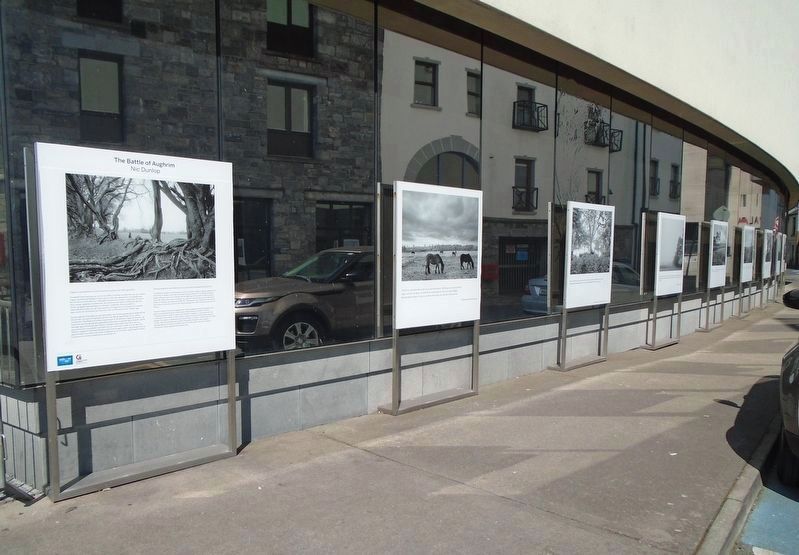
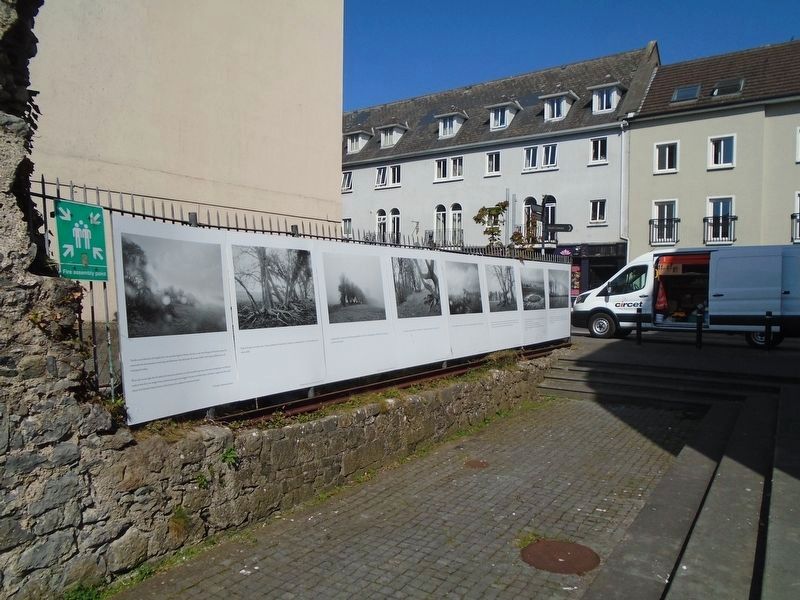
More about this memorial. The outdoor photo essay wraps around the Galway City Museum in a counterclockwise direction.
Photographed by William Fischer, Jr., April 7, 2025
10. The Battle of Aughrim Marker
Photographed by William Fischer, Jr., April 7, 2025
11. The Battle of Aughrim Marker
Photographed by William Fischer, Jr., April 7, 2025
12. The Battle of Aughrim Marker
Photographed by William Fischer, Jr., April 7, 2025
13. The Battle of Aughrim Marker
Photographed by William Fischer, Jr., April 7, 2025
14. The Battle of Aughrim Marker
Photographed by William Fischer, Jr., April 7, 2025
15. The Battle of Aughrim Marker
Photographed by William Fischer, Jr., April 7, 2025
16. The Battle of Aughrim Marker
Same text as photo essay introduction, but with different photo
Photographed by William Fischer, Jr., April 7, 2025
17. The Battle of Aughrim Marker
Photographed by William Fischer, Jr., April 7, 2025
18. The Battle of Aughrim Marker
Photographed by William Fischer, Jr., April 7, 2025
19. The Battle of Aughrim Marker
Photographed by William Fischer, Jr., April 7, 2025
20. The Battle of Aughrim Marker
Photographed by William Fischer, Jr., April 7, 2025
21. The Battle of Aughrim Marker
Photographed by William Fischer, Jr., April 7, 2025
22. The Battle of Aughrim Marker
Photographed by William Fischer, Jr., April 7, 2025
23. The Battle of Aughrim Marker
Photographed by William Fischer, Jr., April 7, 2025
24. The Battle of Aughrim Marker
Photographed by William Fischer, Jr., April 7, 2025
25. The Battle of Aughrim Photo Essay Markers (end)
Credits. This page was last revised on December 3, 2025. It was originally submitted on April 24, 2025, by William Fischer, Jr. of Reynoldsburg, Ohio. This page has been viewed 276 times since then and 44 times this year. Photos:1, 2, 3, 4, 5, 6, 7, 8, 9, 10, 11, 12, 13, 14, 15, 16, 17, 18, 19, 20, 21, 22, 23, 24, 25. submitted on April 24, 2025, by William Fischer, Jr. of Reynoldsburg, Ohio.