
Kew Gardens Hills in Queens in Queens County, New York — The American Northeast (Mid-Atlantic)
Queens Valley Playground
.786 acre

Queens Valley is a former name of Kew Gardens Hills, a neighborhood originally known as Head of the Vleigh. The latter name is derived from Vleigh Road, now Vleigh Place, which connected the town of Flushing to Brooklyn during colonial times. The road allowed travelers to circumvent Flushing Meadow, then an impassable swamp.
During the 18th century, much of Head of the Vleigh was part of a farm owned by William Furman, who called the area Willow Glen due to the weeping willows found on his property. In 1820, Furman sold his land to Timothy Jackson, who explained the farm to accommodate his horses. Despite transportation improvements that led to the development of the surrounding communities of Hopedale (Kew Gardens), Whitepot (Forest Hills), and Richmond Hill, the area, which in the 19th century became known as Queens Valley, remained farmland until the end of the 1800s.
In the early 20th century, however, developers sought to draw wealthy New Yorkers to the area by establishing country clubs. The Queens Valley country club opened in 1922, followed by the Arrow Brook and Pomonok clubs. The area soon became an attractive
this page online
With the arrival of the Independent (IND) subway in 1936, which promised a 20-minute ride into Manhattan, Queens Valley became even more attractive to developers. Entrepreneur Abraham Wolosoff purchased land in the area hoping to use the area's hills and rural setting to attract Settlers. He gave the neighborhood its current name, Kew Gardens Hills, after enjoying a stay near the Royal Botanic Gardens at Kew, west of London.
By the time the World's Fair opened in Flushing Meadows-Corona Park in 1939, more than 1,200 homes had been erected in Kew Gardens Hills. Many residential, institutional, and commercial buildigns were designed in the Colonial Revival style popular in the mid-20th century. In the 1960's, Kew Gardens Hills saw an influx of Jewish residents, who today continue to shape the neighborhood, as evidenced by the many Israeli-owned businesses and kosher food stores among the area's apartments, co-ops, and single-family homes.
The City acquired the land for Queens Valley Playground on September
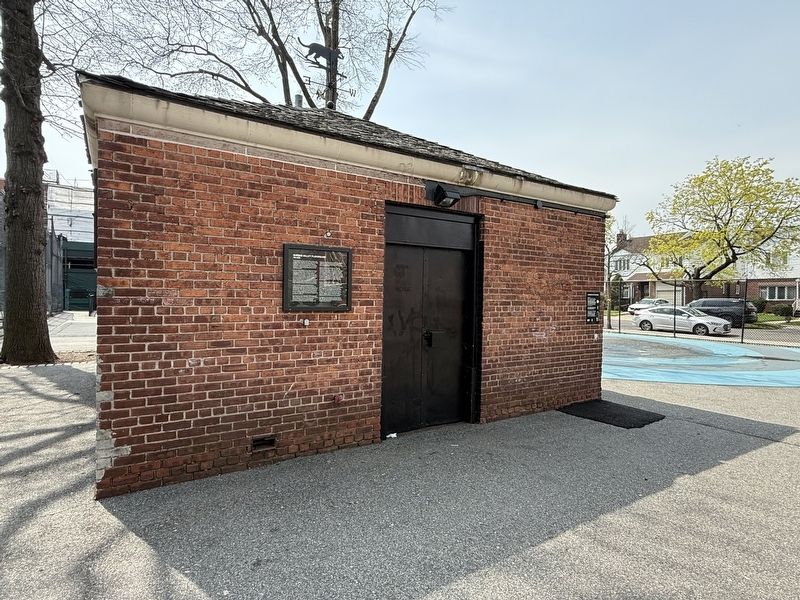
The playground was renovated in 1997 and again in 2005. New age-appropriate play equipment, swings and sprinklers were installed making this playground a family-friendly destination.
Erected by NYC Parks.
Topics and series. This historical marker is listed in these topic lists: Parks & Recreational Areas • Railroads & Streetcars • Religion & Religious Structures • Settlements & Settlers. In addition, it is included in the NYC Parks series list. A significant historical date for this entry is January 12, 1949.
Location. 40° 43.313′ N, 73° 49.435′ W. Marker is in Queens, New York, in Queens County. It is in


Regionally, this marker is in New York City and on Long Island. It is also in the American Northeast, in the Mid-Atlantic, and on the Eastern Seaboard. Globally, it is in the North Atlantic Region, North America, the Western Hemisphere, the Western World, and the Anglosphere. Historically, it finds itself in what was once New Netherland and also one of the original Thirteen Colonies.
Other nearby markers. At least 8 other markers are within 2 miles of this marker, measured as the crow flies: Freedom Square (approx. 0.2 miles away); Queens Borough Hall Persian Gulf War Memorial (approx. 0.6 miles away); Willow Lake Playground (approx. 0.7 miles away); Maple Grove Cemetery (approx. 0.8 miles away); Veterans Memorial (approx. one mile away); Forest Hills Beginnings (approx. one mile away); Great War Memorial (approx. 1.1 miles away); Emerald Playground (approx. 1.1 miles away). Touch for a list and map of all markers in Queens.
Credits. This page was last revised on April 25, 2025. It was originally submitted on April 25, 2025, by Devry Becker Jones of Washington, District of Columbia. This page has been viewed 121 times since then and 21 times this year. Photos: 1, 2, 3. submitted on April 25, 2025, by Devry Becker Jones of Washington, District of Columbia.
