
Seminary Hill in Alexandria, Virginia — The American South (Mid-Atlantic)
Entrance Gate to Fort Ward
Fort Ward Museum & Historic Site
| — | City of Alexandria, Virginia | — |

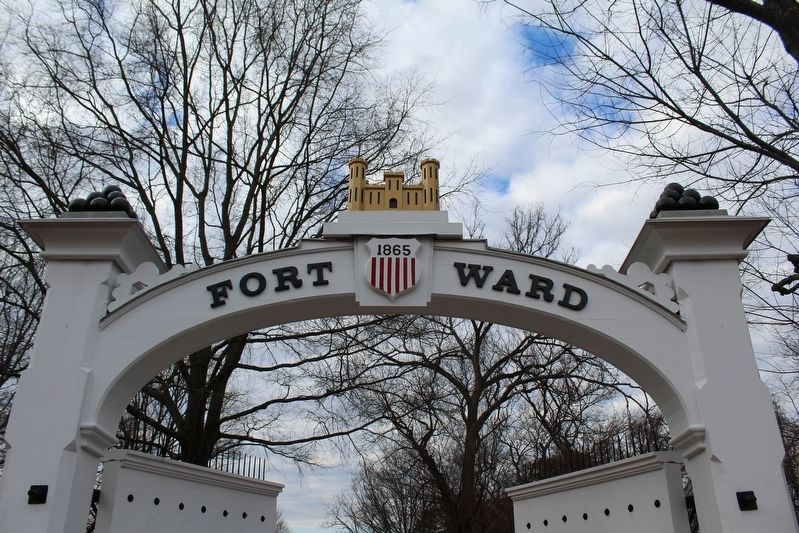
The Fort Ward entrance gate, completed in May 1865, provided the only access to the interior of the fort. The gate's decorative details include stands of cannonballs and the castle insignia of the U.S. Army Corps of Engineers which designed and supervised the construction of the Defenses of Washington. The current gate is a reconstruction, based on the original Corps of Engineers drawing.
A ditch, or dry moat, surrounded the entire fort. The fort's earthen walls reached a height of approximately 20 feet from the bottom of the ditch to the Arch of the gate. The walls were 12-14 feet thick and could absorb the impact of artillery fire.
[Sidebar:]
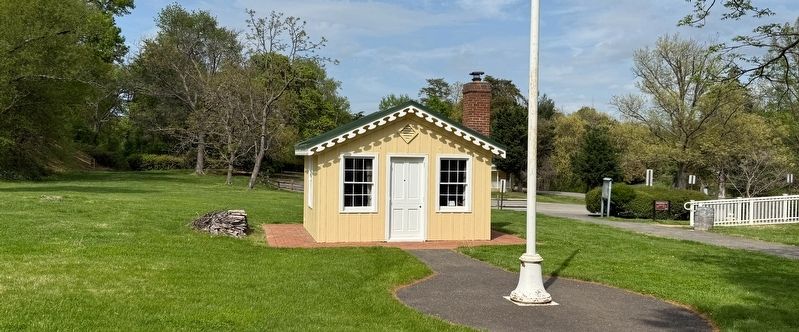
Officers' Hut
The officers' huts, soldiers' barracks and mess hall were located behind the fort, near the present-day Museum. These structures were built in a board-and-batten style, with decorative trim, typical of the period.
Throughout the war, Fort Ward was manned by companies of the First Connecticut Heavy Artillery, as well as units from New York, Pennsylvania, and Ohio. The fort could accommodate a Garrison of approximately 1,200 soldiers, although records indicate that only 300-400 men were stationed here at one time.
Erected by City
this page online
Topics and series. This historical marker is listed in these topic lists: Forts and Castles • War, US Civil. In addition, it is included in the Defenses of Washington, and the Virginia, The City of Alexandria series lists. A significant historical month for this entry is May 1865.
Location. 38° 49.756′ N, 77° 6.134′ W. Marker is in Alexandria, Virginia. It is in Seminary Hill. It is on West Braddock Road east of North Howard Street, on the right when traveling west. Touch for map. Marker is at or near this postal address: 4301 W Braddock Rd, Alexandria VA 22304, United States of America. Touch for directions.

Regionally, this marker is in the Washington Metropolitan Area and in Northern Virginia. It is also in the American South, specifically in the Upper South, in the Mid-Atlantic, and on the Eastern Seaboard. Globally, it is in the North Atlantic Region, North America, the Western Hemisphere, the Western World, and the Anglosphere. Historically, it finds itself in what was once the territory of the Mississippian Culture, one of the original Thirteen Colonies, one of the Confederate States of

Other nearby markers. At least 8 other markers are within walking distance of this marker: Welcome to Historic Fort Ward Park (within shouting distance of this marker); a different marker also named Fort Ward (within shouting distance of this marker); African Americans and the Civil War (within shouting distance of this marker); "The Fort" and "Seminary" Community (within shouting distance of this marker); Bombproof (within shouting distance of this marker); From Fort to Community (about 300 feet away, measured in a direct line); Southwest Bastion (about 300 feet away); Jackson Cemetery (about 300 feet away). Touch for a list and map of all markers in Alexandria.
Other markers no longer nearby. Entrance Gate to Fort Ward / Officers' Hut (was a few steps from this marker but has been replaced with another marker now near it); Fort Ward (was within shouting distance of this marker but has been permanently removed); a different marker also named Bombproof (was about 300 feet away but has been replaced with another marker now near it); a different marker also named Fort Ward (was about 300
Photographed by Evan Dwyer, January 17, 2026
3. Entrance Gate
Details described on the marker, intricately integrated into the reproduction gate.
Related marker. Click here for another marker that is related to this marker. This marker has replaced the linked marker which has difference in text and no subtitle.
Photographed by Devry Becker Jones (CC0), April 21, 2025
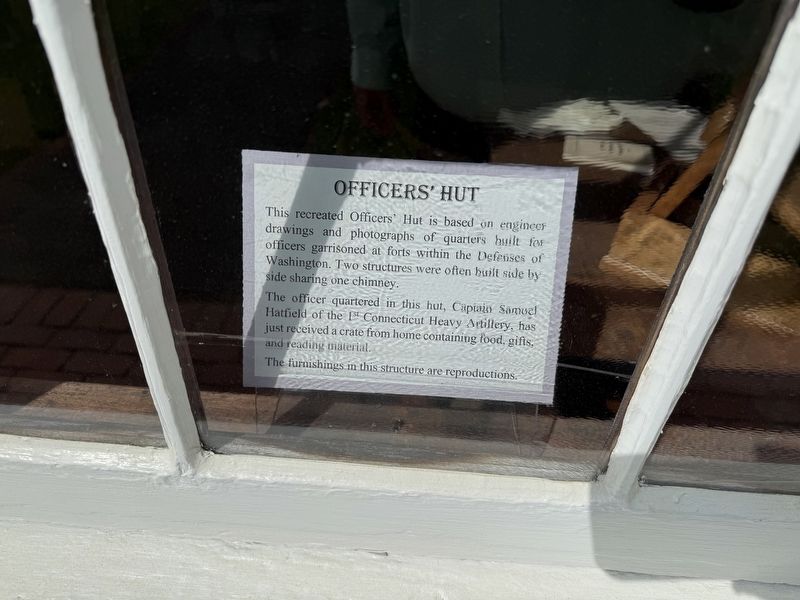
5. Signage in the window to the Officers' Hut
This recreated Officers' Hut is based on engineer drawings and photographs of quarters built for officers garrisoned at forts within the Defenses of Washington. Two structures were often built side by side sharing one chimney.
The officer quartered in this hut, Captain Samuel Hatfield of the 1st Connecticut Heavy Artillery, has just received a crate from home containing food, gifts, and reading material.
The furnishings in this structure are reproductions.
The officer quartered in this hut, Captain Samuel Hatfield of the 1st Connecticut Heavy Artillery, has just received a crate from home containing food, gifts, and reading material.
The furnishings in this structure are reproductions.
Credits. This page was last revised on April 2, 2026. It was originally submitted on April 26, 2025, by Devry Becker Jones of Washington, District of Columbia. This page has been viewed 131 times since then and 20 times this year. Photos: 1, 2. submitted on April 26, 2025, by Devry Becker Jones of Washington, District of Columbia. 3. submitted on March 30, 2026, by Evan Dwyer of Richmond, Virginia. 4, 5. submitted on April 26, 2025, by Devry Becker Jones of Washington, District of Columbia.
