Heptonstall in West Yorkshire, England, United Kingdom — Northwestern Europe (the British Isles)
St Thomas à Becket Church & Churchyard

Photographed by Ray Gurganus, April 14, 2025
1. St Thomas a Becket Church & Churchyard Marker
Here in Heptonstall's ancient churchyard you can see how a community has ball and rebuilt its parish church and commemorated its dead, over a period of over seven hundred years.
It is most unusual to find two churches in a single churchyard, and few other examples existing England. The original church, dedicated to the martyred archbishop St Thomas à Becket remained in use until the mid 19th century. Following storm damage in 1847, the decision was taken to raise money to build a replacement. The new church, dedicated to St Thomas the Apostle was completed in 1854 at a cost of £6,666.
Instead of being demolished, the earlier building was left to become a ruin. Originally a chapel in the great parish of Halifax, it has a complex history. The oldest parts, built in the mid 1200 in local gritstone, show it had a nave, chancel and a short tower. Over the following centuries it was remodelled in stages, and would often have been a busy construction site. The tower was heightened and the nave and chancel were widened by the addition of side aisles, linked to the central areas by a series of arched openings known as arcades.
this page online
During the medieval period, when England was a Roman Catholic country, the church would have been highly decorated, with ornate carvings and colourful wall paintings showing stories from the bible and the lives of the saints. As well as the main altar in the chancel, there were side altars in the aisles and chapel where priests offered special Mass and prayers for the souls of those who had died. Outside, on the east gable of the south nave, you can see the original Sanctus Bell Cote where a bell was rung during Mass.
This all changed in the 16th century, in what is called The Reformation. England broke away from the Catholic church and became a Protestant country with its own Anglican church - the Church of England.
Changes in belief and worship transformed the appearance of churches. St Thomas's became much plainer. Paintings, furnishings and
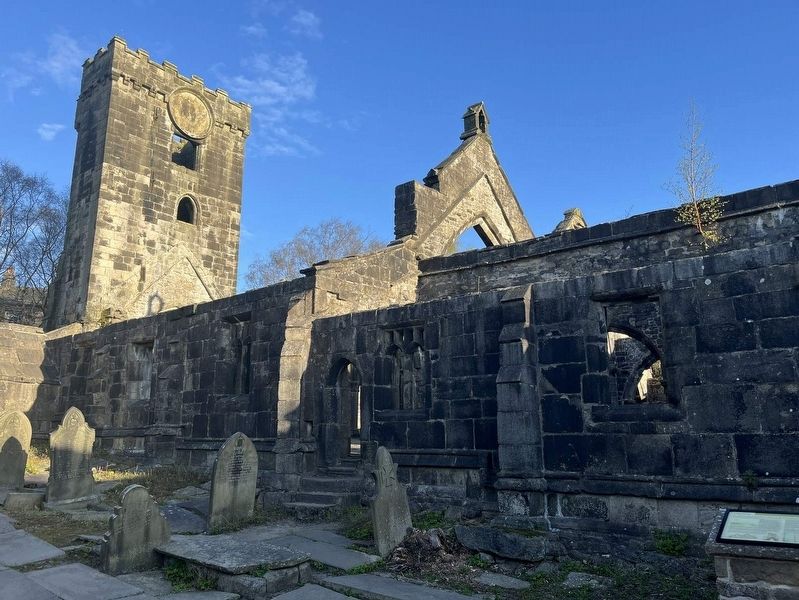
Photographed by Ray Gurganus, April 14, 2025
2. St Thomas à Becket Church ruins
When the medieval Catholic church was focused on the altars where services were held in Latin, the new Protestant services were in English, and the focus was on sermons and bible readings from the pulpit in the nave. By the late 1700s the church had been turned into a great preaching house, dominated by a triple-decker pulpit in the nave for the minister, the clerk and the reader. There was seating for 815 people on the ground floor and a further 300 in new upper galleries. The church bells and clock summoned people to services. You can still see traces of the painted clock face on the tower. (The clock itself, made in Sowerby Bridge 1810, is now in the new church tower.)
The new church was designed by Bradford architects Mallinson & Healey in the Gothic Revival style late medieval designs. Meanwhile, the original medieval church became steadily more ruinous on the mid 20th century, when it became a protected ancient monument.
The Graveyard
Just as the church buildings trace the changes in styles of architecture
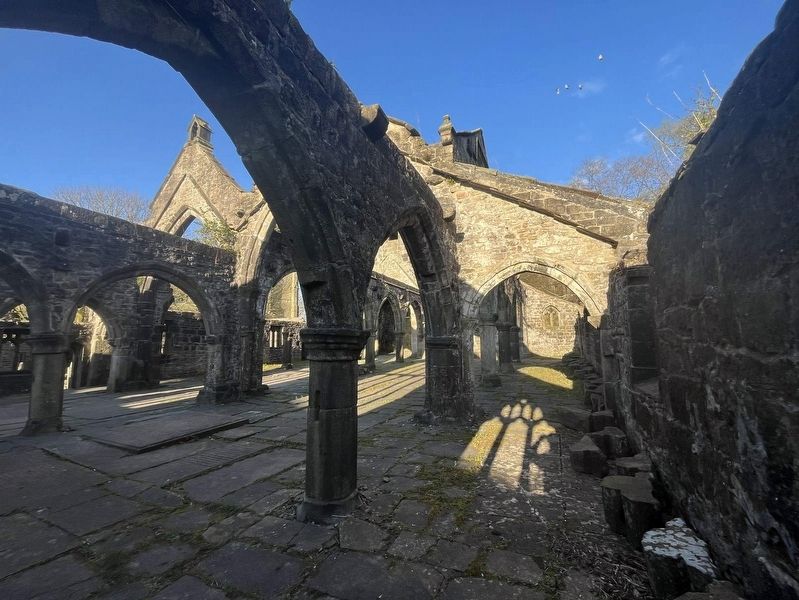
Photographed by Ray Gurganus, April 14, 2025
3. St Thomas à Becket Church ruins
The average parish churchyard contains around 15,000 to 30,000 burials. By 1911 this one had become very crowded, and a new extension was opened across Back Lane, beyond the new church.
Among the noteworthy gravestones in the old churchyard is that of David Hartley (known locally as "King" David), leader of the notorious Cragg Vale Coiners. These counterfeiters were so successful they almost succeeded in destabilising the country's currency. Hartley was caught and hanged in York in 1770, and his body suspended in chains at the top of Beacon Hill in Halifax. His gravestone stands 20 metres west and 8 metres south of here.
In the cemetery across Back Lane, is the grave of the American poet Sylvia Plath, first

Photographed by Ray Gurganus, April 14, 2025
4. St Thomas the Apostle Church
The old church and its burial ground are important historical survivals that provide valuable insights into the lives and beliefs of our forebears.
During 2007-08 major renovation and repairs to the church and churchyard were undertaken by Calderdale Council with additional funding provided by English Heritage.
Erected by English Heritage.
Topics. This historical marker is listed in these topic lists: Cemeteries & Burial Sites • Religion & Religious Structures. A significant historical year for this entry is 1847.
Location. 53° 44.927′ N, 2° 1.284′ W. Marker is in Heptonstall, England, in West Yorkshire. It can be reached from Garden Villas. Touch for map. Marker is at or near this postal address: 1 Garden Villas, Heptonstall, England HX7, United Kingdom. Touch for directions.

Regionally, this marker is in England’s Yorkshire & The Humber. Globally, it is on the Atlantic Ocean, in the North Atlantic Region, in Europe, in Atlantic Europe, on one of the British Isles, in the Western World, and in the Anglosphere. Historically, it finds itself in what was once the Roman Empire.
Other nearby markers. At least 2 other markers are within 3 kilometers of this marker, measured as the crow flies: Hebden Bridge War Memorial (approx. 0.6 kilometers away); Welcome to Hebden Bridge (approx. 2.3 kilometers away).
Credits. This page was last revised on May 19, 2025. It was originally submitted on April 27, 2025, by Ray Gurganus of Washington, District of Columbia. This page has been viewed 425 times since then and 75 times this year. Photos: 1, 2, 3, 4. submitted on April 27, 2025, by Ray Gurganus of Washington, District of Columbia. • Devry Becker Jones was the editor who published this page.
