Charing in Kent, England, United Kingdom — Northwestern Europe (the British Isles)
Ronald N. Stuart Victoria Cross
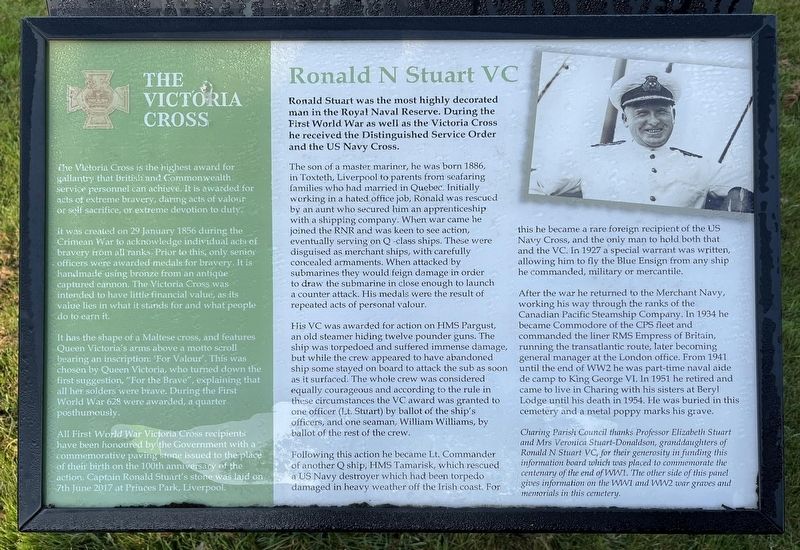
Photographed by Ray Gurganus, March 27, 2025
1. Ronald N. Stuart Victoria Cross Marker
The Victoria Cross
The Victoria Cross is the highest award for gallantry that British and Commonwealth service personnel can achieve. It is awarded for acts of extreme bravery, daring acts of valour or self sacrifice, or extreme devotion to duty.
It was created on 29 January 1856 during the Crimean War to acknowledge individual acts of bravery from all ranks. Prior to this, only senior officers were awarded medals for bravery. It is handmade using bronze from an antique captured cannon. The Victoria Cross was intended to have little financial value, as its value lies in what it stands for and what people do to earn it.
It has the shape of a Maltese cross, and features Queen Victoria's arms above a motto scroll bearing an inscription: 'For Valour'. This was chosen by Queen Victoria, who turned down the first suggestion, "For the Brave", explaining that all her soldiers were brave. During the First World War 628 were awarded, a quarter, posthumously.
All First World War Victoria Cross recipients have been honoured by the Government with a commemorative paving stone issued to the place of their birth on the 100th
this page online
Ronald N Stuart VC
Ronald Stuart was the most highly decorated man in the Royal Naval Reserve. During the First World War as well as the Victoria Cross he received the Distinguished Service Order and the US Navy Cross.
The son of a master mariner, he was born 1886, in Toxteth, Liverpool to parents from seafaring families who had married in Quebec. Initially working in a hated office job, Ronald was rescued by an aunt who secured him an apprenticeship with a shipping company. When war came he joined the RNR and was keen to see action, eventually serving on Q-class ships. These were disguised as merchant ships, with carefully concealed armaments. When attacked by submarines they would feign damage in order to draw the submarine in close enough to launch a counter attack. His medals were the result of repeated acts of personal valour.
His VC was awarded for action on HMS Pargust, an old steamer hiding twelve pounder guns. The ship was torpedoed and suffered immense damage, but while the crew appeared to have abandoned ship some stayed on board to attack the sub as soon as it surfaced. The whole crew was considered equally courageous and according to the rule in these circumstances the VC award was granted to one officer (Lt. Stuart) by ballot of the ship's officers, and one seaman, William Williams, by ballot of the rest of the crew.
Following this action he became Lt. Commander of another Q ship, HMS Tamarisk, which rescued a US Navy destroyer which had been torpedo damaged in heavy weather off the Irish coast. For this he became a rare foreign recipient of the US Navy Cross, and the only man to hold both that and the VC. In 1927 a special warrant was written, allowing him to fly the Blue Ensign from any ship he commanded, military or mercantile.
After the war he returned to the Merchant Navy, working his way through the ranks of the Canadian Pacific Steamship Company. In 1934 he became Commodore of the CPS fleet and commanded the liner RMS Empress of Britain, running the transatlantic route, later becoming general manager at the London office. From 1941 until the end of WW2 he was part-time naval aide de camp to King George VI. In 1951 he retired and came to live in Charing with his sisters at Beryl Lodge until his death in 1954. He was buried in this cemetery and a metal poppy marks his grave.
Charing Parish Council thanks Professor Elizabeth Stuart and Mrs Veronica Stuart-Donaldson, granddaughters of Ronald N Stuart VC, for their generosity in funding this information board which was placed to commemorate the centenary of the end of WWI. The other side of this panel gives information on the WWI and WW2 war graves and memorials in this cemetery.
Topics and series. This historical marker is listed in these topic lists: War, World I • Waterways & Vessels. In addition, it is included in the Distinguished Service Cross/Navy Cross/Air Force Cross Recipients, and the Victoria Cross and George Cross Recipients series lists.
Location. 51° 12.71′ N, 0° 47.511′ E. Marker is in Charing, England, in Kent. It is on Haffenden Meadow. Near the middle of the cemetery. Touch for map. Marker is at or near this postal address: 1 Haffenden Mdw, Charing, England TN27 0JR, United Kingdom. Touch for directions.

Regionally, this marker is in the Greater South East. Globally, it is on the Atlantic Ocean, in the North Atlantic Region, in Europe, in Atlantic Europe, on one of the British Isles, in the Western World, and in the Anglosphere. Historically, it finds itself in what was once the Roman Empire.
Other nearby markers. At least 8 other markers are within 10 kilometers of this marker, measured as the crow flies: To mark the Centenary of the WW1 Armistice (here, next to this marker); Historic Charing (approx. 0.3 kilometers away); Corporal Frederick George Coppins VC (approx. 0.3 kilometers away); a different marker also named Historic Charing (approx. 0.3 kilometers away); A medieval building (approx. 0.3 kilometers away); In the Parish of Calehill with Westwell (approx. 0.3 kilometers away); Simone Weil (approx. 8.6 kilometers away); British Mark IV Female Tank, No 245 (approx. 8.8 kilometers away). Touch for a list and map of all markers in Charing.
Credits. This page was last revised on March 18, 2026. It was originally submitted on April 30, 2025, by Ray Gurganus of Washington, District of Columbia. This page has been viewed 128 times since then and 29 times this year. Photo 1. submitted on April 30, 2025, by Ray Gurganus of Washington, District of Columbia. • Andrew Ruppenstein was the editor who published this page.
Editor’s want-list for this marker. Photo of the marker within its surroundings and a photo of his gravestone. • Can you help?
