
Montmartre in Paris in Département de Paris, Île-de-France, France — Western Europe
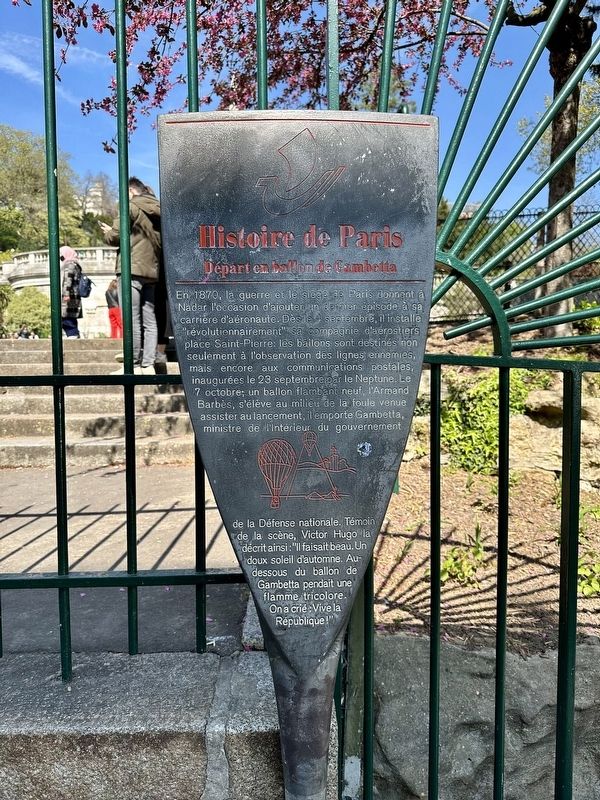
Départ de Gambetta en ballon
⎯⎯⎯
Departure of Gambetta by Balloon
Photographed by Andrew Ruppenstein, April 10, 2025
1. Départ de Gambetta en ballon / Departure of Gambetta by Balloon Marker

En 1870, la guerre et le siège de Paris donnent à Nadar l'occasion d'ajouter un demier épisode à sa carrière d'aéronaute. Dès le 4 septembre, il installe "révolutionnairement" sa compagnie d'aérostiers place Saint-Pierre: les bailons sont destinés non seulement à l'observation des lignes ennemies, mais encore aux communications postales, inaugurées le 23 septembre par le Neptune. Le 7 octobre; un ballon flambant neuf, l'Armand Barbès, s'élève au milieu de la foule venue assister au lancement, il emporte Gambetta, ministre de l'Intérieur du gouvernement de la Défense nationale. Témoin de la scène, Victor Hugo la décrit ainsi : "Il faisait beau. Un doux soleil d'automne. Audessous du ballon de Gambetta pendait une flamme tricolore. On a crié: Vive la République!"
In 1870, the war and the Siege of Paris gave Nadar the opportunity to add a final episode to his career as an aeronaut. On September 4, he "revolutionarily" established his balloon company in Place Saint-Pierre: the balloons were intended not only for observing enemy lines,
this page online
Topics and series. This historical marker is listed in these topic lists: Air & Space • Wars, Non-US. In addition, it is included in the Histoire de Paris series list. A significant historical date for this entry is October 7, 1870.
Location. 48° 53.068′ N, 2° 20.618′ E. Marker is in Paris, Île-de-France, in Département de Paris. It is in Montmartre. It is at the intersection of Place Saint-Pierre and Rue de Steinkerque, on the right when traveling west on Place Saint-Pierre. Touch for map. Marker is in this post office area: Paris, Île-de-France 75018, France. Touch for directions.

Regionally, it is in the North Atlantic Region, Europe, the European Union, Atlantic Europe,

Photographed by Andrew Ruppenstein, April 10, 2025
2. Departure of Gambetta by Balloon Marker - wide view
Other nearby markers. At least 8 other markers are within walking distance of this marker: Square Louise-Michel (within shouting distance of this marker); Jean Roger Debrais (about 90 meters away, measured in a direct line); Le dispensaire de Clemenceau / Clemenceau’s Dispensary (about 180 meters away); Georges Clemenceau (about 180 meters away); La basilique du Sacré-Cœur (about 180 meters away); École de Orsel Deported Jewish Students Memorial (about 210 meters away); Le parc d’artillerie de Montmartre / The Montmartre Artillery “Park” (approx. 0.2 kilometers away); La Grande Crue de 1910 / The Great Flood of 1910 (approx. 0.3 kilometers away). Touch for a list and map of all markers in Paris.
Also see . . . Léon Gambetta (Wikipedia). On Gambetta’s departure during the siege of Paris:
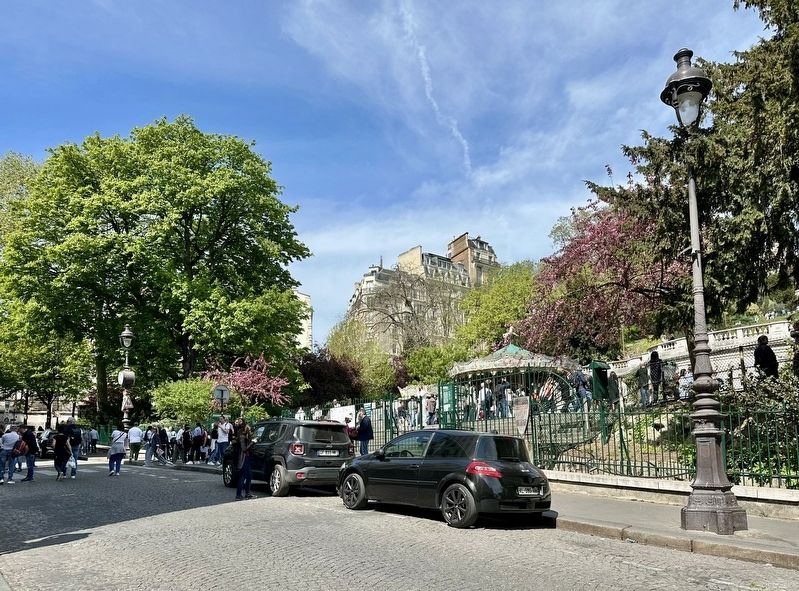
Gambetta was one of the first members of the new Government of National Defense, becoming Minister of the Interior. He advised his colleagues to leave(Submitted on May 1, 2025.)Paris and run the government from some provincial city.Photographed by Andrew Ruppenstein, April 12, 20253. Departure of Gambetta by Balloon Marker - wider viewThe marker is visible here above the rear of the rightmost car.
This advice was rejected because of fear of another revolution in Paris, and a delegation to organize resistance in the provinces was dispatched to Tours, but when this was seen to be ineffective, Gambetta himself left Paris 7 October with Eugène Spuller in a coal gas-filled balloon—the "Armand-Barbès"—and upon arriving at Tours took control as minister of the interior and of war. Aided by Freycinet, a young officer of engineers, as his assistant secretary of war, he quickly organized an army, which might have relieved Paris if Metz had held out, but Bazaine's surrender brought the army of the Prussian prince Friederich Karl back into the field, and success was impossible. After the French defeat near Orléans early in December the seat of government was transferred to Bordeaux.
Additional keywords. panneau

Photographed by G.C.A. Paris, October 7, 1870
4. Departure of Gambetta by the balloon “Armand Barbes” on October 7, 1870
Credits. This page was last revised on May 1, 2025. It was originally submitted on May 1, 2025, by Andrew Ruppenstein of Lamorinda, California. This page has been viewed 165 times since then and 52 times this year. Photos: 1, 2, 3, 4. submitted on May 1, 2025, by Andrew Ruppenstein of Lamorinda, California.
