Saint Victor in Paris in Département de Paris, Île-de-France, France — Western Europe
Les premieres paratonnerres
⎯⎯⎯
The First Lightning Rods
| — | Histoire de Paris | — |
Photographed by Andrew Ruppenstein, April 8, 2025
1. Les premieres paratonnerres / The First Lightning Rods Marker

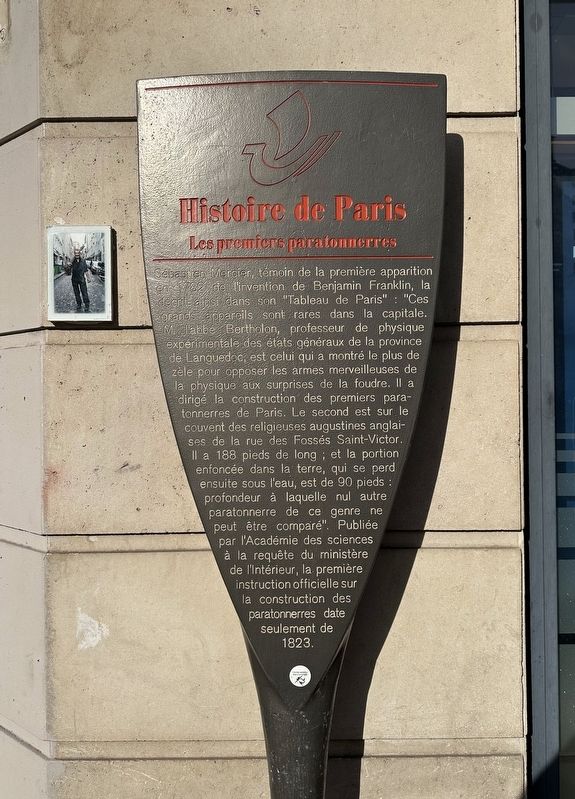
Sébastien Mercier, témoin de la première apparition en 1782 de l'invention de Benjamin Franklin, la décrit ainsi dans son "Tableau de Paris": "Ces grands appareils sont rares dans la capitale. M. l'abbé Bertholon, professeur de physique expérimentale des états généraux de la province de Languedoc, est celui qui a montré le plus de zèle pour opposer les armes merveilleuses de la physique aux surprises de la foudre. Il a dirigé la construction des premiers paratonnerres de Paris. Le second est sur le couvent des religieuses augustines anglaises de la rue des Fossés Saint-Victor. Il a 188 pieds de long; et la portion enfoncée dans la terre, qui se perd ensuite sous l'eau, est de 90 pieds: profondeur à laquelle nul autre paratonnerre de ce genre ne peut être comparé". Publiée par l'Académie des sciences à la requête du ministère de l'Intérieur, la première instruction officielle sur la construction des paratonnerres date seulement de 1823.
The First Lightning Rods
Sébastien Mercier, witness to the first appearance of Benjamin Franklin's invention in 1782, describes it thus in his "Tableau de Paris": "These large devices are rare in the capital. Abbé Bertholon, professor
this page online
Topics and series. This historical marker is listed in this topic list: Science & Medicine. In addition, it is included in the Histoire de Paris series list. A significant historical date for this entry is May 19, 1752.
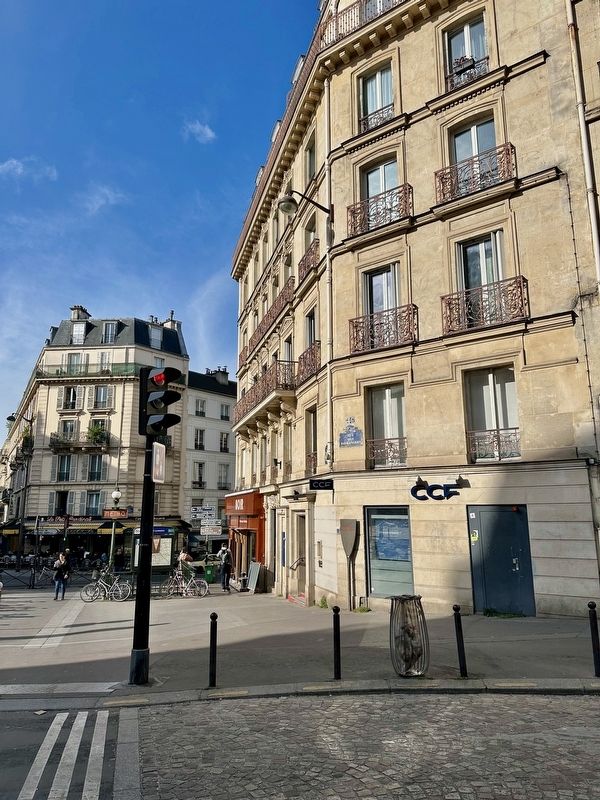
Location. 48° 50.79′ N, 2° 21.115′ E. Marker is in Paris, Île-de-France, in Département de Paris. It is in Saint Victor. It is at the intersection of Rue des Boulangers and Rue Monge on Rue des Boulangers. Touch for map. Marker is at or near this postal address: 46 Rue des Boulangers, Paris, Île-de-France 75005, France. Touch for directions.

Regionally,
Photographed by Andrew Ruppenstein, April 8, 2025
2. Les premieres paratonnerres / The First Lightning Rods Marker - wide view
Other nearby markers. At least 8 other markers are within walking distance of this marker: André-Marie Ampère (a few steps from this marker); Ampère découvre l’électrodynamique / Ampère Discovers Electrodynamics (a few steps from this marker); Collège des Ecossais / Scots College (about 120 meters away, measured in a direct line); La Porte Saint-Victor / Saint Victor Gate (about 120 meters away); Louis Braille (1809-1852) (about 120 meters away); Enceinte de Philippe Auguste / The Wall of Philip II Augustus (about 150 meters away); Les Arènes de Lutèce / The Arenas of Lutetia (about 150 meters away); Valery Larbaud (1881-1957) (about 150 meters away). Touch for a list and map of all markers in Paris.
Also see . . . Paratonnerre (Wikipedia, in French). The English-language Wikipedia article on lightning rods omits the French contributions to their design and implementation. Hence a translation of the relevant French article (in translation):
Benjamin Franklin was fascinated by electricity and believed that lightning was an electrical phenomenon. While the physicist was the first to propose the idea, on July 29, 1750, of protecting oneself from lightning using metal rods pointed skyward and connected to the ground, Franklin was not the first to conduct this experiment.(Submitted on May 2, 2025.)
As early as 1744, Charles François de Cisternay du Fay demonstrated that the spikes had the ability to remotely cause a slow flow of electricity present in the atmosphere.
History records Franklin's kite experiment taking place on June 15, 1752, but it is highly likely that he did not actually conduct this experiment, and furthermore, regarding the capture of lightning, he was preceded by the Count of Buffon, who had a long iron bar placed on the Montbar tower observatory, and then just after by the Frenchman Thomas-François Dalibard, who recommended that a similar iron bar, 40 feet high, be erected at Marly-la-Ville. It was the latter, placed on May 10, 1752, which, for meteorological reasons, was the first to be struck by lightning (on May 19, 1752), and Mr. Delor is said to have repeated the experiment in Paris a week later, before Buffon's device was baptized by fire nine days after that of Marly-la-Ville. Shortly after, other lightning rods were erected at the Paris Observatory, in Saint-Germain-en-Laye, in Montmorency, and throughout the world.
Additional keywords. panneau
Credits. This page was last revised on May 2, 2025. It was originally submitted on May 2, 2025, by Andrew Ruppenstein of Lamorinda, California. This page has been viewed 194 times since then and 62 times this year. Photos: 1, 2. submitted on May 2, 2025, by Andrew Ruppenstein of Lamorinda, California.
