
Fort Howard in Edgemere in Baltimore County, Maryland — The American Northeast (Mid-Atlantic)
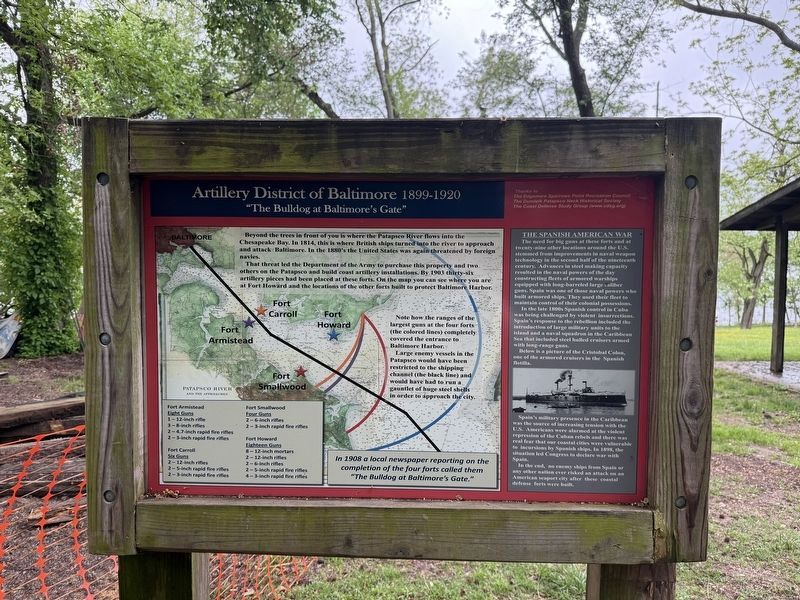
Artillery District of Baltimore 1899-1920
"The Bulldog at Baltimore's Gate"
Photographed by Devry Becker Jones (CC0), May 4, 2025
1. Artillery District of Baltimore 1899-1920 Marker
Beyond the trees in front of you is where the Patapsco River flows into the Chesapeake Bay. In 1814, this is where British ships turned into the river to approach and attack Baltimore. In the 1880's the United States was again threatened by foreign navies.
That threat led the Department of the Army to purchase this property and two others on the Patapsco and build coast artillery installations. By 1903 thirty-six artillery pieces had been placed at these forts. On the map you can see where you are at Fort Howard and the locations of the other forts built to protect Baltimore Harbor.
Note how the ranges of the largest guns at the four forts (the colored lines) completely covered the entrance to Baltimore Harbor.
Large enemy vessels in the Patapsco would have been restricted to the shipping channel (the black line) and would have had to run a gauntlet of huge steel shells in order to approach the city.
In 1908 a local newspaper reported on the completion of the four forts called them "The Bulldog at Baltimore's Gate."
this page online
In the late 1800s Spanish control in Cuba was being challenged by violent insurrections. Spain's response to the rebellion included the introduction of large military units to the island and a naval squadron in the Caribbean Sea that included steel hulled cruisers armed with long-range guns.
Below is a picture of the Cristobal Colon, one of the armored cruisers in the Spanish flotilla.
Spain's military presence in the Caribbean was the source of increasing tension with the U.S. Americans were alarmed at the violent repression of the Cuban rebels and there was real fear that our coastal cities were vulnerable to incursions by Spanish ships. In 1898, the situation led Congress to declare war with Spain.
In the

Photographed by Devry Becker Jones (CC0), May 4, 2025
2. Artillery District of Baltimore 1899-1920 Marker
Erected by The Edgemere Sparrows Point Recreation Council; The Dundalk Patapsco Neck Historical Society; The Coast Defense Study Group.
Topics. This historical marker is listed in these topic lists: Forts and Castles • War, Spanish-American • Waterways & Vessels. A significant historical year for this entry is 1814.
Location. 39° 11.801′ N, 76° 26.508′ W. Marker is in Edgemere, Maryland, in Baltimore County. It is in Fort Howard. It is on Fort Howard Park Road south of Key Street, on the right when traveling north. Touch for map. Marker is at or near this postal address: Fort Howard Park Rd, Fort Howard MD 21052, United States of America. Touch for directions.

Regionally, this marker is in the Baltimore Metro Region and in Central Maryland. It is also in the American Mid-Atlantic, in the Chesapeake Bay Region, and on the Eastern Seaboard. Globally, it is in the North Atlantic Region, North America, the Western Hemisphere, the Western World, and the Anglosphere. Historically,

Photographed by Evan Dwyer, March 7, 2026
3. Artillery District of Baltimore 1899-1920 Marker
View described by the marker of the waters beyond.
Other nearby markers. At least 8 other markers are within walking distance of this marker: Battery Harris (within shouting distance of this marker); Life at Fort Howard 1920-1940 - The 12th Infantry (within shouting distance of this marker); Fort Howard During World War I (about 300 feet away, measured in a direct line); This Maple (about 300 feet away); Life at Fort Howard 1898-1917 (about 400 feet away); Searchlight Power House (about 400 feet away); Battery Key (about 500 feet away); Power House (about 500 feet away). Touch for a list and map of all markers in Edgemere.
Credits. This page was last revised on March 18, 2026. It was originally submitted on May 4, 2025, by Devry Becker Jones of Washington, District of Columbia. This page has been viewed 173 times since then and 22 times this year. Photos: 1, 2. submitted on May 4, 2025, by Devry Becker Jones of Washington, District of Columbia. 3. submitted on March 8, 2026, by Evan Dwyer of Richmond, Virginia.
