The Superstack
⎯⎯⎯
La Supercheminée
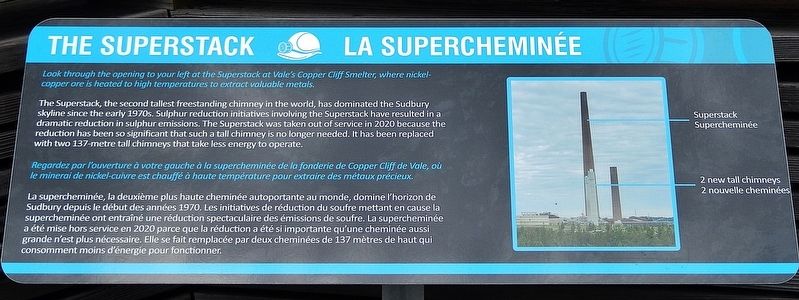

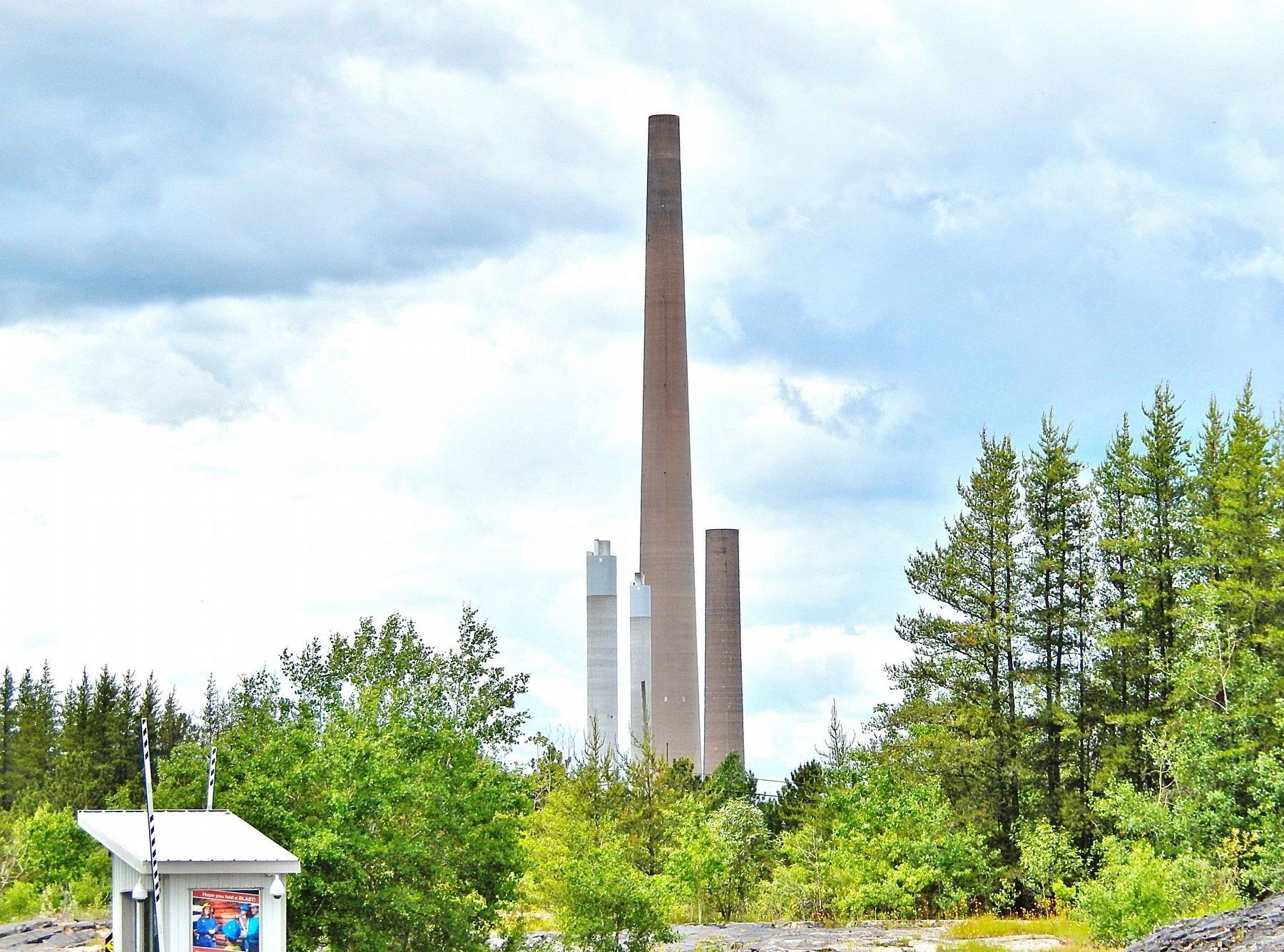
The Superstack, the second tallest freestanding chimney in the world, has dominated the Sudbury skyline since the early 1970s. Sulphur reduction initiatives involving the Superstack have resulted in a dramatic reduction in sulphur emissions. The Superstack was taken out of service in 2020 because the reduction has been so significant that such a tall chimney is no longer needed. It has been replaced with two 137-metre tall chimneys that take less energy to operate.
La supercheminée, la deuxième plus haute cheminée autoportante au monde, domine l'horizon de Sudbury depuis le début des années 1970. Les initiatives de réduction du soufre mettant en cause la supercheminée ont entraîné une réduction spectaculaire des émissions de soufre.
this page online
Topics. This historical marker is listed in these topic lists: Architecture • Environment • Industry & Commerce. A significant historical year for this entry is 2020.
Location. 46° 28.476′ N, 81° 1.926′ W. Marker is in Greater Sudbury, Ontario. It can be reached from Big Nickel Mine Drive (Regional Road 34) 0.4 kilometers north of Lorne Street (Regional Road 55), on the right when traveling north. The marker is located near the north end of the Dynamic Earth Museum parking lot. Touch for map. Marker is at or near this postal address: 122 Big Nickel Road, Greater Sudbury ON P3C 5T7, Canada. Touch for directions.

Regionally, this marker is in Northeastern Ontario and specifically in Northern Ontario. It is also in Central Canada. Globally, it is in North America, the Great North Woods, the Western Hemisphere, the Western World, and the Anglosphere. Historically,
Other nearby markers. At least 8 other markers are within 5 kilometers of this marker, measured as the crow flies: In Honour and Memory of the Holditch Family (about 120 meters away, measured in a direct line); Nickel Mining in Canada / Production de nickel au Canada (about 150 meters away); The Famous Big Nickel / Le célèbre big nickel (about 180 meters away); Dr. Ted Szilva, O. Ont., LLD, D.O.M. (about 180 meters away); Austin Airways 1934-1987 (approx. 2.9 kilometers away); The Irish Regiment of Canada (approx. 3.5 kilometers away); The Founding of Sudbury / La fondation de Sudbury (approx. 3.5 kilometers away); The Sudbury Basin (approx. 3.6 kilometers away). Touch for a list and map of all markers in Greater Sudbury.
Also see . . . Inco Superstack (Wikipedia).
Excerpt: The Inco Superstack in Sudbury, Ontario, with a height of 1,250 ft, is the tallest chimney in Canada and in the Western Hemisphere and the second-tallest freestanding chimney in the world, after the(Submitted on May 5, 2025, by Cosmos Mariner of Cape Canaveral, Florida.)Ekibastuz GRES-2 Power Station, in Kazakhstan. It is also the second-tallest freestanding structure of any type in Canada, behind the CN Tower. As of 2023, it is the 51st-tallest freestanding structure in the world. The Superstack is located on top of the largest nickel smelting operation in the world at Vale's Copper Cliff processing facility in the city of Greater Sudbury.Photographed by Cosmos Mariner, June 8, 20243. The Superstack / La SupercheminéeLooking northwest from the Dynamic Earth Museum grounds. The Superstack is about 1.2 mile (2km) from the museum! The 2 new (shorter, white) chimneys are visible to the left of the Superstack.The Superstack was built by Inco Limited (later purchased by Vale) at an estimated cost of 25 million dollars. Construction on the structure was underway during the Sudbury tornado of August 20, 1970; the structure swayed heavily in the wind but remained standing and suffered only minor damage. The stack entered into full operation in 1972. The Superstack was built to disperse sulphur gases and other byproducts of the smelting process away from the city of Sudbury. It did so by placing the gases high in the air, where they normally blew right past the city on the prevailing winds. As a result, the gases could be detected in the atmosphere around Greater Sudbury in a 150-mile radius of the Inco plant. During the 1970s and 80s, the sulphur dioxide plume formed a permanent,
opaque, cloud-like formation running across the entire horizon as seen from a distance.In 2018, Vale announced that the stack would be decommissioned and dismantled, beginning in 2020. Two new, smaller stacks were constructed under the company's Clean Atmospheric Emissions Reduction Project. In July 2020, Vale announced that the Superstack had been officially taken out of service but would remain operational in standby mode for two more months as a backup in the event of a malfunction in the new system, and the dismantling of the Superstack would then begin. Although some have called for the stack to be left in place as a tourist attraction, in September 2024, Vale announced an updated plan, which will see the stack dismantled by 2029.
Credits. This page was last revised on May 5, 2025. It was originally submitted on May 5, 2025, by Cosmos Mariner of Cape Canaveral, Florida. This page has been viewed 371 times since then and 195 times this year. Photos: 1, 2, 3. submitted on May 5, 2025, by Cosmos Mariner of Cape Canaveral, Florida.
