The Lumbering Industry
Introduction
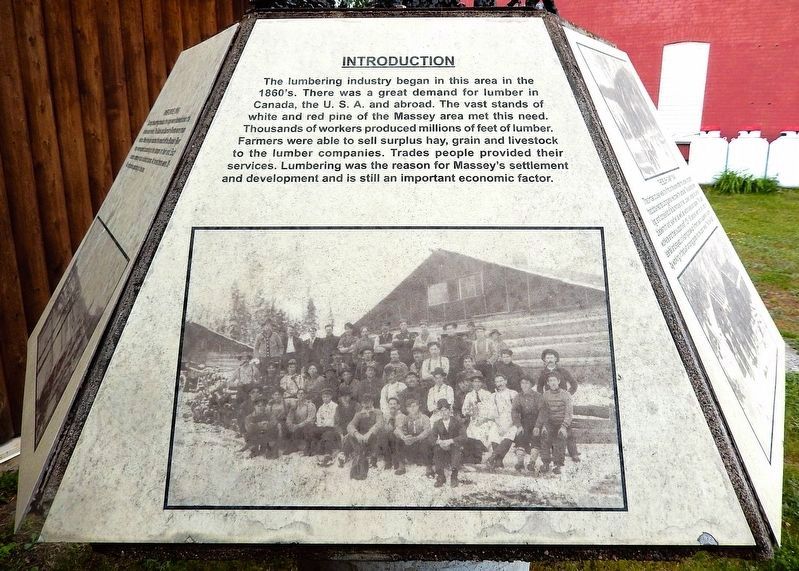
The lumbering industry began in this area in the 1860's. There was a great demand for lumber in Canada, the U. S. A. and abroad. The vast stands of white and red pine of the Massey area met this need. Thousands of workers produced millions of feet of lumber. Farmers were able to sell surplus hay, grain and livestock to the lumber companies. Trades people provided their services. Lumbering was the reason for Massey's settlement and development and is still an important economic factor.
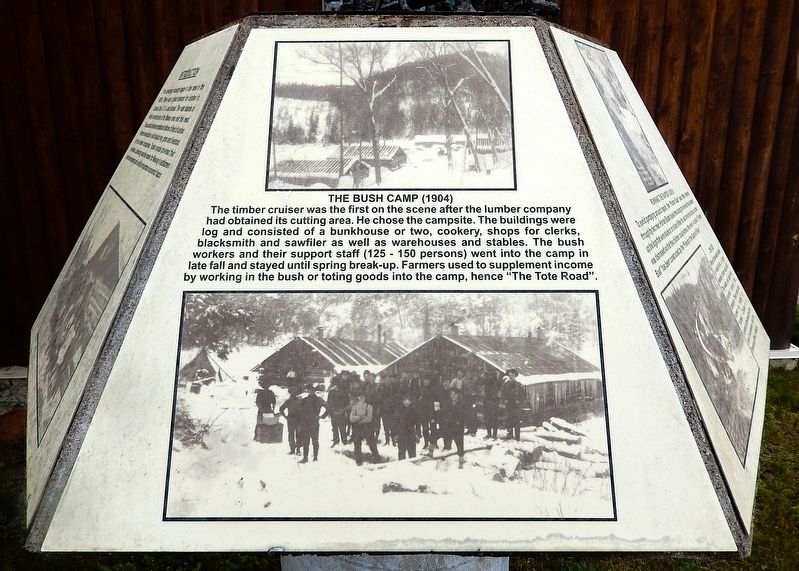
The Bush Camp (1904)
The timber cruiser was the first on the scene after the lumber company had obtained its cutting area. He chose the campsite. The buildings were log and consisted of a bunkhouse or two, cookery, shops for clerks, blacksmith and sawfiler as well as warehouses and stables. The bush workers and their support staff (125 - 150 persons) went into the camp in late fall and stayed until spring break-up. Farmers used to supplement income by working in the bush or toting goods into the camp, hence “The Tote Road”.
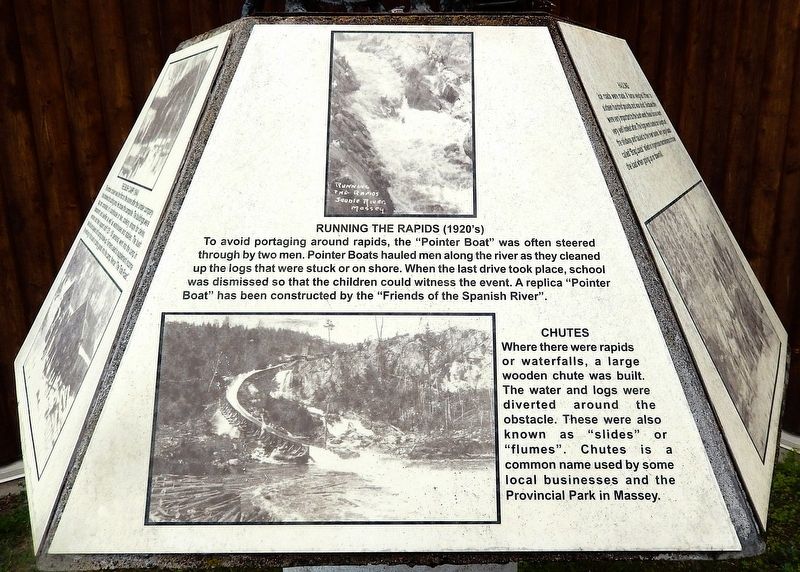
Running the Rapids (1920’s)
To avoid portaging around rapids, the “Pointer Boat” was often steered through by
this page online
Chutes
Where there were rapids or waterfalls, a large wooden chute was built. The water and logs were diverted around the obstacle. These were also known as “slides” or “flumes”. Chutes is a common name used by some local businesses and the Provincial Park in Massey.
Hauling
Ice roads were made. A horse weighed fifteen to sixteen hundred pounds and was shod. Because they were very important to the bush work, these horses were very well looked after. The logs were loaded on sleighs at the skidway and hauled to the river banks. Very large loads called “Brag Loads” relied on ingenious mechanisms to brake the load when going up or downhill.
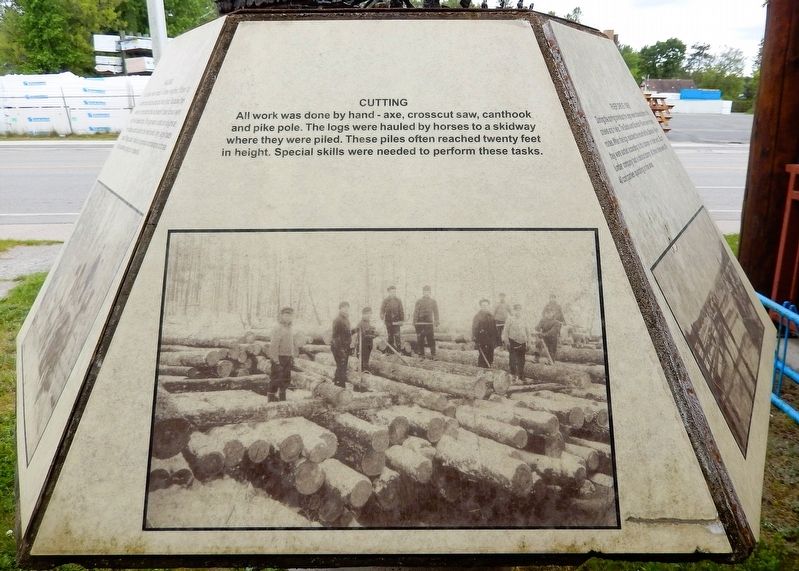
Cutting
All work was done by hand — axe, crosscut saw, canthook and pike pole. The logs were hauled by horses to a skidway where they were piled. These piles often reached twenty feet in height. Special skills were needed
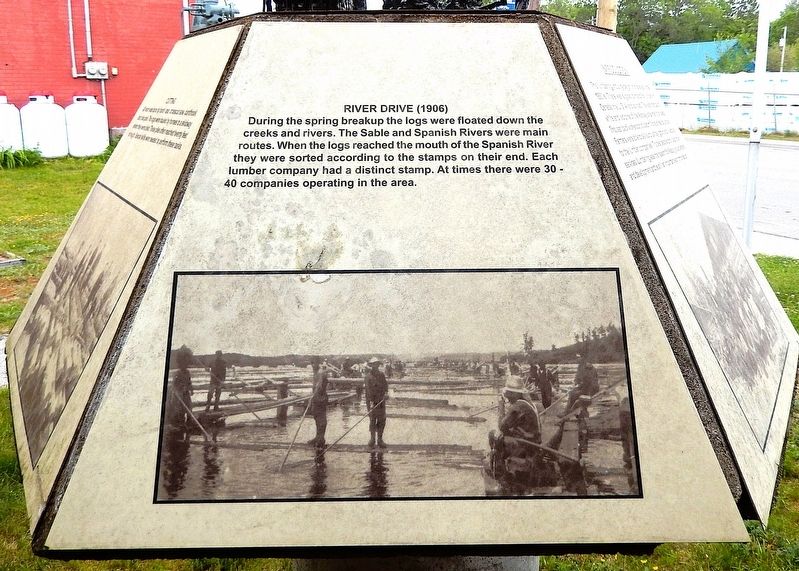
River Drive (1906)
During the spring breakup the logs were floated down the creeks and rivers. The Sable and Spanish Rivers were main routes. When the logs reached the mouth of the Spanish River they were sorted according to the stamps on their end. Each lumber company had a distinct stamp. At times there were 30-40 companies operating in the area.
Topics. This historical marker is listed in these topic lists: Horticulture & Forestry • Industry & Commerce • Settlements & Settlers • Waterways & Vessels.
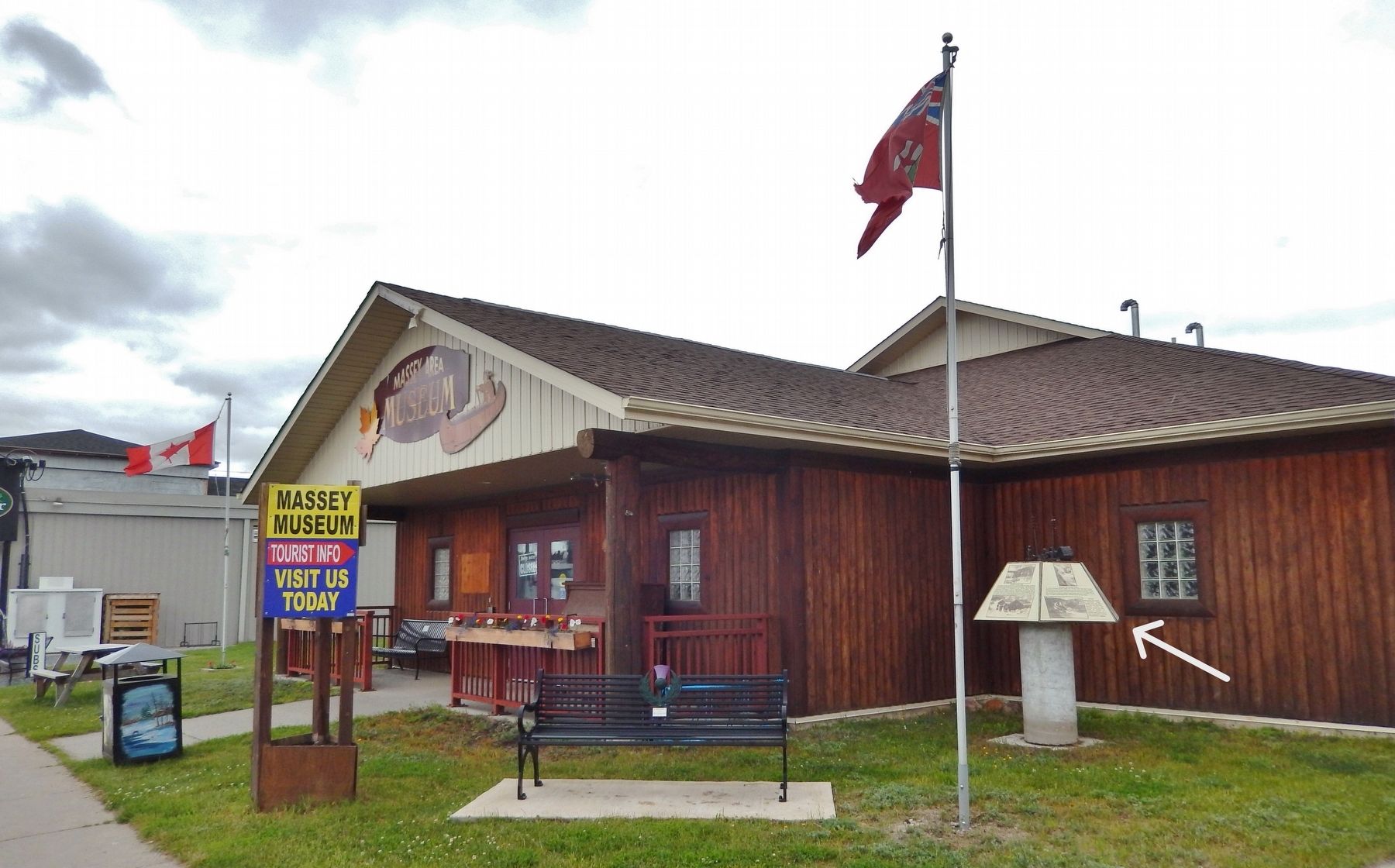
Location. 46° 12.766′ N, 82° 4.579′ W. Marker is in Massey, Ontario, in Sudbury District. It is on Sauble Street East (Trans-Canada Highway) (Provincial Highway 17) just west of 1st Street South, on the right when traveling west. The marker is located in front of the Massey Area Museum, near the southeast corner of the building. Touch for map. Marker is at or near this postal address: 150 Sauble Street East, Massey ON P0P 1P0, Canada. Touch for directions.

Regionally, this marker is in Northeastern Ontario and specifically in Northern Ontario.
Other nearby markers. At least 6 other markers are within 16 kilometers of this marker, measured as the crow flies: Home of Broomball (within shouting distance of this marker); Townships of Sable and Spanish Rivers (about 120 meters away, measured in a direct line); Lest We Forget (about 180 meters away); a different marker also named Lest We Forget (approx. 16 kilometers away); Webbwood (approx. 16 kilometers away); Centennial of Confederation (approx. 16 kilometers away).
More about this marker. The marker comprises 6 trapezoidal interpretive panels around a hexagonal, lampshade-like exhibit.
Also see . . . History of the Spanish River Area.
Excerpt: At one time the whole of Northern Ontario was covered by a vast and seemingly endless forest. Until the arrival(Submitted on May 11, 2025, by Cosmos Mariner of Cape Canaveral, Florida.)of the railway in 1883 this expanse was broken only by lakes of diverse sizes and shapes and deeply cut by swift, if often shallow rivers.Photographed by Cosmos Mariner, June 9, 20244. The Lumbering Industry Marker (panel 4 of 6)The coming of the railroad to the Sudbury district in 1883, provided the catalyst that set off phenomenal growth in the frequency and scope of logging around Sudbury. The railway not only made logging operations economically more profitable, but it also made a program of settlement feasible. For the lumbering industry sizeable rivers were also a factor of primary importance to the economic viability of logging operations. The Spanish River's size and location made it ideal for floating timber. The first settlers arrived by steamboat and cleared land along the banks of the Spanish River. The Sudbury to Algoma Branch of the C.P.R. brought an additional number of settlers to the area and also its name; “Massey” after a surveyor for the railroad company.

Credits. This page was last revised on May 11, 2025. It was originally submitted on May 8, 2025, by Cosmos Mariner of Cape Canaveral, Florida. This page has been viewed 161 times since then and 44 times this year. Photos: 1, 2, 3, 4, 5, 6, 7. submitted on May 11, 2025, by Cosmos Mariner of Cape Canaveral, Florida.
