Madison in Boone County, West Virginia — The American South (Appalachia)
Little Coal River
An Important and Historical Water Trail Serving Man and Industry

Photographed by Mark Parker, May 6, 2025
1. Little Coal River Marker
Little Coal River
The Litle Coal River is formed by Pond Fork and Spruce Laurel at Madison, WV. The river fows north by Danville, WV, Julian, WV and loops around to McCorkle, WY. The Little Coal River joins the Big Coal River at Alum Creek, WV and together they form the Coal River.
Originally named "Walhondecepe" by the Delaware Indians, the three rivers that make up the Coal River Watershed have served as a vital transportation link to the Kanawha River. The Indians used the rivers as a favorite hunting and fishing site.
Since the first settlers came to the region the rivers have served not only as a river trail but as a source of fishing, recreation, drinking water, social life and an important site for baptisms.
The region's availability of large seams of cannel coal, which could be used to produce a very desirable coal oil, eventually replaced whale oil for lighting in the urban areas of the US. This was the first coal-based economic boom for the region.
The Big Coal River, Little Coal River and Coal River provided a river trail which was enhanced in the mid 1850's by the construction of a 34 mile lock and
this page online
The Coal River Navigation Company of Virginia originally invested $208,000 to complete the system. At its height over 800,000 bushels of coal were shipped annually.
Beginning around 1800, flax mills and gristmills were built and operated along the three Coal Rivers. The mills provided an important source for the production of textiles in addition to staples such as flour and cornmeal.
Lumber was harvested throughout the Coal River Watershed once the upper lock and dams had washed away, Transporting lumber from the upper reaches of the Watershed was a dangerous and difficult process requiring high water and large log rafts to transport the logs to sawmills throughout the region. Finished lumber mills proliferated in the St. Albans area during this period as did flour processors and broom and barrel manufacturers.
Coal mining throughout the watershed region began in the early 1800's and continues today. The history of coal mining in the region is well documented and has defined the growth and development of the region. The use of the river for transportation of coal changed dramatically after the construction

Photographed by Mark Parker, May 6, 2025
2. Little Coal River Marker (Text closeup)
The rivers' role in the region once rail lines had been built was that of providing water for processing, cleaning and serving community needs for drinking water, fishing, recreation and sanitation.
River recreation and community social life have been centered on the Coal Rivers since the earliest settlers arrived in the region. The bountiful supply of fish, mussels, fresh water clams, crayfish, otter, beaver, muskrat, blue heron, duck, geese and other wildlife made the rivers a natural source of food for all residents. Baptisms were conducted in the rivers by ministers from the many churches located in the area. The rivers' winding path through the mountains naturally forms hundreds of sandy beach areas. The beaches were and remain the center of social events and regular recreational swimming activities for the local citizens. The utilization of the river as a center of recreation for the youth growing up in the region is the basis of the term "river rats" which locals embrace fondly.
The information and pictures have been provided with permission from: Bill Dean, Author of Coal Steamboats, Timber and Trains; Coal River Group Collection: Boone County, WV Historical Photos: The Armstrong Funeral Home Collection: The Gilmer County Historical Society and The Sherman Tide Yearbook Collection.
Topics.

Photographed by Mark Parker, May 6, 2025
3. Little Coal River Marker (photo closeups)
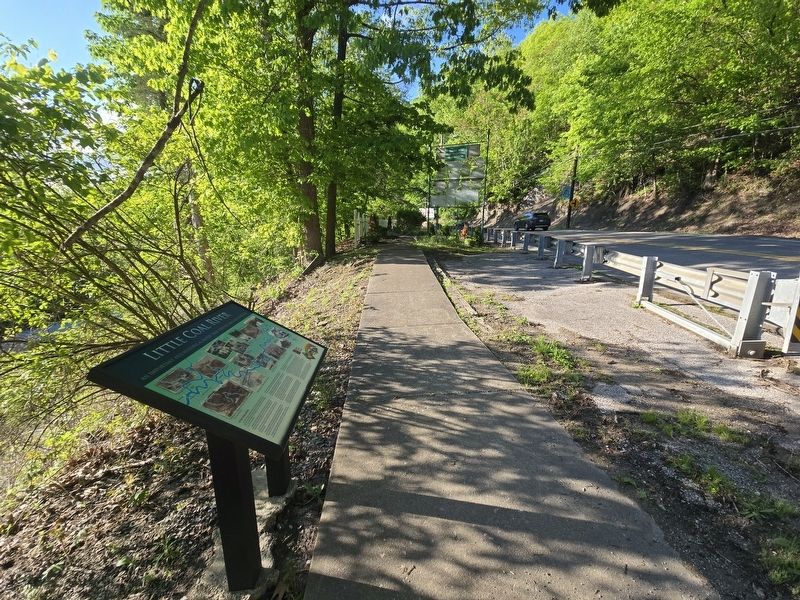
Location. 38° 4.169′ N, 81° 49.1′ W. Marker is in Madison, West Virginia, in Boone County. It is on State Street (West Virginia Route 85) 0.2 miles north of Avenue C, on the left when traveling north. Touch for map. Marker is at or near this postal address: 357 Old Plant Rd, Madison WV 25130, United States of America. Touch for directions.

Regionally, this marker is in the Southern Coalfields. It is also in the American South, specifically in the Upper South, in Appalachia, and specifically in Southern Appalachia. Globally, it is in North America, the Western Hemisphere, the Western World, and the Anglosphere. Historically, it finds itself in what was once the territory of the Mississippian Culture.
Other nearby markers. At least 8 other markers are within 9 miles of this marker, measured as the crow flies: Madison (approx. 0.2 miles away); Boone County World War Memorial (approx. 0.2 miles away); Boone County Courthouse
Photographed by Mark Parker, May 6, 2025
4. Little Coal River Marker looking north on State Street
Another marker is no longer nearby. Indian Camp (was approx. 8.4 miles away but has been confirmed missing).
Credits. This page was last revised on May 11, 2025. It was originally submitted on May 8, 2025, by Mark Parker of Hickory, North Carolina. This page has been viewed 233 times since then and 82 times this year. Photos: 1, 2, 3, 4. submitted on May 8, 2025, by Mark Parker of Hickory, North Carolina. • Devry Becker Jones was the editor who published this page.
