Ile de la Cité in Paris in Département de Paris, Île-de-France, France — Western Europe
Siege of Paris (886)

Photographed by Andrew Ruppenstein, April 8, 2025
1. Siege of Paris (886) Marker

au mois de février
Eudes etant comte de Paris
et Gozlin évêque
Ermenfroi, Hervé, Herland, Ouacre
Hervi, Arnoud, Seuil, Joubert
Gui, Hardré, Aimard et Gossouin
tomberent près d'ici
en defendant la Tour du Petit Pont
contre les Normands
“Ils se firent suivre de bien des ennemis dans la mort.”
Abbon, I, 520
In the year 886 in the month of February, under Odo, the Count of Paris, and Gozlin, the Bishop of Paris, Ermenfroi, Hervé, Herland, Ouacre, Hervi, Arnoud, Seuil, Joubert, Gui, Hardré, Aimard and Gossouin fell near here while defending the Petit Pont Tower against the Norsemen.
“They were followed by many enemies in death.”
Abbo, I, 520
Topics. This historical marker is listed in this topic list: Wars, Non-US. A significant historical date for this entry is February 6, 886 CE.
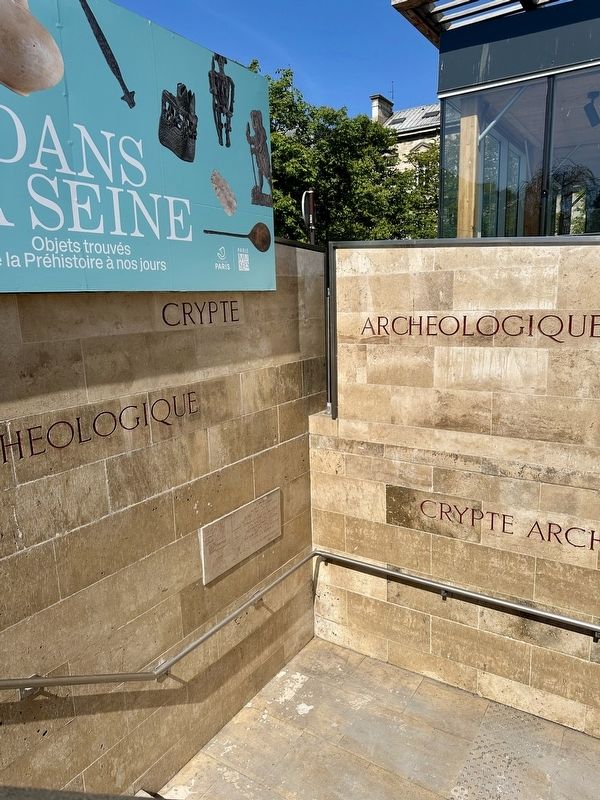
Location. 48° 51.219′ N, 2° 20.863′ E. Marker is in Paris, Île-de-France, in Département de Paris. It is in Ile de la Cité. It can be reached from Parvis Notre Dame - Place Jean-Paul II. The marker is in the stairwell/entrance of Crypte Archéologique de l'İle de la Cité (“Archaeological Museum”).
this page online

Regionally, it is in the North Atlantic Region, Europe, the European Union, Atlantic Europe, the Schengen Area, Western Europe, a coastal Mediterranean country, and the Western World. Historically, it finds itself in what was once a French colony and also the Roman Empire.
Other nearby markers. At least 8 other markers are within walking distance of this marker: Jardin de la place-Jean-Paul-II / Pope Jean Paul II Garden Square (1980) (within shouting distance of this marker); André Perrin (within shouting distance of this marker); A Tous Les Français (within shouting distance of this marker); 70eme Anniversaire de la Libération de Paris / 70th Anniversary of the Liberation of Paris (within shouting distance of this marker); Marcel Rey (about 90 meters away, measured in a direct line); Square René Viviani (1928) (about 120 meters away); Defenseurs du Fortin Huchette / Defenders of the Huchette Barricade Memorial

Photographed by Andrew Ruppenstein, April 8, 2025
2. Siege of Paris (886) Marker - wide view, from within the stairwell.
Also see . . . Siege of Paris (885–886) (Wikipedia). Excerpt:
The siege of Paris of 885–886 was part of a Viking raid on the Seine, in the Kingdom of the West Franks. The siege was the most important event of the reign of Charles the Fat, and a turning point in the fortunes of the Carolingian dynasty and the history of France. It also proved for the Franks the strategic importance of Paris at a time when it also was one of the largest cities in West Francia. The siege is the subject of an eyewitness account in the Latin poem Bella Parisiacae urbis of Abbo Cernuus.(Submitted on May 8, 2025.)
… On 6 February, rains caused the debris-filled river to overflow and the bridge supports to give way. The bridge gone, the northeast tower was now isolated with only twelve defenders inside. The Vikings asked the twelve to surrender, but they refused and were all subsequently killed.
In May, disease began to spread in the Parisian ranks and Gozlin died. Odo then slipped through Viking-controlled territory to petitionCharles for support; Charles consented. Odo fought his way back into Paris and Charles and Henry of Saxony marched northward. According to Joshua J. Mark, "at some point in 886 CE, Odo returned with the armies of Charles the Fat. He fought his way through the Viking forces and into the city with his men; the Vikings in quick pursuit. Odo organized an immediate defence and the Danes were again driven back to their ships."Photographed by Andrew Ruppenstein, April 8, 20253. Siege of Paris (886) Marker - wide view, looking into stairwell from plaza
Additional keywords. plaque commémorative
Credits. This page was last revised on May 9, 2025. It was originally submitted on May 8, 2025, by Andrew Ruppenstein of Lamorinda, California. This page has been viewed 129 times since then and 28 times this year. Photos: 1, 2, 3. submitted on May 8, 2025, by Andrew Ruppenstein of Lamorinda, California.
