Wilmington in New Hanover County, North Carolina — The American South (South Atlantic)
In the Beginning: 15 Boats
| — | U.S.S. North Carolina | — |
Photographed by Brandon D Cross
1. In the Beginning: 15 Boats Marker
(panel 1)
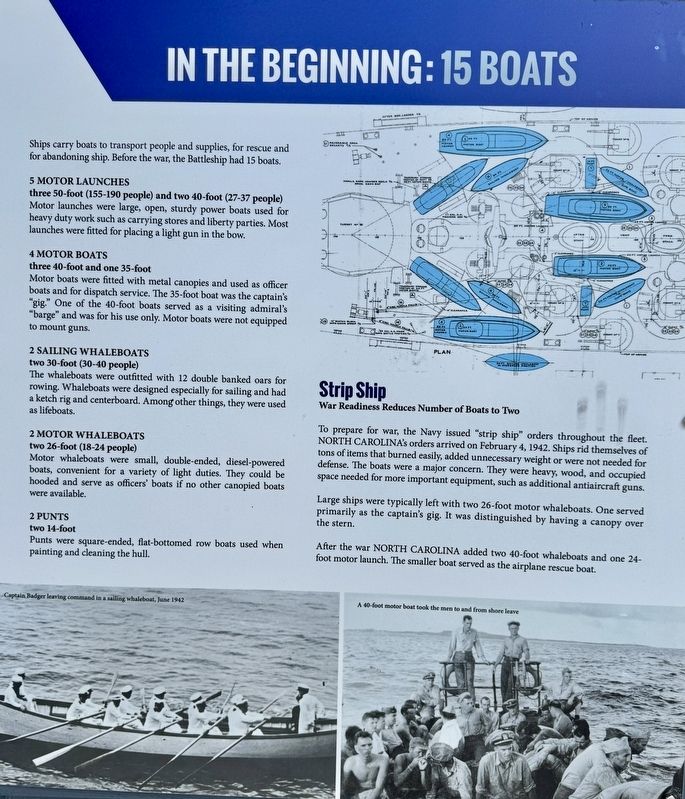
Ships carry boats to transport people and supplies, for rescue and for abandoning ship. Before the war, the Battleship had 15 boats.
5 Motor Launces
three 50-foot (155-190 people) and two 40-foot (27-37 people)\
Motor launches were large, open, sturdy power boats used for heavy duty work such as carrying stores and liberty parties. Most launches were fitted for placing a light gun in the bow.
4 Motor Boats
three 40-fort and one 35-foot
Motor boats were fitted with metal canopies and used as officer boats and for dispatch service. The 35-foot boat was the captain's "gig." One of the 40-foot boats served as a visiting admiral's "barge" and was for his use only. Motor boats were not equipped to mount guns.
2 Sailing Whaleboats
two 30-foot (30-40 people)
The whaleboats were outfitted with 12 double banked oars for rowing. Whaleboats were designed especially for sailing and had a ketch rig and centerboard. Among other things, they were used as lifeboats.
2 Motor Whaleboats
two 26-foot (18-24 people)
Motor whaleboats were small, double-ended, diesel-powered boats, convenient for a variety of
this page online
2 Punts
two 14-foot
Punts were square-ended, flat-bottomed row boats used when painting and cleaning the hull.
Strip Ship
War Readiness Reduces Number of Boats to Two
To prepare for war, the Navy issued "strip ship" orders throughout the fleet. North Carolina orders arrived on February 4, 1942. Ships rid themselves of tons of items that burned easily, added unnecessary weight or were not needed for defense. The boats were a major concern. They were heavy, wood, and occupied space needed for more important equipment, such as additional antiaircraft guns.
Large ships were typically left with two 26-foot motor whaleboats. One served primarily as the captain's gig. It was distinguished by having a canopy over the stern.
After the war North Carolina added two 40-foot whaleboats and one 24-foot motor launch. The smaller boat served as the airplane rescue boat.
(captions)
Captain Badger leaving command in a sailing whaleboat, June 1942
A 40-foot motor boat took the men to and from shore leave
(panel 2)
Personnel
Trained

Photographed by Brandon D Cross
2. Personnel (panel 2) center
Coxswain: He was in charge of the boat. He drove the boat and gave orders to the crew and passengers. He made certain the boat was in good condition, fueled, and ready to go with all necessary equipment. He knew the course so he navigated the boat to the various stops. He calculated the weight of passengers and/or cargo in order to keep within the boat's weight limits.
Engineer: He was a motor machinist's mate. The coxswain gave him orders by ringing a bell. One bell meant Ahead. Two bells signaled Stop. Three bells signaled Back. Four bells meant Full Speed. The engineer ensured that the engine, related equipment, and bilges (inside bottom of boat) were in excellent condition, clean, and safe.
Bowman: The bow man helped with ship handling, especially the various lines and the boat hook. The boat hook was a wooden pole with a hook on the end used to temporarily secure the boat to the landing spot for loading, unloading, and mooring.
Boat Maintenance
Care for the two boats was assigned to 5th and 6th

Photographed by Brandon D Cross
3. In the Beginning: 15 Boats Marker
Crew Memories
"If you were assigned to one boat, that was your particular job and you kept it cleaned, painted, and ready to go. The engineer made sure [the boat] had fuel at all times.
During the day we get to check compass courses for night running. I like that job. It's pretty interesting work. After a while or when the moon shines you don't need any compass because you can see, and after a while you get used to passing different ships and markings. It's good to remember them because in passing them you can figure out just where your ship sits."
Paul Wieser Boatswain’s Mate 1/C
"The first couple of weeks in Portland, Maine, in March 1942, our liberty boats were without canopies. The run from the ship to Portland was 45 minutes. With open boats in March in Portland, you nearly froze to death!"
Harold A. Smith Fire Controlman 1/C
(captions)
Auxiliaries (A) Division, starboard watch, 1944
Boat Engine Repair Shop, 01 level, view to port, August 1941
Erected by Friends of the Battleship North Carolina.
Topics. This historical marker is listed in these topic lists: War, World II • Waterways & Vessels. A significant historical year for this entry is 1942.
Location. 34° 14.191′ N, 77° 57.256′ W. Marker is in Wilmington, North Carolina, in New Hanover County. It can be reached from Battleship Road NE 0.2 miles south of U.S.S. North Carolina Road, on the right when traveling north. The marker is located on the USS North Carolina..
via Naval History and Heritage Command, 1944
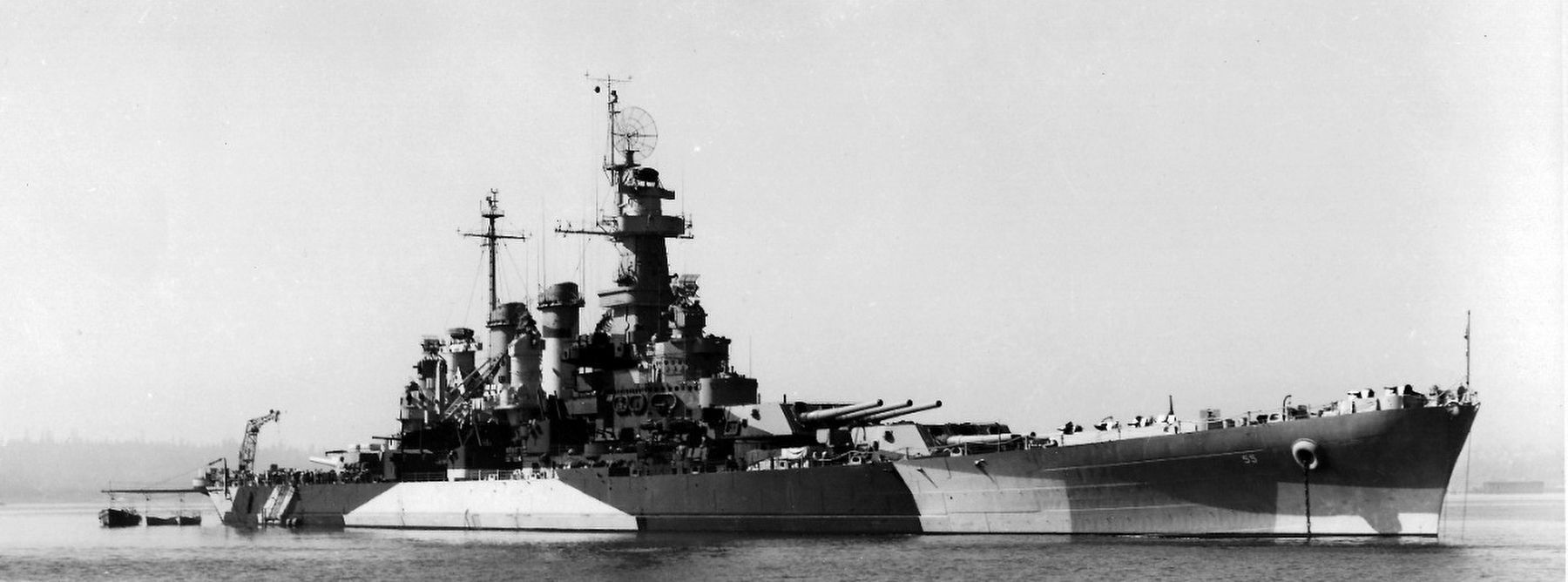
4. USS North Carolina (BB 55), 1941 - 1961
Naval History and Heritage Command website entry
Click for more information.
Click for more information.

Regionally, this marker is in the Coastal Plain and on the Cape Fear Coast. It is also in the American South, specifically in the Upper South, in the Tidewater, and on the Eastern Seaboard. Globally, it is in the North Atlantic Region, North America, the Western Hemisphere, the Western World, and the Anglosphere. Historically, it finds itself in what was once the territory of the Mississippian Culture, one of the original Thirteen Colonies, one of the Confederate States of America, and the Antebellum South.
Other nearby markers. At least 8 other markers are within walking distance of this marker: U.S.S. North Carolina Battleship Memorial (here, next to this marker); Magnetic Compass (here, next to this marker); Boats on the Move: Large Boat Cranes (a few steps from this marker); Sky II (a few steps from this marker); Friendly Fire (a few steps from this marker); Flag Plot (a few steps from this marker); The Navigators (a few steps from this marker); Navigating At Sea (a few steps from this marker). Touch for a list and map of all markers in Wilmington.
Also see . . . What would a Coxswain’s duty be on a Battleship in WWII? - Navy, Coast Guard and …. (Submitted on May 12, 2025, by Brandon D Cross of Flagler Beach, Florida.)
Credits. This page was last revised on May 28, 2025. It was originally submitted on May 12, 2025, by Brandon D Cross of Flagler Beach, Florida. This page has been viewed 121 times since then and 32 times this year. Photos: 1, 2, 3. submitted on May 12, 2025, by Brandon D Cross of Flagler Beach, Florida. 4. submitted on May 28, 2025, by Larry Gertner of New York, New York. • Bernard Fisher was the editor who published this page.
