Chichester in West Sussex, England, United Kingdom — Northwestern Europe (the British Isles)
Priory Park Orchard
Photographed by Ray Gurganus, April 4, 2025
1. Priory Park Orchard Marker
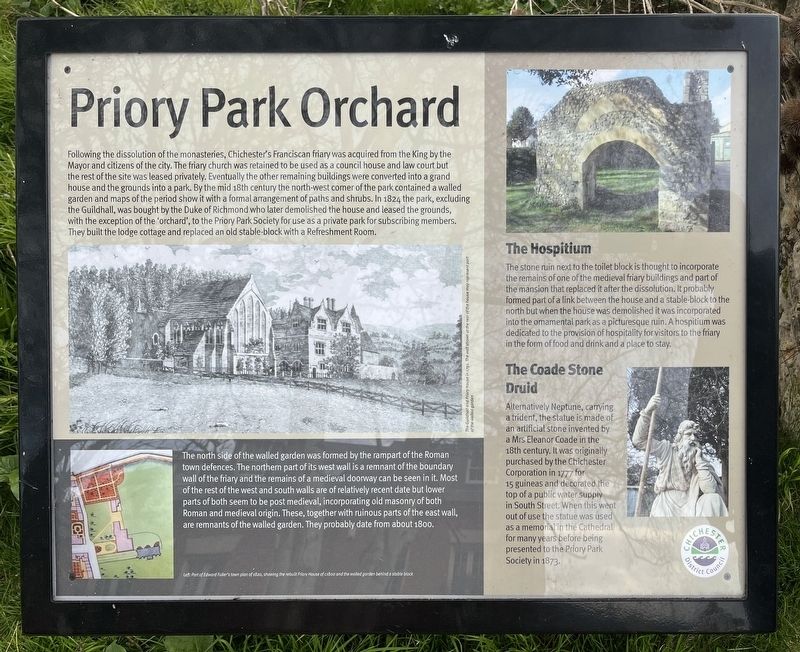
The north side of the walled garden was formed by the rampart of the Roman town defences. The northern part of its west wall is a remnant of the boundary wall of the friary and the remains of a medieval doorway can be seen in it. Most of the rest of the west and south
this page online
The Hospitium
The stone ruin next to the toilet block is thought to incorporate the remains of one of the medieval friary buildings and part of the mansion that replaced it after the dissolution. It probably formed part of a link between the house and a stable-block to the north but when the house was demolished it was incorporated into the ornamental park as a picturesque ruin. A hospitium was dedicated to the provision of hospitality for visitors to the friary in the form of food and drink and a place to stay.
The Coade Stone Druid
Alternatively Neptune, carrying a trident, the statue is made of an artificial stone invented by a Mrs Eleanor Coade in the 18th century. It was originally purchased by the Chichester Corporation in 1777 for 15 guineas and decorated the top of a public water Supply in South Street. When this went out of use the statue was used as
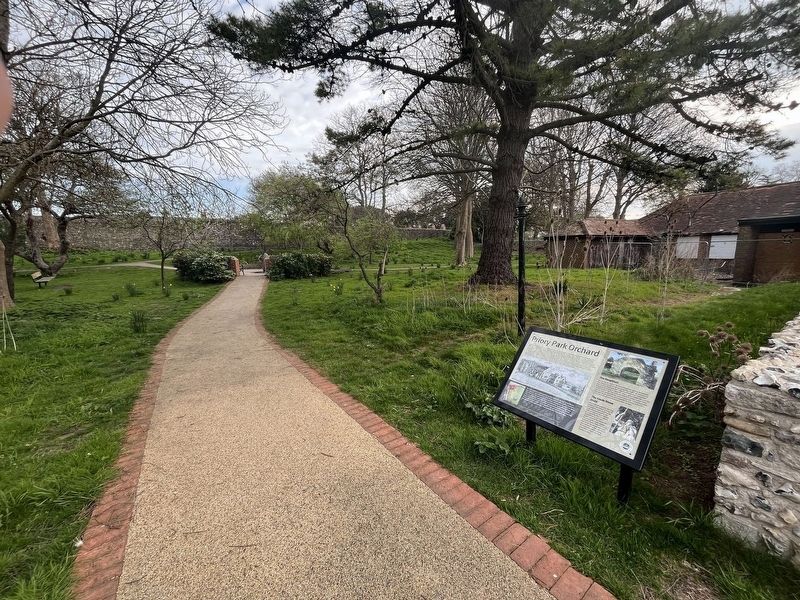
Photographed by Ray Gurganus, April 4, 2025
2. Priory Park Orchard Marker
Erected by Chichester District Council.
Topics. This historical marker is listed in this topic list: Parks & Recreational Areas.
Location. 50° 50.388′ N, 0° 46.647′ W. Marker is in Chichester, England, in West Sussex. It can be reached from Priory Lane. Touch for map. Marker is at or near this postal address: 3 Priory Ln, Chichester, England PO19 1NL, United Kingdom. Touch for directions.

Regionally, this marker is in the Greater South East. Globally, it is on the Atlantic Ocean, in the North Atlantic Region, in Europe, in Atlantic Europe, on one of the British Isles, in the Western World, and in the Anglosphere. Historically, it finds itself in what was once the Roman Empire.
Other nearby markers. At least 8 other markers are within walking distance of this marker: The Guildhall (within shouting distance of this marker); 1100 - Creation of a city (about 180 meters away, measured in a direct line); AD 280 - The Emperor's seal of approval (about 210 meters away); The Council House and Assembly Room (approx. 0.2 kilometers away); 1800s - A new use for the walls (approx. 0.2 kilometers away); Admirals Lord Horatio Nelson and Sir George Murray (approx. 0.3 kilometers away); Ethel Margaret 'Madge' Turner (approx. 0.3 kilometers away); Litten Gardens (approx. half a kilometer away). Touch for a list and map of all markers in Chichester.
Credits. This page was last revised on May 26, 2025. It was originally submitted on May 12, 2025, by Ray Gurganus of Washington, District of Columbia. This page has been viewed 81 times since then and 18 times this year. Photos: 1, 2. submitted on May 12, 2025, by Ray Gurganus of Washington, District of Columbia. • Bill Pfingsten was the editor who published this page.
