Riverview in Tulsa in Tulsa County, Oklahoma — The American South (West South Central)
Bruce Goff • Patti Adams Shriner

Photographed by Duane and Tracy Marsteller, April 9, 2025
1. Bruce Goff • Patti Adams Shriner Marker
Goff's mature work had no precedent. His contemporaries primarily followed tight functionalistic floorplans with flat roofs and no ornament. Goff's idiosyncratic floorplans, attention to spatial effect, and use of recycled and/or unconventional materials such as gilded zebrawood, cellophane strips, cake pans, glass cullet, Quonset Hut ribs, ashtrays, and white turkey feathers, challenge conventional distinctions between order and disorder. “Improbable” is one word used to describe Goff's work.
The Tulsa Spotlight Theatre, originally a residence and music school for Patti Adams Shriner, makes use of Vitrolite and other Art Deco touches, yet is massed and organized in the International style when the taste of the time was bland modernism. The Spotlight and other Goff buildings are among the 53 in Tulsa that are listed on the
this page online
[Timeline]
1904 Born June 7 in Alton, Kansas.
1915 Family moved to Tulsa.
1916 Apprenticeship with the architecture firm of Rush, Endacott & Rush at age 12.
1918 Bruce Goff built his first house at age 14. One of his earliest designs that was actually built was a house at 1732 South Yorktown Avenue.
1920 McGregor House, 1401 South Quaker.
1926 Boston Avenue Methodist Church (with Adah Robinson). This was designated a National Historic Landmark as “one of the most significant churches of the twentieth century”.
1927 Page Warehouse, 2036 East 11th Street.
1928 Residence for Patti Adams Shriner.
1934 Goff moved to Chicago.
1942 Goff begins teaching at the School of Architecture at the University of Oklahoma.
1943 Goff became chair of the school.
1947 Ledbetter House and Taylor House, Norman.
1950 Bavinger House, Norman. This building was awarded the Twenty-five Year Award from the American Institute of Architects in 1987.
1951 Life magazine reports that Bruce Goff is one of the few architects that Frank Lloyd Wright considers creative.
1955 John Frank House, Sapulpa.
1955 Goff departed

Photographed by Duane and Tracy Marsteller, April 9, 2025
2. Bruce Goff • Patti Adams Shriner Marker
1956 Shin’enKan, Bartlesville.
1978 Pavilion for Japanese Art at the Los Angeles County Museum of Art.
1982 Died Aug, 4 in Tyler, Texas.
Captions (top to bottom)
• Bruce Goff and Frank Lloyd Wright in 1954 at the University of Oklahoma in Norman.
• Bruce Goff in 1955 with Julia Urrutia, a 19-year-old University of Oklahoma student who became Panama's fifth female architect. Riverside Hall, Tulsa, Oklahoma By Bruce Goff, Architect
Born in Texas in 1882, Patti was raised in tiny Ryan, OK. Her conspicuous musical talent soon put her in front of larger audiences. Unafraid of traveling alone, Patti

via Osborne County (Kansas) Hall of Fame (Public Domain)
3. Bruce Alonzo Goff (1904-1982)
Peers called his architectural style “Imaginative Design”. Among American architects, he is considered second only to Frank Lloyd Wright.
She earned her way to Paris in 1910, studying with the celebrated composer and concert pianist Maurice Moszkowski. “It's hard to believe he's the Moszkowski, he's so nice to me,” Patti rhapsodized in her diary. Moszkowski later penned a recommendation that secured a coveted scholarship for Patti, enabling her to extend her studies for a second year. One of Patti's public performances won a rapturous review in the March 10, 1911 issue of the influential Chicago magazine Music News:
“… this young artiste has all the qualities that spell success. A charming personality, great force of character and perseverance, great capacity for hard work, combined with talent and a devotion to her art. Her playing is forceful but sympathetic, full of feeling of soul, and of that utter absorption which has such an effect on an audience.”
“She will go back to America in July to enter the concert field. As she has had such great success in Paris, her success in America is assured.”
It wasn't to be. Rocky family finances and a quickly regretted marriage to star violinist Jacob Schreiner dampened Patti's musical advancement, though not her ambition. She ended the marriage in 1921, keeping her husband's name but simplifying it to Shriner.
If a middle-aged divorced woman was expected to fade into obscurity, Patti was having none of it. Tulsa's long running oil boom maintained the flow of piano students to her home at 15th and Denver Avenue. They came from the city's wealthiest families: Price, McBirney, Lorton, Insull, Gilliland, and more. Perhaps assured by their patronage, Patti boldly bought riverfront property and built a structure
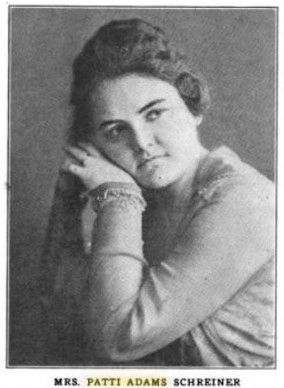
The Musical Monitor, September 1921; via Google Books (Public Domain), circa 1921
4. Patti Adams Shriner (1882-1965)
She kept her married name after her divorce but slightly altered the spelling.
Her school opened on Easter Sunday, 1929. One student was impoverished Patti Johnson, who would become the wealthy arts philanthropist Patti Johnson Wilson. Another student was Rosalie Talbott, eventual soloist for the Tulsa Philharmonic and co-founder of the Tulsa Ballet. “I am still determined that he shall play like some of your pupils,” wrote Florence Pollock of Bartlesvile to Patti Shriner about her son, Il-year-old Frank. “If you can't make him, then he is doomed.” She did indeed “make him,” turning Frank into a prodigy who went on to Juilliard.
Meanwhile, the Great Depression had begun. It crushed everything: demand for oil, Tulsa's fortunes, Patti's dreams. Four and a half years after establishing her school, Patti lost the property to foreclosure. Eventually she settled near family in Cleveland, OK. Though it was an hour's drive, parents in Tulsa still brought their children to her for lessons. Patti also taught the children and grandchildren of her sister, Dimple Adams Walker, launching some in music careers.
Patti died in 1965 at age 82. Appropriately, her tombstone is inscribed with measures from a favorite composition, Chopin's Fantaisie-Impromptu, Op. 66.
Perhaps the last word should come from Elwyn Ratliff, who studied under Patti and went on to teach piano in Tulsa for decades. With foreclosure already looming over the school, Ratliff performed the last recital given there. In an undated letter signed “Your devoted pupil, Elwyn,” he wrote to Patti: “You have given me a wonderful musical education for which I can never, never thank you enough.”
Ken Brune at Brune Law • US Rep. Kevin & Tammy Hern • Tulsa County Comm, Karen Keith • Ron & Bonnie Peters, Greg & Ronda • Phil & Joyce Ward • Tulsa Foundation for Architecture • Cecil Whitehurst Walker • May Ollie “Dimple” Adams Walker • Kent & Frances Walker • Archie Adams Walker & family • David Lee & Bettie Jane Walker • Barbara Walker Abbott & family • Ron & Jane Walker & family • Davie Louise Walker • Bruce, Joyce & Andrew Walker • Cecille Walker Henning & family • Brad Adams Walker & family
Erected by those listed above ▲.
Topics. This historical marker is listed in these topic lists: Architecture • Arts, Letters, Music • Education • Women. A significant historical date for this entry is June 7, 1904.
Location. 36° 8.484′ N, 95° 59.932′ W. Marker is in Tulsa, Oklahoma, in Tulsa County. It is in Riverview. It is on Riverside Drive north of South Houston Avenue, on the right when traveling south. The marker is on the River Parks East Trail, and is just across Riverside Drive from the Tulsa Spotlight Theater. Touch for map. Marker is at or near this postal address: 1381 Riverside Dr, Tulsa OK 74119, United States of America. Touch for directions.

Regionally, this marker is in the Muscogee Nation, specifically in the Cherokee Nation, and in Northeast Oklahoma—Green Country. It is also in the American South, specifically on the prairies, and on the Southern Plains. Globally, it is in North America, the Western Hemisphere, the Western World, and the Anglosphere. Historically, it finds itself in what was once the territory of the Mississippian Culture and also the Louisiana Purchase.
Other nearby markers. At least 8 other markers are within walking distance of this marker: Tulsa Spotlight Theatre and “The Drunkard” (here, next to this marker); Clinton–Hardy House (approx. 0.2 miles away); Sophian Plaza (approx. 0.2 miles away); The Bridge that Saved Tulsa (approx. ¼ mile away); The Bridge Builder (approx. 0.3 miles away); Cyrus Avery Route 66 Memorial Bridge (approx. 0.3 miles away); Cyrus Stevens Avery (approx. 0.3 miles away); "East Meets West" (approx. 0.3 miles away). Touch for a list and map of all markers in Tulsa.
Another marker is no longer nearby. 11th Street Bridge, Tulsa, Oklahoma (was approx. 0.3 miles away but has been permanently removed).
Credits. This page was last revised on May 13, 2025. It was originally submitted on May 12, 2025, by Duane and Tracy Marsteller of Murfreesboro, Tennessee. This page has been viewed 331 times since then and 114 times this year. Photos: 1. submitted on May 12, 2025, by Duane and Tracy Marsteller of Murfreesboro, Tennessee. 2. submitted on May 13, 2025, by Duane and Tracy Marsteller of Murfreesboro, Tennessee. 3. submitted on May 11, 2025, by Duane and Tracy Marsteller of Murfreesboro, Tennessee. 4. submitted on May 13, 2025, by Duane and Tracy Marsteller of Murfreesboro, Tennessee.
