Bishop's Gate in Albany in Albany County, New York — The American Northeast (Mid-Atlantic)
Gen. Henry Knox Trail
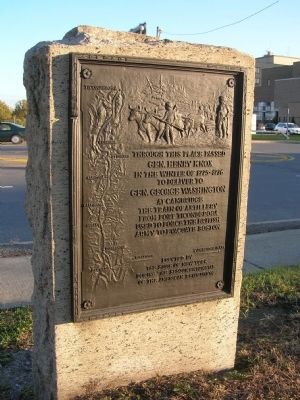
Photographed by Howard C. Ohlhous, October 22, 2009
1. Gen. Henry Knox Trail Marker NY-21 Albany, NY
The Henry Knox Cannon Trail follows the route that Gen. Henry Knox used to transport 59 cannons from Fort Ticonderoga and Crown Point, New York to Cambridge, Massachusetts in the winter of 1775-1776.
Gen. Henry Knox
In the Winter of 1775 - 1776
to deliver to
Gen. George Washington
at Cambridge
the train of artillery
from Fort Ticonderoga
used to force the British
Army to evacuate Boston
Erected by the State of New York during the Sesquicentennial of the American Revolution
Erected 1926 by State of New York during the Sesquicentennial of the American Revolution. (Marker Number NY-21.)
Topics and series. This historical marker is listed in these topic lists: Roads & Vehicles • War, US Revolutionary. In addition, it is included in the Former U.S. Presidents: #01 George Washington, and the General Henry Knox Trail series lists. A significant historical year for this entry is 1775.
Location. 42° 40.515′ N, 73° 44.909′ W. Marker is in Albany, New York, in Albany County. It is in Bishop's Gate. It is on Northern Boulevard, on the right when traveling south. The Gen. Henry Knox Marker Was originally in this intersection, but has been relocated to edge of highway expansion area. Now located at the southwest area of the intersection of Loudonville Road and Northern Boulevard
this page online

Regionally, this marker is in Upstate New York and in the Capital District. It is also in the American Northeast and in the Mid-Atlantic. Globally, it is in North America, the Western Hemisphere, the Western World, and the Anglosphere. Historically, it finds itself
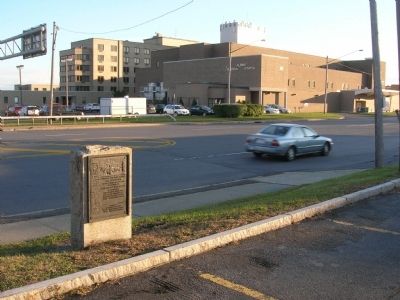
Photographed by Howard C. Ohlhous, January 22/2009
2. Gen. Henry Knox Trail Marker, Albany, NY
Albany Memorial Hospitol is in the background on the far side of Northern Blvd.
Other nearby markers. At least 8 other markers are within 2 miles of this marker, measured as the crow flies: Henry Johnson (approx. 0.9 miles away); Lil's Diner (approx. one mile away); Stephen and Harriet Myers Residence (approx. one mile away); Boardman & Gray Piano Factory (approx. one mile away); Chapman House (approx. 1.1 miles away); Ten Broeck Family Burial Vault (approx. 1.1 miles away); Abraham Ten Broeck (approx. 1.1 miles away); Brig. Gen. Abraham Ten Broeck (approx. 1.2 miles away). Touch for a list and map of all markers in Albany.
More about this marker. The marker consists of a bronze plaque mounted on a large stone base. The plaque is attributed to sculptor Henry James Albright, 1887-1951.
A relief plaque on a stone marker commemorates General Henry Knox's delivery of artillery from Fort Ticonderoga to General George Washington at Cambridge, Massachusetts in the winter of 1775-1776. The image on the relief plaque depicts a young male figure driving a team of oxen. A uniformed male, probably General Knox, stands to the far right.
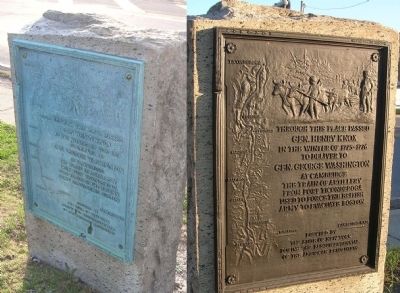
Photographed by Howard C. Ohlhous
3. Gen. Henry Knox Trail Marker
Comparison of the Albany, New York (NY-21) Knox Cannon Trail marker as seen before restoration on the left(April 2008), and on the right after restoration (October 2009).
Recently many of the Knox Cannon Trail bronze plaques have received conservation work to restore the original sculptural detail that had been lost over time. Typically these plaques are restored using a technique developed in consultation with the National Park Service, which uses a system of air abrasive cleaning with a compound of pulverized walnut shells to attain the original finish and then they are sealed with a lacquer coating.
Regarding Gen. Henry Knox Trail. The Henry Knox Cannon Trail denotes the path followed by Colonel Knox and his men from December 1775 to January 1776 to transport 59 captured weapon pieces from Fort Ticonderoga and Crown Point on Lake Champlain, New York to General George Washington at Dorchester Heights overlooking Boston, Massachusetts.
This pivotal event of the American Revolution resulted in the evacuation of British soldiers from Boston.
The Advisory Board on Battlefields and Historic Sites recommended that the state of New York purchase 30 granite markers in identical pattern, each with a bronze tablet featuring a map of the trail, an image in relief of cannon being dragged by ox sled through the snow, and the words:
"Through this place passed General Henry Knox in the winter of 1775 - 1776 to deliver to General George Washington at Cambridge the Train of Artillery from Fort Ticonderoga used to force the British army
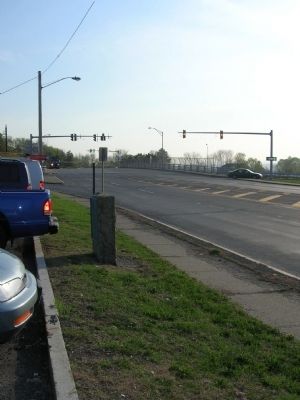
Photographed by Howard C. Ohlhous, /23/2008
4. Gen. Henry Knox Trail Marker NY-21
The marker is located in a narrow strip of grass between the shopping area parking lot and the sidewalk beside a major roadway.
In all, 30 of the bronze plaques are in New York State and 26 in Massachusetts. They represent the 56-day journey of American troops from Fort Ticonderoga to Boston.
The monuments were erected beginning in 1926, during the commemoration of the 150-year anniversary of the American Revolution, and completed in 1927. The trail is one of the earliest heritage paths created in the United States.
According to the Hudson River Valley Institute website, General Washington believed he could dislodge the British from the city, and dispatched Henry Knox, a 25-year-old Boston bookseller, to organize transportation of the captured artillery pieces from Lake Champlain forts to the heights overlooking Boston in the winter of 1775. The British had occupied Boston since their victory in the Battle of Bunker Hill.
Henry Knox arrived at Fort Ticonderoga on the evening of December 5, 1775 accompanied by his 19-year-old brother William and a servant, Miller. Early the next day, assisted by the garrison of Fort Ticonderoga, he began to move the guns, including 43 heavy brass and iron cannons,
Photographed by Howard C. Ohlhous, May 23, 2008
5. Gen. Henry Knox Trail Marker
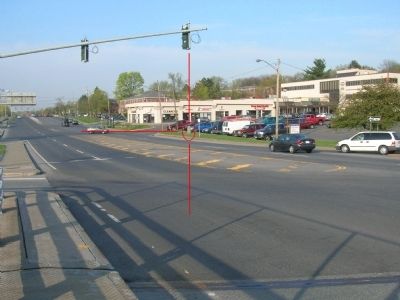
The marker is located roughly in the center of this photo which is a view down (southeast) Northern Boulevard.
In the second week of March, 1776, four months before the Declaration of Independence was signed, General Washington was ready to bombard the British in Boston from Dorchester Heights, using the array of heavy guns General Knox had laboriously dragged from Lake Champlain.
Lord William Howe recognized that only the evacuation of his army could save it, and on March 18 the victorious American army marched into the deserted city.
Related markers. Click here for a list of markers that are related to this marker. These markers follow the route used by Knox to transfer cannons from Fort Ticonderoga to Cambridge, Mass.
Also see . . . "Major General Henry Knox" biography from The American Revolution Homepage website. (Submitted on October 27, 2009, by Howard C. Ohlhous of Duanesburg, New York.)
Additional keywords. George Washington, Ft George, Ft Edward, Saratoga, Halfmoon, Albany, Kinderhook, Claverach, Noblestown, Cambridge, Revolutionary trial
Photographed by U.S. Army Center Of Military History
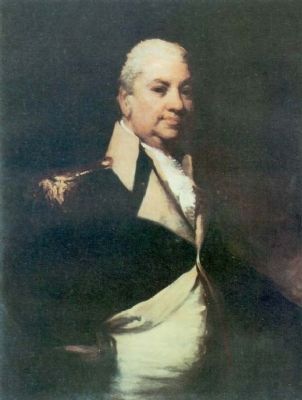
6. Gen. Henry Knox
Born in Boston, July 25, 1750, and died Oct. 25, 1806
Photographed by Bill Coughlin, July 11, 2008
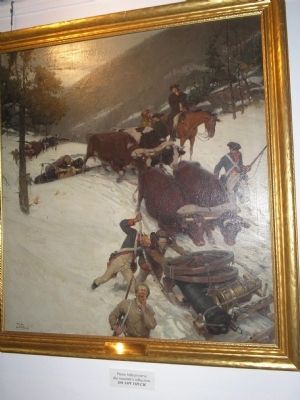
7. The Noble Train of Artillery
This Tom Lovell painting of General Knox and his soldiers transporting the cannons is on display at Fort Ticonderoga.
Credits. This page was last revised on May 13, 2025. It was originally submitted on October 27, 2009, by Howard C. Ohlhous of Duanesburg, New York. This page has been viewed 4,217 times since then and 140 times this year. Last updated on May 13, 2025, by Diane Klinefelter of McMurray, Pennsylvania. Photos: 1, 2, 3, 4, 5, 6. submitted on October 27, 2009, by Howard C. Ohlhous of Duanesburg, New York. 7. submitted on July 24, 2009, by Bill Coughlin of Woodland Park, New Jersey. • Devry Becker Jones was the editor who published this page.
