Wilmington in New Hanover County, North Carolina — The American South (South Atlantic)
Kingfishers Aboard North Carolina
U.S.S. North Carolina
| — | Eyes in the Sky | — |

Photographed by Brandon D Cross
1. Eyes in the Sky Marker (panel 1)
(panel 1)
Purpose
• Spotting gunfire
• Patrolling for enemy submarines
• Rescuing airmen
• Towing targets for anti-aircraft batteries
• Dropping messages to ships at sea
• Flying mail runs to ports
• Making flights for radar calibration
Vought-OS2U-3 Kingfisher
Wingspan 35 feet 11 inches
Length 33 feet 7 inches
Height 15 feet 1½ inches
Empty weight 4,560 pounds
Power plant 450 horsepower Pratt & Whitney R-985-AN-2 air cooled radial engine
Armament Two guns: one fixed and one flexible.30 caliber machine gun
500 rounds for the fixed gun; 600 rounds for the flexible gun
100-pound bomb under each wing; 325-pound depth charges
Take-off speed 70 miles per hour
Cruising speed 119 miles per hour
Landing speed 55 miles per hour
Maximum speed 171 miles per hour at 5,000 feet
Service ceiling 15,500 feet
Rate of climb 800 feet per minute
Range 908 miles or approximately six hours
Crew two: pilot (officer) and radioman (enlisted)
Emergency equipment one two-man life raft, rations, fishing kit, water, folding carbine, paddles, rubberized cover to use as a sail, shelter or to catch rainwater.
The Origins of the Battleship’s Kingfisher
It
this page online
This plane was flown by Ensign Mac J. Roebuck and gunner AMM1/c Stanley Goddard. They were unhurt and walked down the mountain to the coast where they were rescued. The plane was left to the elements after a brief salvage operation.
In 1963, the Canadian authorities recovered the plane and shipped it to the Air Museum in Calgary. The wreckage was turned over to the NORTH CAROLINA for restoration. The Battleship requested that Vought Aeronautics restore the plane.
In 1970, it was shipped to Dallas, Texas, where the Quarter-Century Club (retired Vought workers) began the restoration. After a year of work, the OS2U-3 Kingfisher was placed aboard the Battleship and dedicated on June 25, 1971. There is only a handful of Kingfisher planes left in the world.
(captions)
The Vought Quarter Century Club posing in front of the restored Kingfisher.
Stanley Goddard
Mac Roebuck
(panel 2)

Photographed by Brandon D Cross
2. Eyes in the Sky Marker (panel 2)
"Iwo Jima [February 1945] was my most demanding effort to that time. I will say that the briefings and grid charts used at lwo were of the highest quality and we had an excellent preparation for spotting. D-day landings and the barrage on the beach by the Japanese caused great concern. We were asked to make low passes over our area to try and locate (enemy) gun positions.
The nature of spotting [a ship's gunfire to be certain that they hit their targets] means that you flew "low and slow," anywhere from 200 feet to 1,500 feet altitude at speeds of 80 to 120 knots. In the case of Iwo Jima, I spent nearly 40 hours over the island.
Flying was once described as hours of sheer boredom broken with moments of stark terror."
CDR Almon P. Oliver, USN, Retired
"Shipboard planes obstructed fire from guns mounted aft leaving the stern protected by only four 20mm guns. The arcs of train and elevation of these guns were limited by the airplane crane which had not been lowered. Fortunately, no guns fired into our planes on the catapults because these planes were each both filed with 140 gallons of gas and were loaded with

Photographed by Brandon D Cross
3. Eyes in the Sky Marker (left & far left)
Report of Action of August 24, 1942(Battle of the Eastern Solomons) The 40MM guns were not on the fantail in 1942.
"With full flaps, low pitch, and full power we went off that catapult at 45 knots. And in my case, I was only semi-conscious. I blacked out but you had your plane trimmed so it was in flight. It was actually flying itself when you went off the end of the catapult and you just took control as you regained consciousness."
LT(jg) Everette Landers, USN, Retired
(captions)
North Carolina initially carried three OS2U-2 Kingfisher planes. The number of planes dropped to two with the addition of 20mm guns and 40mm gun mounts on her fantail.
Ensign Mac Roebuck and the wrecked Kingfisher on Calvert Island, Canada.
Erected by Friends of the Battleship North Carolina.
Topics. This historical marker is listed in these topic lists: Air & Space • War, World II • Waterways & Vessels.
Location. 34° 14.197′ N, 77° 57.202′ W. Marker is in Wilmington, North Carolina, in New Hanover County. It can be reached from Battleship Road NE 0.2

Photographed by Brandon D Cross
4. Vought-OS2U-3 Kingfisher on the USS North Carolina

Regionally, this marker is in North Carolina’s Coastal Plain and on the Cape Fear Coast. It is also in the American South, specifically in the Upper South, in the Tidewater, and on the Eastern Seaboard. Globally, it is in the North Atlantic Region, North America, the Western Hemisphere, the Western World, and the Anglosphere. Historically, it finds itself in what was once the territory of the Mississippian Culture, one of the original Thirteen Colonies, one of the Confederate States of America, and the Antebellum South.
Other nearby markers. At least 8 other markers are within walking distance of this marker: Launching Aircraft At Sea (here, next to this marker); Aircraft Recovery (here, next to this marker); Search and Rescue Missions (here, next to this marker); V Division: The Aviation Detachment (here, next to this marker);

Photographed by Wekipedia Commons
5. Vought-OS2U-3 Kingfisher
Also see . . .
1. Vought OS2U-3 Restoration Project USS North Carolina. (Submitted on May 13, 2025, by Brandon D Cross of Flagler Beach, Florida.)
2. Vought-OS2U-3 Kingfisher. (Submitted on May 13, 2025, by Brandon D Cross of Flagler Beach, Florida.)
3. OS2U-3 Kingfisher. (Submitted on May 13, 2025.)
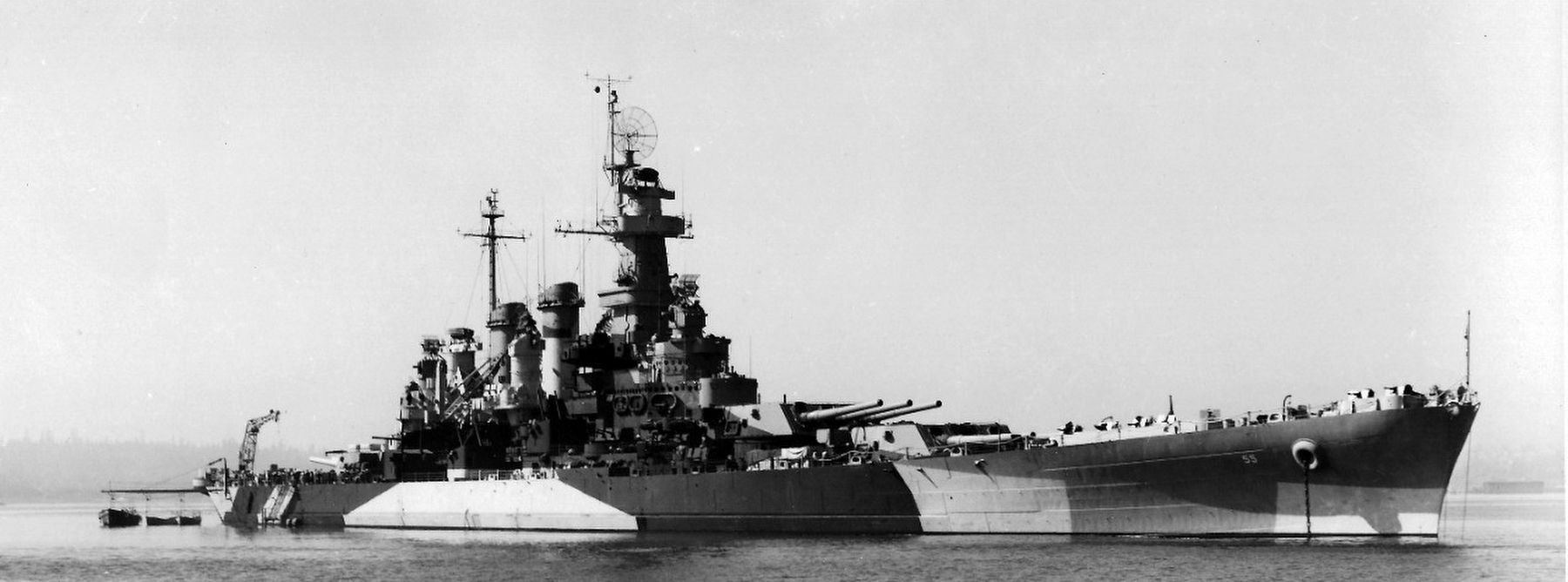
via Naval History and Heritage Command, 1944
6. USS North Carolina (BB-55) 1941-1961
Naval History and Heritage Command website entry
Click for more information.
Click for more information.
Credits. This page was last revised on May 22, 2025. It was originally submitted on May 13, 2025, by Brandon D Cross of Flagler Beach, Florida. This page has been viewed 122 times since then and 19 times this year. Photos: 1, 2, 3, 4, 5. submitted on May 13, 2025, by Brandon D Cross of Flagler Beach, Florida. 6. submitted on May 22, 2025, by Larry Gertner of New York, New York. • Bernard Fisher was the editor who published this page.
