Big Bog State Recreation Area near Waskish in Beltrami County, Minnesota — The American Midwest (Upper Plains)
The Red Lake Walleye Story
Photographed by McGhiever, August 29, 2021
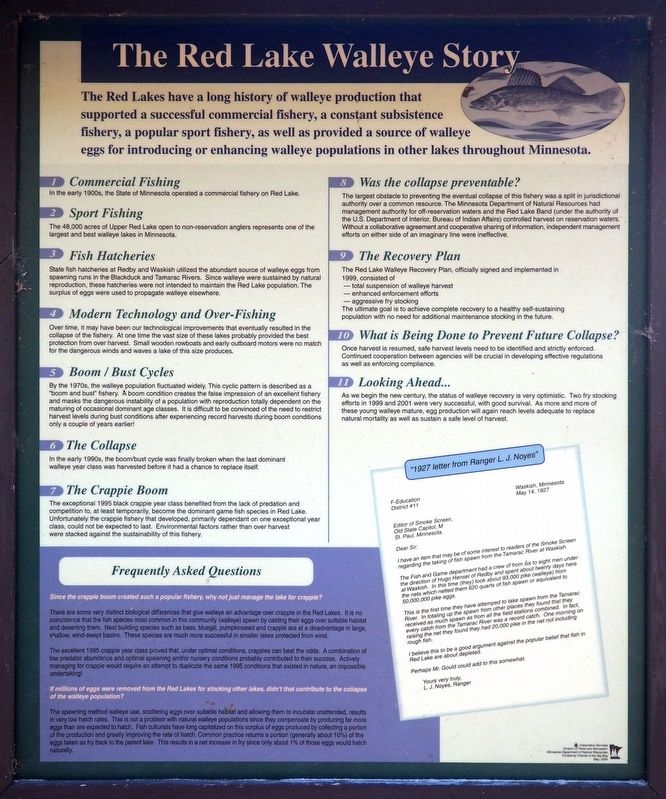
1. The Red Lake Walleye Story Marker
The Red Lakes have a long history of walleye production that supported a successful commercial fishery, a constant subsistence fishery, a popular sport fishery, as well as provided a source of walleye eggs for introducing or enhancing walleye populations in other lakes throughout Minnesota.
1. Commercial Fishing
In the early 1900s, the State of Minnesota operated a commercial fishery on Red Lake.
2. Sport Fishing
The 48,000 acres of Upper Red Lake open to non-reservation anglers represents one of the largest and best walleye lakes in Minnesota.
3. Fish Hatcheries
State fish hatcheries at Redby and Waskish utilized the abundant source of walleye eggs from spawning runs in the Blackduck and Tamarac Rivers. Since walleye were sustained by natural reproduction, these hatcheries were not intended to maintain the Red Lake population. The surplus of eggs were used to propagate walleye elsewhere.
4. Modern Technology and Over-Fishing
Over time, it may have been our technological improvements that eventually resulted in the collapse of the fishery. At one time the vast size of these lakes probably provided the
this page online
5. Boom / Bust Cycles
By the 1970s, the walleye population fluctuated widely. This cyclic pattern is described as a "boom and bust" fishery. A boom condition creates the false impression of an excellent fishery and masks the dangerous instability of a population with reproduction totally dependent on the maturing of occasional dominant age classes. It is difficult to be convinced of the need to restrict harvest levels during bust conditions after experiencing record harvests during boom conditions only a couple of years earlier!
6. The Collapse
In the early 1990s, the boom/bust cycle was finally broken when the last dominant walleye year class was harvested before it had a chance to replace itself.
7. The Crappie Boom
The exceptional 1995 black crappie year class benefited from the lack of predation and competition to, at least temporarily, become the dominant game fish species in Red Lake. Unfortunately the crappie fishery that developed, primarily dependent on

Photographed by McGhiever, September 1, 2021
2. The Red Lake Walleye Story Marker (east panel) at the beach on Upper Red Lake
8. Was the collapse preventable?
The largest obstacle to preventing the eventual collapse of this fisher was a split in jurisdictional authority over a common resource. The Minnesota Department of Natural Resources had management authority for off-reservation waters and the Red Lake Band (under the authority of the U.S. Department of Interior, Bureau of Indian Affairs) controlled harvest on reservation waters. Without a collaborative agreement and cooperative sharing of information, independent management efforts on either side of an imaginary line were ineffective.
9. The Recovery Plan
The Red Lake Walleye Recovery Plan, officially signed and implemented in 1999, consisted of
— total suspension of walleye harvest
— enhanced enforcement efforts
— aggressive fry stocking
The ultimate goal is to achieve complete recovery to a healthy self-sustaining population with no need for additional maintenance stocking in the future.
10. What is Being Done to Prevent Future Collapse?
Once harvest is resumed, safe harvest levels need to be identified and strictly enforced. Continued cooperation between agencies will be crucial in developing effective regulations as well as enforcing compliance.
11. Looking Ahead...
As he begin the new century, the status of the walleye recovery is very optimistic. Two fry stocking efforts in 1999 and 2001 were very successful, with good survival. As more and more of these young walleye mature, egg production will again reach levels adequate to replace natural mortality as well as sustain a safe level of harvest.
Since the crappie boom created such a popular fishery, why not just manage the lake for crappie?
There are some very distinct biological differences that give walleye and advantage over crappie in the Red Lakes. It is no coincidence that the fish species most common in this community (walleye) spawn by casting their eggs over suitable habitat and deserting them. Nest building species such as bass, bluegill, pumpkinseed and crappie are at a disadvantage in large, shallow, wind-swept basins. These species are much more successful in smaller lakes protected from wind.
The excellent 1995 crappie year class proved that, under optimal conditions, crappies can beat the odds. A combination of low predator abundance and optimal spawning and/or nursery conditions probably contributed to their success. Actively managing for crappie would require an attempt to duplicate the same 1995 conditions that existed in nature, an impossible undertaking!
If millions of eggs were removed from the Red Lakes for stocking other lakes, didn't that contribute to the collapse of the walleye population?
The spawning method walleye use, scattering eggs over suitable habitat and then allowing them to incubate unattended, results in very low hatch rates. This is not a problem with natural walleye populations since they compensate by producing far more eggs than are expected to hatch. Fish culturists have long capitalized on this surplus of eggs produced by collecting a portion of the production and greatly improving the rate of hatch. Common practice returns a portion (generally about 10%) of the eggs taken as fry back to the parent lake. This results in a net increase in fry since only about 1% of those eggs would hatch naturally.
"1927 letter from Ranger L. J. Noyes"
F-Education
District #11
Waskish, Minnesota
May 14, 1927
Editor of Smoke Screen
Old State Capitol, M
St. Paul, Minnesota.
Dear Sir:
I have an item that may be of some interest to readers of the Smoke Screen regarding the taking of fish spawn from the Tamarac River at Waskish.
The Fish and Game department had a crew of from six to eight men under the direction of Hugo Hensel of Redby and spent about twenty days here at Waskish. In this time (they) took about 93,000 pike (walleye) from the nets which netted them 620 quarts of fish spawn or equivalent to 50,000,000 pike eggs.
This is the first time they have attempted to take spawn from the Tamarac River. In totaling up the spawn from other places they found that they received as much spawn as from all the field stations combined. In fact, every catch from the Tamarac River was a record catch. One morning on raising the net they found they had 20,000 pike in the net not including rough fish.
I believe this to be a good argument against the popular belief that fish in Red Lake are about to be depleted.
Perhaps Mr. Gould could add to this somewhat.
Yours very truly,
L. J. Noyes, Ranger
Erected 2004 by Minnesota Department of Natural Resources.
Topics. This historical marker is listed in these topic lists: Animals • Industry & Commerce • Waterways & Vessels. A significant historical year for this entry is 1900.
Location. 48° 10.204′ N, 94° 30.901′ W. Marker is near Waskish, Minnesota, in Beltrami County. It is in the Big Bog State Recreation Area. It is on Waskish Beach Road N.E. west of State Highway 72, on the left when traveling west. The marker is in the southern unit of Big Bog State Recreation Area (fee area) at the beach. Touch for map. Marker is at or near this postal address: 55716 Minnesota Highway 72, Waskish MN 56685, United States of America. Touch for directions.

Regionally, this marker is in the Northland. It is also in the American Midwest and in the Corn Belt. Globally, it is in North America, the Great North Woods, the Western Hemisphere, the Western World, and the Anglosphere. Historically, it finds itself in what was once Rupert’s Land, the territory of the Mississippian Culture, the Louisiana Purchase, and the Northwest Territory.
Other nearby markers. At least 8 other markers are within walking distance of this marker: Miskwagami-wizaga-iganing (here, next to this marker); Where There is Smoke / Forests of the Agassiz Lowlands (about 800 feet away, measured in a direct line); Red Lake is Minnesota's Largest Lake! / Flat Terrain Lets Water Pool (about 800 feet away); Pure Peatland / A Boring Story (about 800 feet away); The Marina (about 800 feet away); Journey along the waters… (approx. 0.3 miles away); Historic Waskish Hatchery 1941–1979 (approx. 0.3 miles away); The Old Waskish Town Site (approx. 0.4 miles away). Touch for a list and map of all markers in Waskish.
Credits. This page was last revised on May 18, 2025. It was originally submitted on May 17, 2025, by McGhiever of Minneapolis, Minnesota. This page has been viewed 150 times since then and 35 times this year. Photos: 1. submitted on May 17, 2025, by McGhiever of Minneapolis, Minnesota. 2. submitted on May 16, 2025, by McGhiever of Minneapolis, Minnesota.
