
Buckeye - Shaker in Cleveland in Cuyahoga County, Ohio — The American Midwest (Great Lakes)
Ludlow Community
⎯⎯⎯
Ludlow Community Association
Photographed by Grant & Mary Ann Fish, April 12, 2025
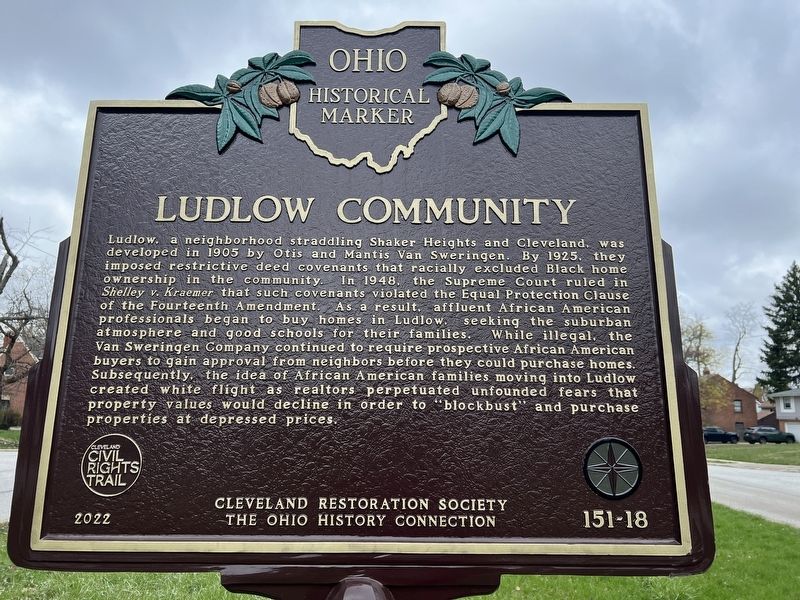
1. Ludlow Community Marker
Ludlow Community. Ludlow, a neighborhood straddling Shaker Heights and Cleveland, was developed in 1905 by Otis and Mantis Van Sweringen. By 1920, they imposed restrictive deed covenants that racially excluded Black home ownership in the community. In 1948, the Supreme Court ruled in Shelley v. Kraemer that such covenants violated the Equal Protection Clause of the Fourteenth Amendment. As a result, affluent African American professionals began to buy homes in Ludlow, seeking the suburban atmosphere and good schools for their families. While illegal, the Van Sweringen Company continued to require prospective African American buyers to gain approval from neighbors before they could purchase homes. Subsequently, the idea of African American families moving into Ludlow created white flight as realtors perpetuated unfounded fears that property values would decline in order to “blockbust” and purchase properties at depressed prices.
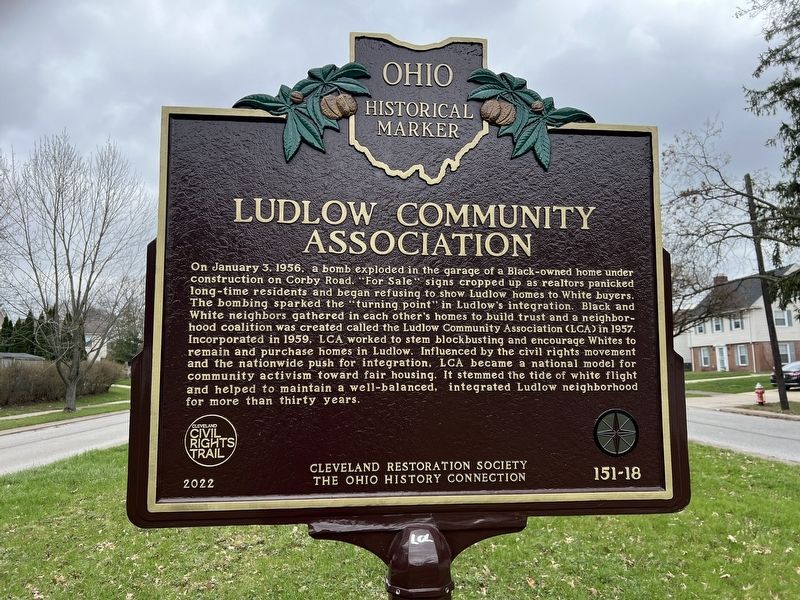
Ludlow Community Association. On January 3, 1956, a bomb exploded in the garage of a Black-owned home under construction on Corby Road. “For Sale” signs cropped up as realtors panicked long-time
this page online
Erected 2022 by Cleveland Restoration Society, Ohio History Connection. (Marker Number 151-18.)
Topics and series. This historical marker is listed in these topic lists: African Americans • Civil Rights. In addition, it is included in the Ohio Historical Society / The Ohio History Connection series list. A significant historical year for this entry is 1905.
Location. 41° 28.693′ N, 81° 35.278′ W. Marker is in Cleveland, Ohio, in Cuyahoga County.
Photographed by Grant & Mary Ann Fish, April 12, 2025
2. Ludlow Community Association Marker

Regionally, this marker is on Ohio’s Lake Erie Shore and in the Western Reserve. It is also in the American Midwest. Globally, it is in North America, on the Great Lakes, in the Western Hemisphere, in the Western World, and in the Anglosphere. Historically, it finds itself in what was once the Haudenosaunee (Iroquois) Confederacy, the territory of the Mississippian Culture, and the Northwest Territory.
Other nearby markers. At least 8 other markers are within walking distance of this marker: Shaker Gate Post (approx. 0.4 miles away); Shaker Square (approx. 0.4 miles away); Honoring the Memory of O.P. and M.J. Van Sweringen (approx. half a mile away); Shaker Mill Stone (approx. half a mile away); Van Sweringen Demonstration House (approx. half a mile away); a different marker also named Van Sweringen Demonstration House (approx. half a mile away); a different
Photographed by Grant & Mary Ann Fish, April 12, 2025
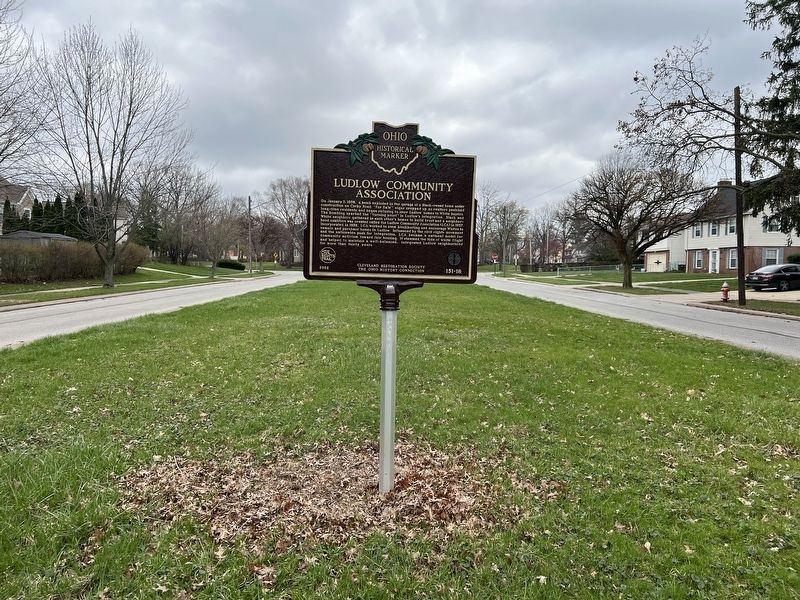
3. Marker in the Hampton Road median
Photographed looking northwest from Corby Road
Credits. This page was last revised on December 17, 2025. It was originally submitted on May 19, 2025, by Grant & Mary Ann Fish of Galloway, Ohio. This page has been viewed 176 times since then and 62 times this year. Photos: 1, 2, 3. submitted on May 19, 2025, by Grant & Mary Ann Fish of Galloway, Ohio. • Devry Becker Jones was the editor who published this page.
