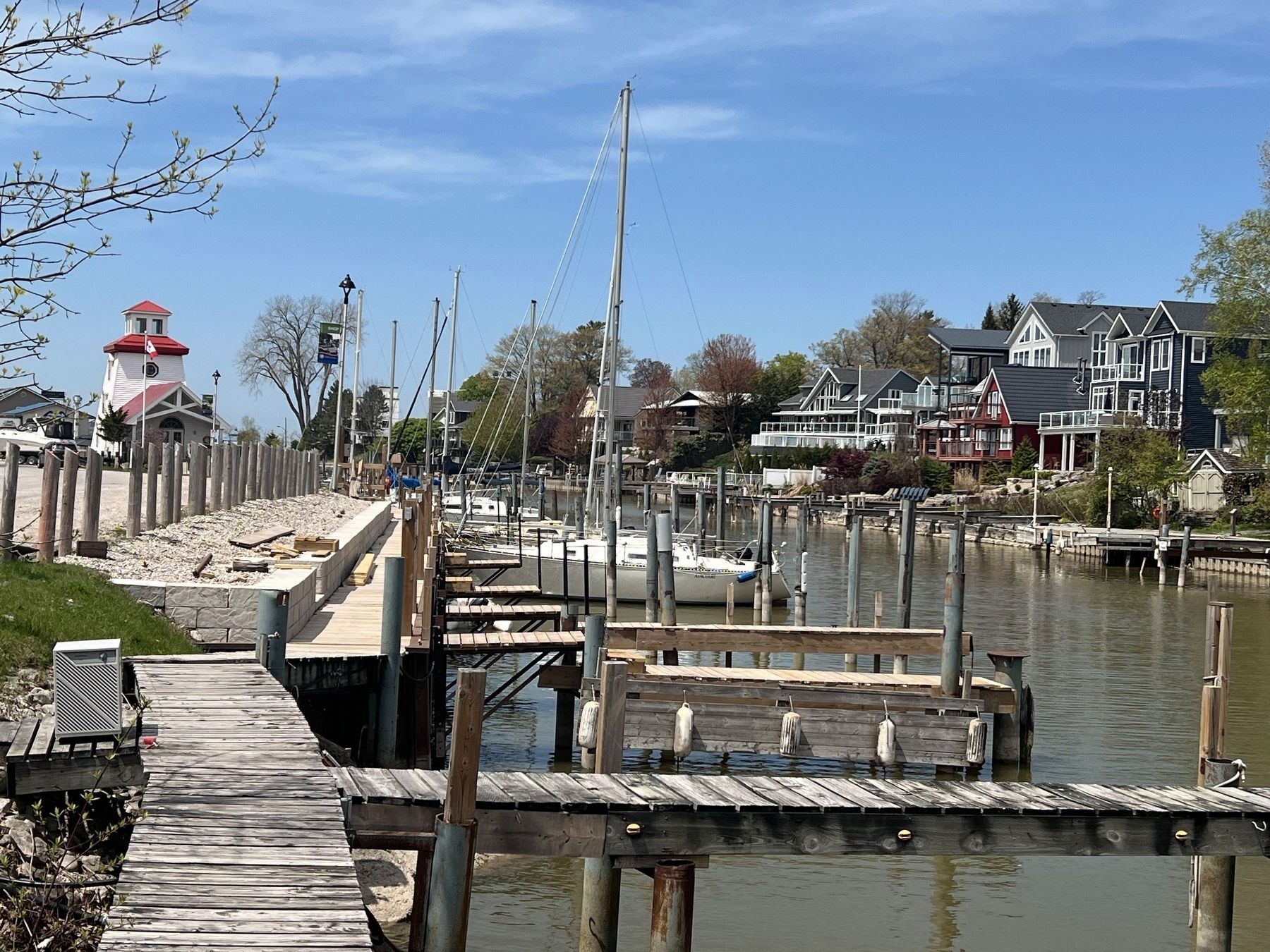
Grand Bend in Lambton County, Ontario — Central Canada (North America)
Grand Bend Early Enterprise
Photographed by Tim Boyd, May 12, 2025
1. Grand Bend Early Enterprise Marker
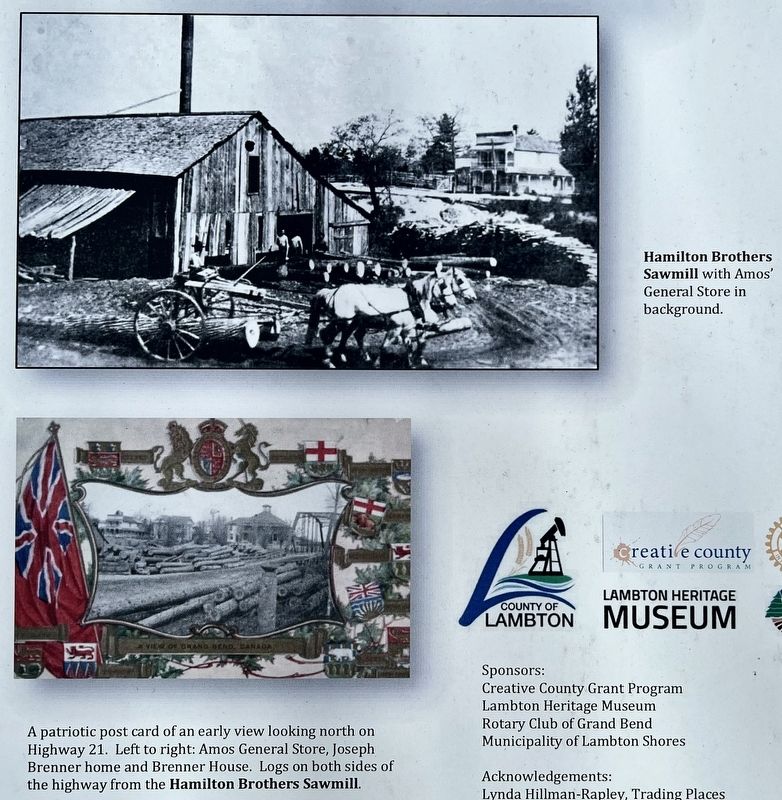
Inscription.
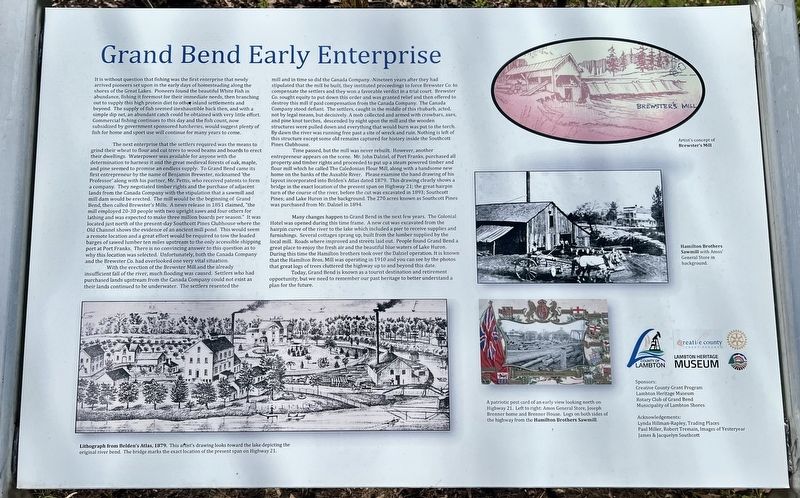
Grand Bend Early Enterprise. . It is without question that fishing was the first enterprise that newly arrived pioneers set upon in the early days of homesteading along the shores of the Great Lakes. Pioneers found the beautiful White Fish in abundance, fishing it foremost for their immediate needs, then branching out to supply this high protein diet to other inland settlements and beyond. The supply of fish seemed inexhaustible back then, and with a simple dip net, an abundant catch could be obtained with very little effort. Commercial fishing continues to this day and the fish count, now subsidized by government sponsored hatcheries, would suggest plenty of fish for home and sport use will continue for many years to come., The next enterprise that the settlers required was the means to grind their wheat to flour and cut trees to wood beams and boards to erect their dwellings. Waterpower was available for anyone with the determination to harness it and the great medieval forests of oak, maple, and pine seemed to promise an endless subolv. To Grand Bend came its first entrepreneur by the name of Benjamin Brewster, nicknamed the Professor' along with his partner, Mr. Pettis, who received patents to form a company. They negotiated timber rights and the purchase of adjacent lands from the Canada Company with the stipulation that a sawmill and mill dam would be erected. The mill would be the beginning of Grand Bend, then called Brewster's Mills. A news release in 1851 claimed, "the mill employed 20-30 people with two upright saws and four others for lathing and was expected to make three million boards per season." It was located just north of the present-day Southcott Pines Clubhouse where the Old Channel shows the evidence of an ancient mill pond. This would seem a remote location and a great effort would be required to tow the loaded barges of sawed lumber ten miles upstream to the only accessible shipping port at Port Franks. There is no convincing answer to this question as to why this location was selected. Unfortunately, both the Canada Company and the Brewster Co. had overlooked one very vital situation., With the erection of the Brewster Mill and the already insufficient fall of the river, much flooding was caused. Settlers who had purchased lands upstream from the Canada Company could not exist as their lands continued to be underwater. The settlers resented the mill and in time so did the Canada Company. Nineteen years after they had stipulated that the mill be built, they instituted proceedings to force Brewster Co. to compensate the settlers and they won a favorable verdict in a trial court. Brewster Co. sought equity to put down this order and was granted relief and then offered to destroy this mill if paid compensation from the Canada Company. The Canada Company stood defiant. The settlers, caught in the middle of this rhubarb, acted, not by legal means, but decisively. A mob collected and armed with crowbars, axes and pine knot torches, descended by night upon the mill and the wooden structures were pulled down and everything that would burn was put to the torch. By dawn the river was running free past a site of wreck and ruin. Nothing is left of this structure except some old remains captured for history inside the Southcott Pines Clubhouse., Time passed, but the mill was never rebuilt. However, another entrepreneur appears on the scene. Mr. John Dalziel, of Port Franks, purchased all property and timber rights and proceeded to put up a steam powered timber and flour mill which he called The Caledonian Flour Mill, along with a handsome new home on the banks of the Auxable River. Please examine the hand drawing of his layout incorporated into Belden's Atlas dated 18/9. This drawing clearly shows a bridge in the exact location of the present span on Highway 21; the great hairpin turn of the course of the river, before the cut was excavated in 1893; Southcott Pines; and Lake Huron in the background. The 270 acres known as Southcott Pines was purchased from Mr. Dalziel in 1894., Many changes happen to Grand Bend in the next few years. The Colonial Hotel was opened during this time frame. A new cut was excavated from the hairpin curve of the river to the lake which included a pier to receive supplies and furnishings. Several cottages sprang up, built from the lumber supplied by the local mill. Roads where improved and streets laid out. People found Grand Bend a great place to enjoy the fresh air and the beautiful blue waters of Lake Huron. During this time the Hamilton brothers took over the Dalziel operation. It is known that the Hamilton Bros. Mill was operating in 1910 and you can see by the photos that great logs of trees cluttered the highway up to and beyond this date., Today, Grand Bend is known as a tourist destination and retirement opportunity, but we need to remember our past heritage to better understand a plan for the future.
It is without question that fishing was the first enterprise that newly arrived pioneers set upon in the early days of homesteading along the shores of the Great Lakes. Pioneers found the beautiful White Fish in abundance, fishing it foremost for their immediate needs, then branching out to supply this high protein diet to other inland settlements and beyond. The supply of fish seemed inexhaustible back then, and with a simple dip net, an abundant catch could be obtained with very little effort. Commercial fishing continues to this day and the fish count, now subsidized by government sponsored hatcheries, would suggest plenty of fish for home and sport use will continue for many years to come.
The next enterprise that the settlers required was the means to grind their wheat to flour and cut trees to wood beams and boards to erect their dwellings. Waterpower was available for anyone with the determination to harness it and the great medieval forests of oak, maple, and pine seemed to promise an endless subolv. To Grand Bend came its first entrepreneur by the name of Benjamin Brewster, nicknamed the Professor' along with his partner, Mr. Pettis, who received patents to form a company. They negotiated timber rights and the purchase of adjacent lands from the Canada Company with the stipulation that a sawmill and mill dam would be erected. The mill would be the beginning of Grand Bend, then called Brewster's Mills. A news release in 1851 claimed, "the mill employed 20-30 people
Click or scan to see this page online
with two upright saws and four others for lathing and was expected to make three million boards per season." It was located just north of the present-day Southcott Pines Clubhouse where the Old Channel shows the evidence of an ancient mill pond. This would seem a remote location and a great effort would be required to tow the loaded barges of sawed lumber ten miles upstream to the only accessible shipping port at Port Franks. There is no convincing answer to this question as to why this location was selected. Unfortunately, both the Canada Company and the Brewster Co. had overlooked one very vital situation.
With the erection of the Brewster Mill and the already insufficient fall of the river, much flooding was caused. Settlers who had purchased lands upstream from the Canada Company could not exist as their lands continued to be underwater. The settlers resented the mill and in time so did the Canada Company. Nineteen years after they had stipulated that the mill be built, they instituted proceedings to force Brewster Co. to compensate the settlers and they won a favorable verdict in a trial court. Brewster Co. sought equity to put down this order and was granted relief and then offered to destroy this mill if paid compensation from the Canada Company. The Canada Company stood defiant. The settlers, caught in the middle of this rhubarb, acted, not by legal means, but decisively. A mob collected and armed with crowbars, axes and pine knot torches, descended by night upon the mill and the wooden structures were pulled
Photographed by Tim Boyd, May 12, 2025
2. Grand Bend Early Enterprise Marker
down and everything that would burn was put to the torch.
By dawn the river was running free past a site of wreck and ruin. Nothing is left of this structure except some old remains captured for history inside the Southcott Pines Clubhouse.
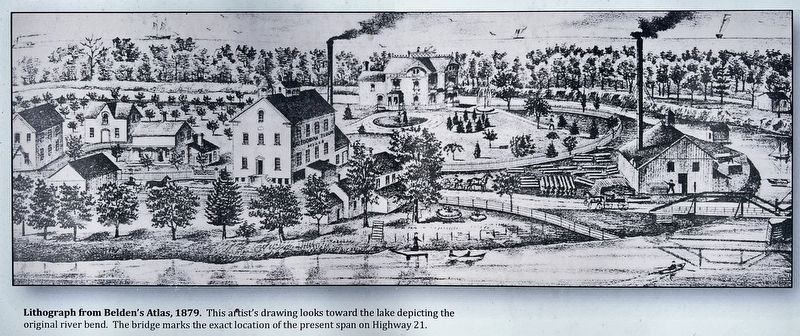
Time passed, but the mill was never rebuilt. However, another entrepreneur appears on the scene. Mr. John Dalziel, of Port Franks, purchased all property and timber rights and proceeded to put up a steam powered timber and flour mill which he called The Caledonian Flour Mill, along with a handsome new home on the banks of the Auxable River. Please examine the hand drawing of his layout incorporated into Belden's Atlas dated 18/9. This drawing clearly shows a bridge in the exact location of the present span on Highway 21; the great hairpin turn of the course of the river, before the cut was excavated in 1893; Southcott Pines; and Lake Huron in the background. The 270 acres known as Southcott Pines was purchased from Mr. Dalziel in 1894.
Many changes happen to Grand Bend in the next few years. The Colonial Hotel was opened during this time frame. A new cut was excavated from the hairpin curve of the river to the lake which included a pier to receive supplies and furnishings. Several cottages sprang up, built from the lumber supplied by the local mill. Roads where improved and streets laid out. People found Grand Bend a great place to enjoy the fresh air and the beautiful blue waters of Lake Huron.
During this time the Hamilton brothers took over the Dalziel operation.
Photographed by Beldens Atlas, 1879
3. Grand Bend Early Enterprise marker illustration and caption detail
It is known that the Hamilton Bros. Mill was operating in 1910 and you can see by the photos that great logs of trees cluttered the highway up to and beyond this date.
Today, Grand Bend is known as a tourist destination and retirement opportunity, but we need to remember our past heritage to better understand a plan for the future.
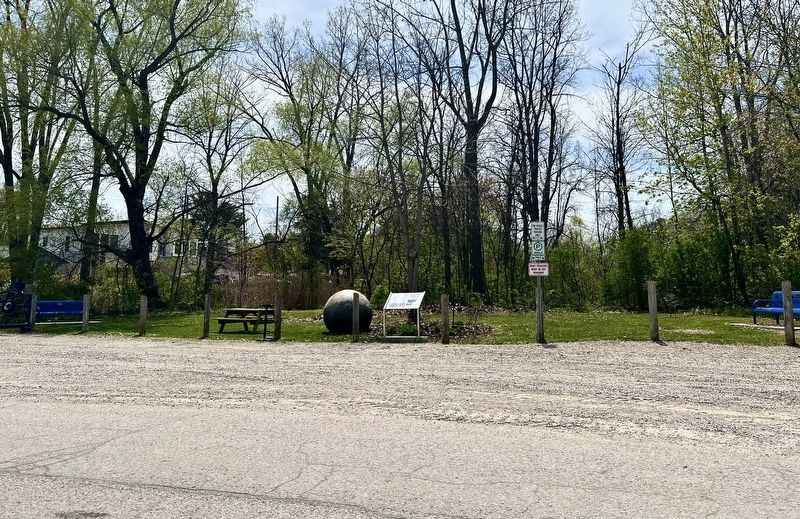
Location. 43° 18.714′ N, 81° 45.686′ W. Marker is in Grand Bend, Ontario, in Lambton County. It is at the intersection of River Road and Alberta Street, on the left when traveling north on River Road. Touch for map. Marker is at or near this postal address: 46 River Road, Grand Bend ON N0M 1T0, Canada. Touch for directions.
Regionally, this marker is in the Southwest Ontario Area and in Southwestern Ontario. It is also in Central Canada. Globally, it is in North America, the Western Hemisphere, the Western World, and the Anglosphere. Historically, it finds itself in what was once a British colony, the Viceroyalty of New France, the Haudenosaunee (Iroquois) Confederacy, and Ruperts Land.
Other nearby markers. At least 4 other markers are within 29 kilometers of this marker, measured as the crow flies: Grand Bend (within shouting distance of this marker); The Founding of Parkhill (approx. 17.8 kilometers away); The Founding of Thedford (approx. 18.2 kilometers away); Sir George W. Ross (approx. 27.8 kilometers away).
Photographed by Tim Boyd, May 12, 2025
4. Grand Bend Early Enterprise marker photos and captions detail

Photographed by Tim Boyd, May 12, 2025
5. Grand Bend, 2025
Credits. This page was last revised on May 23, 2025. It was originally submitted on May 19, 2025, by Tim Boyd of Hamilton, Ontario. This page has been viewed 121 times since then and 14 times this year. Photos:1, 2, 3, 4, 5. submitted on May 19, 2025, by Tim Boyd of Hamilton, Ontario. • Andrew Ruppenstein was the editor who published this page.