
Barrie in Simcoe County, Ontario — Central Canada (North America)
Five Points
| — | Waterfront Heritage Trail | — |
Photographed by Cosmos Mariner, June 5, 2024
1. Five Points Marker
Mill Road
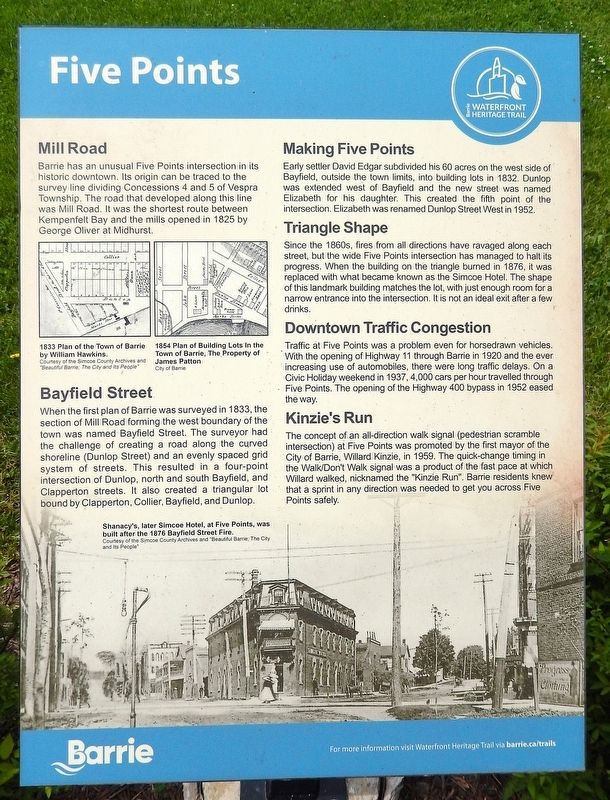
Barrie has an unusual Five Points intersection in its historic downtown. Its origin can be traced to the survey line dividing Concessions 4 and 5 of Vespra Township. The road that developed along this line was Mill Road. It was the shortest route between Kempenfelt Bay and the mills opened in 1825 by George Oliver at Midhurst.
Bayfield Street
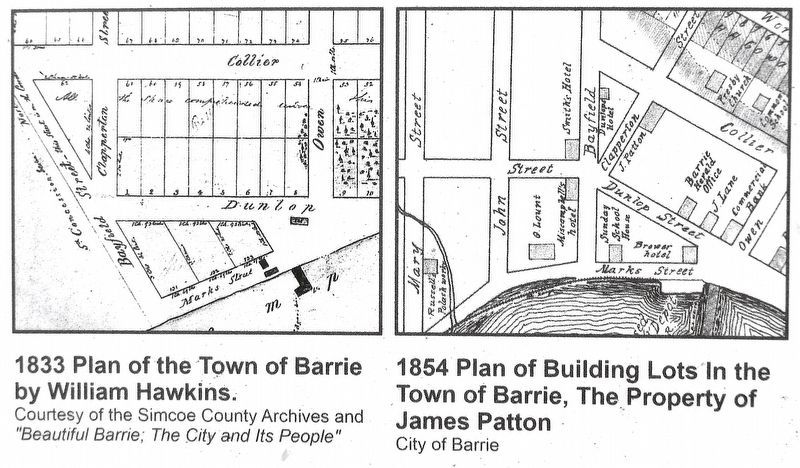
When the first plan of Barrie was surveyed in 1833, the section of Mill Road forming the west boundary of the town was named Bayfield Street. The surveyor had the challenge of creating a road along the curved shoreline (Dunlop Street) and an evenly spaced grid system of streets. This resulted in a four-point intersection of Dunlop, north and south Bayfield, and Clapperton streets. It also created a triangular lot bound by Clapperton, Collier, Bayfield, and Dunlop.
Making Five Points
Early settler David Edgar subdivided his 60 acres on the west side of Bayfield, outside the town limits, into building lots in 1832. Dunlop was extended west of Bayfield and the new street was named Elizabeth for his daughter. This created the fifth point of the intersection. Elizabeth was renamed
this page online
Triangle Shape
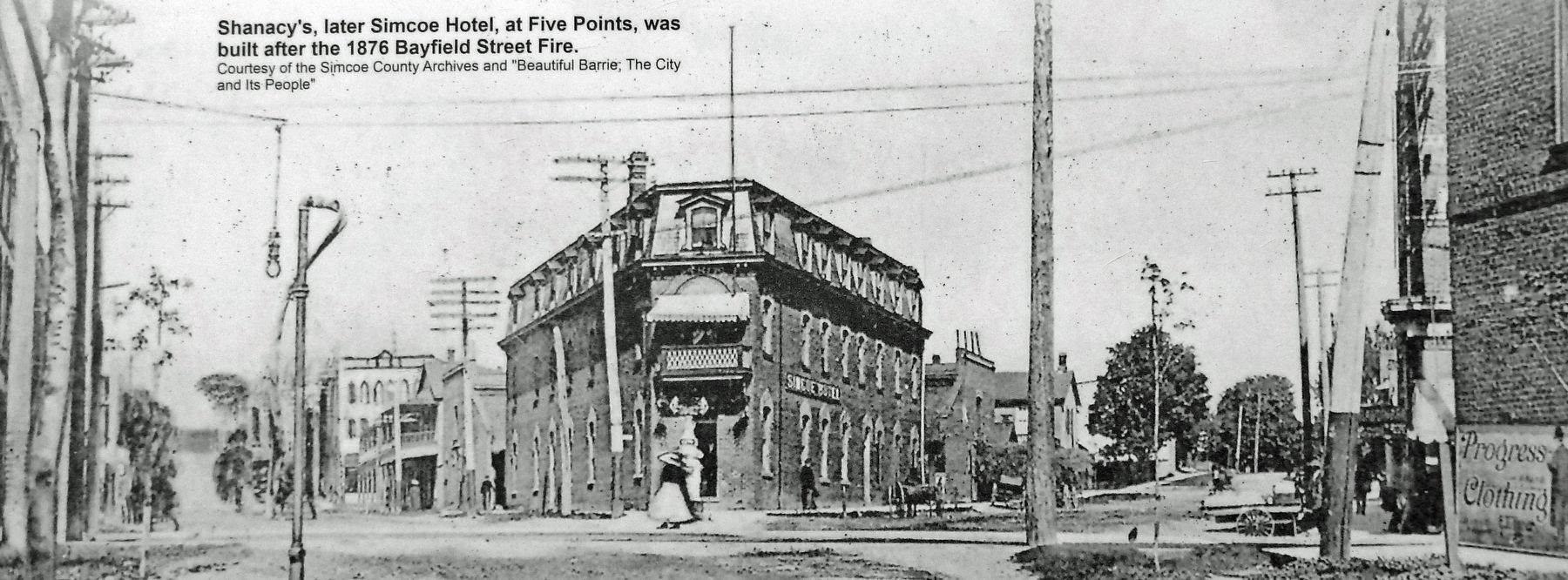
Since the 1860s, fires from all directions have ravaged along each street, but the wide Five Points intersection has managed to halt its progress. When the building on the triangle burned in 1876, it was replaced with what became known as the Simcoe Hotel. The shape of this landmark building matches the lot, with just enough room for a narrow entrance into the intersection. It is not an ideal exit after a few drinks.
Downtown Traffic Congestion
Traffic at Five Points was a problem even for horsedrawn vehicles. With the opening of Highway 11 through Barrie in 1920 and the ever increasing use of automobiles, there were long traffic delays. On a Civic Holiday weekend in 1937, 4,000 cars per hour travelled through Five Points. The opening of the Highway 400 bypass in 1952 eased the way.
Kinzie's Run
The concept of an all-direction walk signal (pedestrian scramble intersection) at Five Points was promoted by the first mayor of the City of Barrie, Willard Kinzie, in 1959. The quick-change timing in the Walk/Don't Walk signal was a product of the fast pace at which Willard walked, nicknamed the "Kinzie
2. Marker detail: Barrie Town Plan & Building Lot Plan
1833 Plan of the Town of Barrie by William Hawkins. [Courtesy of the Simcoe County Archives and "Beautiful Barrie; The City and Its People"] • • • 1854 Plan of Building Lots In the Town of Barrie, The Property of James Patton [Courtesy City of Barrie]
Erected by Barrie Waterfront Heritage Trail.
Topics. This historical marker is listed in these topic lists: Industry & Commerce • Roads & Vehicles • Settlements & Settlers. A significant historical year for this entry is 1833.
Location. 44° 23.301′ N, 79° 41.218′ W. Marker is in Barrie, Ontario, in Simcoe County. It is at the intersection of Simcoe Street and Lakeshore Mews, on the right when traveling east on Simcoe Street. The marker is at Waterfront Heritage Trail Station #9 ("Downtown"), on the west side of the Heritage Park parking lot. Touch for map. Marker is at or near this postal address: 5 Simcoe Street, Barrie ON L4M 1L6, Canada. Touch for directions.

Regionally, this marker is in Central Ontario Cottage Country and specifically in Georgian Bay Country. It is also in Central Canada. Globally, it is in North America, the Western Hemisphere, the Western World, and the Anglosphere. Historically, it finds itself in what was once a British colony, the Viceroyalty of New France, the Haudenosaunee
Simcoe County Archives, and "Beautiful Barrie; The City and Its People”, after 1876
3. Marker detail: Shanacy's, later Simcoe Hotel, at Five Points
It was built after the 1876 Bayfield Street Fire.
Other nearby markers. At least 8 other markers are within walking distance of this marker: Memorial Square (here, next to this marker); Railway Watercraft (here, next to this marker); Nine Mile Portage (here, next to this marker); Birth of Barrie (here, next to this marker); Wharfs & Boatworks (here, next to this marker); Lost Buildings (here, next to this marker); County Town (here, next to this marker); Market Hall (here, next to this marker). Touch for a list and map of all markers in Barrie.
Also see . . . Five Points intersection no stranger to fire (Barrie Today).
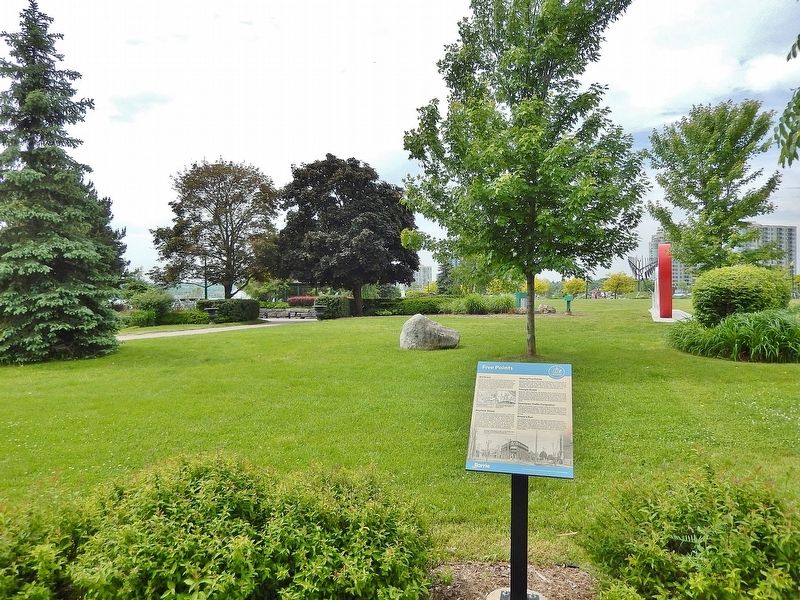
(By Mary Harris, 8/26/2023) Excerpt: None of the famed Five Points escaped doing battle with fire, but the northeastern point may have been the most scorched of them all. One final blaze claimed the whole corner eventually. The Bank of Toronto building, built by Francis Steevens about 1852, was one of the earliest structures built of brick in Barrie. It was rather unusual at the time for this small back-country town. If Francis Steevens thought he had outsmarted Barrie’s oldest foe, the flames of destructive(Submitted on May 21, 2025, by Cosmos Mariner of Cape Canaveral, Florida.)fire, he was in for an unpleasant surprise. In 1873, when the Bank of Toronto vacated the corner building, it was converted into the appropriately named Bank Hotel. In late 1874, the hotel was doing very well under the management of Charles Clarkson. Then came that fateful day in June 1875, four years to the day after the fire that saw the entire Glebe Block across the street reduced to ashes. When it was over, nothing remained but a few partial walls and the solidly built bank vault within the hotel. Even as it lay in ruins, the Bank Hotel was credited with preventing the fire from crossing the Five Points and destroying the Simcoe Hotel, the Wellington Hotel and other buildings.Photographed by Cosmos Mariner, June 5, 20244. Five Points MarkerLooking west through Heritage Park. The Waterfront Heritage Trail is on the left.
Credits. This page was last revised on May 22, 2025. It was originally submitted on May 19, 2025, by Cosmos Mariner of Cape Canaveral, Florida. This page has been viewed 118 times since then and 19 times this year. Photos: 1, 2, 3, 4. submitted on May 21, 2025, by Cosmos Mariner of Cape Canaveral, Florida.
