Barrie in Simcoe County, Ontario — Central Canada (North America)
Steamboat J.C. Morrison
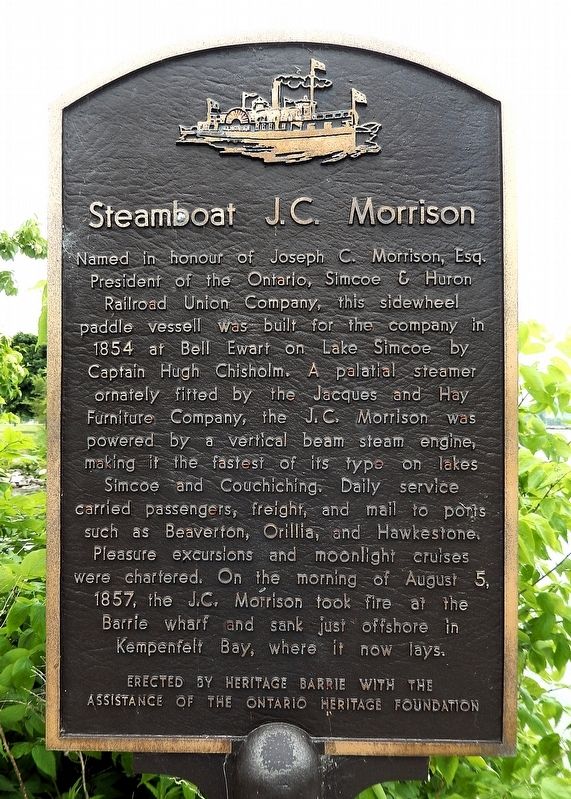
Photographed by Cosmos Mariner, June 5, 2024
1. Steamboat J.C. Morrison Marker
Named in honour of Joseph C. Morrison, Esq. President of the Ontario, Simcoe & Huron Railroad Union Company, this sidewheel paddle vessel was built for the company in 1854 at Bell Ewart on Lake Simcoe by Captain Hugh Chisholm. A palatial steamer ornately fitted by the Jacques and Hay Furniture Company, the J.C. Morrison was powered by a vertical beam steam engine, making it the fastest of its type on lakes Simcoe and Couchiching. Daily service carried passengers, freight, and mail to ports such as Beaverton, Orillia, and Hawkestone. Pleasure excursions and moonlight cruises were chartered. On the morning of August 5, 1857, the J.C. Morrison took fire at the Barrie wharf and sank just offshore in Kempenfelt Bay, where it now lays.
Erected by Heritage Barrie and The Ontario Heritage Foundation.
Topics. This historical marker is listed in these topic lists: Disasters • Industry & Commerce • Waterways & Vessels. A significant historical date for this entry is August 5, 1857.
Location. 44° 22.567′ N, 79° 41.261′ W. Marker is in Barrie, Ontario, in Simcoe County. It can be reached from Lakeshore Drive just north of Tiffin
this page online

Regionally, this marker is in Central Ontario Cottage Country and specifically in Georgian Bay Country. It is also in Central Canada. Globally, it is in North America, on the Great Lakes, in the Western Hemisphere, in the Western World, and in the Anglosphere. Historically, it finds itself in what was once a British colony, the Viceroyalty of New France, the Haudenosaunee (Iroquois) Confederacy, and Rupert’s Land.
Other nearby markers. At least 8 other markers are within walking distance of this marker: Steamboating on Lake Simcoe / La navigation à vapeur sur le lac Simcoe (here, next to this marker); Boats on the Bay (here, next to this marker); Kempenfelt Kelly (here, next to this marker); Allandale Railway Station (about 240 meters away, measured in a direct line); An Independent Village (approx. 0.3 kilometers away); Train Town Kids (approx.

Photographed by Cosmos Mariner, June 5, 2024
2. Steamboat J.C. Morrison Marker
Looking north; Kempenfelt Bay (Lake Simcoe) is in the background.
Also see . . . J. C. Morrison (Wikipedia).
Excerpt: Her 25-foot-tall beam engine and boiler were designed by Gartshore & Company and her silverware was manufactured by W. Adams & Sons. The ship was 150 feet long with a 24-foot beam, had a total tonnage of 150, and her 20-foot paddle wheels could make the vessel travel at 18 miles per hour. By June 30, 1855, the Joseph Curran Morrison was fully completed with a final cost of between $18,000 and $20,000 (roughly $698,411 today).(Submitted on May 20, 2025, by Cosmos Mariner of Cape Canaveral, Florida.)
On August 5, 1857, J. C. Morrison was docked at Allendale Station overnight with passengers asleep in their berths. At around 12:30 AM, one of the firemen was woken up and ordered to head up on deck. The fireman saw fire spreading from the ship's boiler while he was on his way up, so he sounded the alarm. Captain Bell gave the order to abandon ship and began to wake his passengers. Only a few minutes passed before the entire ship was in flames. Captain Bell eventually saved himself from the burning J. C. Morrison after evacuating every last passenger on board. Firefighters quickly made it on the scene and decided to let the ship go out on the lake to burn without the risk of nearby buildings going up in flames. As they did, a light breeze began to push the ship farther north than intended, causing the vessel to land at one of the many wharves on the north side of Barrie. She was let go once more, burning with such intensity that buildings on the shoreline were lit up by the reflection of the flames. J. C. Morrison finally plunged after an hour and a half of burning, described with a "loud hissing noise". Nothing was saved from J. C. Morrison with the exception of some cash and a few account books, which were saved by the ship's purser. The cause of the fire was never determined by officials.
In 1974, two Innisfil scuba divers located the broken-up wreck of J. C. Morrison. Artifacts were recovered and put on display at the Simcoe County Museum. The wreck is mostly used as a training site for amateur scuba divers in Simcoe County.
Credits. This page was last revised on May 20, 2025. It was originally submitted on May 19, 2025, by Cosmos Mariner of Cape Canaveral, Florida. This page has been viewed 197 times since then and 38 times this year. Photos: 1, 2. submitted on May 20, 2025, by Cosmos Mariner of Cape Canaveral, Florida.
