Near Colonial Heights in Chesterfield County, Virginia — The American South (Mid-Atlantic)
Battle of Swift Creek
"Brave to Madness"
Photographed by Craig Swain, November 22, 2008
1. Battle of Swift Creek Marker (correct version)
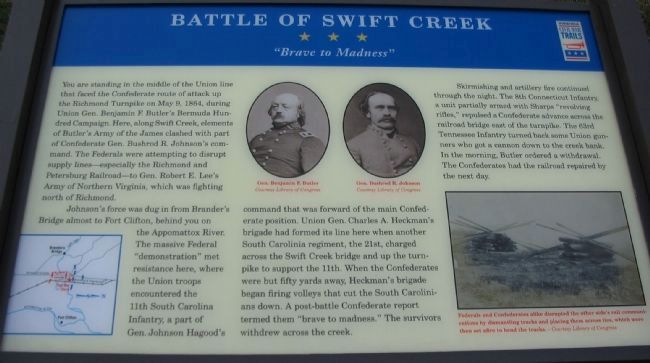
This earlier version of the marker has the correct captions on the portraits.
You are standing in the middle of the Union line that faced the Confederate route of attack up the Richmond Turnpike on May 9, 1864, during Union Gen. Benjamin F. Butler's Bermuda Hundred Campaign. Here, along Swift Creek, elements of Butler's Army of the James clashed with part of Confederate Gen. Bushrod R. Johnson's command. The Federals were attempting to disrupt supply lines—especially the Richmond and Petersburg Railroad—to Gen. Robert E. Lee's Army of Northern Virginia, which was fighting north of Richmond.
Johnson's force was dug in from Brander's Bridge almost to Fort Clifton, behind you on the Appomattox River. The massive Federal "demonstration" met resistance here, where the Union troops encountered the 11th South Carolina Infantry, a part of Gen. Johnson Hagood's command that was forward of the main Confederate position. Union Gen. Charles A. Heckman's brigade had formed its line here when another South Carolina regiment, the 21st, charged across the Swift Creek bridge and up the turnpike to support the 11th. When the Confederates were but fifty yards away, Heckman's brigade began firing volleys that cut
this page online
Skirmishing and artillery fire continued through the night. The 8th Connecticut Infantry, a unit partially armed with Sharps "revolving rifles," repulsed a Confederate advance across the railroad bridge east of the turnpike. The 63rd Tennessee Infantry turned back some Union gunners who got a cannon down to the creek bank. In the morning, Butler ordered a withdrawal. The Confederates had the railroad repaired by the next day.
(captions)
Gen. Benjamin F. Butler Courtesy Library of Congress
Gen. Bushrod R. Johnson Courtesy Library of Congress
Federals and Confederates alike disrupted the other side's rail communications by dismantling tracks and placing them across ties, which were set afire to bend the tracks. - Courtesy Library of Congress
Erected by Virginia Civil War Trails.
Topics and series. This historical marker is listed in this topic list: War, US Civil. In addition, it is included in the Virginia Civil War Trails series list. A significant historical date for this entry is May 9, 1864.
Location. 37° 17.027′ N,

Photographed by Evan Dwyer, March 1, 2025
2. Battle of Swift Creek Marker

Regionally, this marker is in the Piedmont, in Central Virginia, and in the Richmond Metropolitan Area. It is also in the American South, specifically in the Upper South, and on the Eastern Seaboard. Globally, it is in the North Atlantic Region, North America, the Western Hemisphere, the Western World, and the Anglosphere. Historically, it finds itself in what was once the territory of the Mississippian Culture, one of the original Thirteen Colonies, one of the Confederate States of America, and the Antebellum South.
Other nearby markers. At least 8 other markers are within one mile of this marker, measured as the crow flies: "Brave to Madness" (about 500 feet away); Swift Creek Battlefield: A Landscape of Change (about 500 feet

Photographed by Craig Swain, November 22, 2008
3. Battle of Swift Creek Marker
This is a photo in context before it was moved.
Another marker is no longer nearby. Union Army Checked (was about 400 feet away, measured in a direct line but has been permanently removed).
More about this marker. Marker has been in two locations within the lot - originally it was at the base of the road bank that forms the west boundary of the lot. It is now on the northern side of the lot facing the battlefield area.
Additional commentary.
1.
Veterans of the S.C 25th Regiment of Hagood's Brigade, said in an obituary of Captain James M Carson, Commander Company A, that he "led the disastrous charge" at Swift Creek. In Gen. Hagood's "Memoirs of the War of Secession", pages 227-231, he says that Captain Carson commanded a detachment of the 25th Reigment that was with Gantt's 11th Regiment in this battle. He
Photographed by Mike McKeown, April 26, 2024
4. Battle of Swift Creek Marker (mislabeled captions)
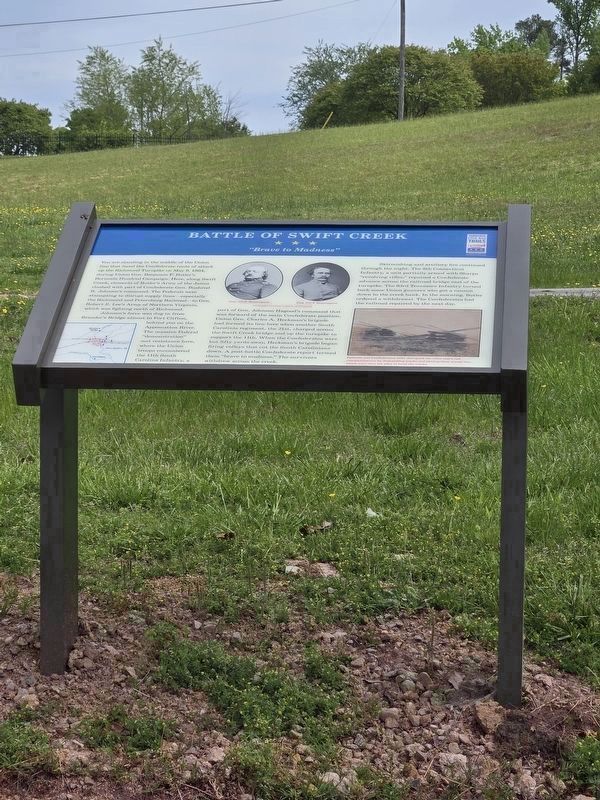
This panel was quickly replaced with updated captions.
When I was a small boy, my grand father told me of being able to put his finger in a deep groove above the left ear of his father, Captain James M Carson, from a wound he received in Virginia.
Capt. Carson later commanded the 25th Regiment as it was ordered out of the defenses at Petersburg, and left o/a the
Photographed by Craig Swain, November 22, 2008
5. Swift Creek Mill
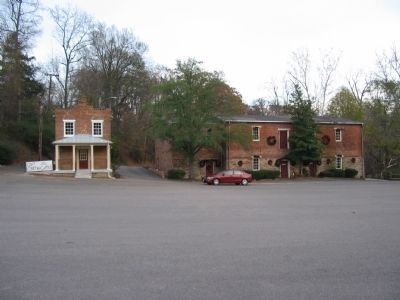
The mill was the center of the battle area. Today it is a theater and playhouse.
Ft. Fisher guarded Wilmington, the last open port the South had. About 65 ships including five Ironclads surrounded Ft. Fisher off the coast in an arc and fired on the fort aiming in a coordinated way, from one parapet to the next gun parapet, in the second and successful attack there. There Captain Carson was wounded again, early in the day's hand to hand fighting This time in the left shoulder. Family lore is that his arm and life were saved by a Union Surgeon. He was sent by ship to Ft. Monroe as a P.W. And was afterwards transferred to a P.W. prison on an island in New York harbor. At the end of the war, he was sent by ship to Virginia and had to walk home to South Carolina.
My own father, James M Carson II, named for and grand son of Captain James M Carson mentioned above, commanded an Anti Aircraft Battery at Pearl Harbor, Dec. 7, 1941, and later

Photographed by Craig Swain, November 22, 2008
6. Swift Creek Mill Pond
Looking from the parking area to the south across Swift Creek. Hagood's Brigade initially occupied defensive positions on the south side of the creek. The area is now heavily developed.
I am great grand son and a two tour Infantry veteran of the Vietnam War.
I have an original hard bound copy of the obituary of my great grand father, with various first hand witness statements of his and their service in the South Carolina 25th Regiment, (AKA, Washington Light Infantry, of Charleston, S.C.)
Col. James M Carson III
U.S.M.A, '64
Ashland, Va
July 13, 2013 Note To Editor only visible by Contributor and editor
— Submitted July 13, 2013, by James M Carson, Jr of Ashland, Virginia.
Credits. This page was last revised on May 19, 2025. It was originally submitted on December 23, 2008, by Craig Swain of Leesburg, Virginia. This page has been viewed 6,145 times since then and 162 times this year. Last updated on May 19, 2025, by Evan Dwyer of Richmond, Virginia. Photos: 1. submitted on December 23, 2008, by Craig Swain of Leesburg, Virginia. 2. submitted on May 19, 2025, by Evan Dwyer of Richmond, Virginia. 3. submitted on December 23, 2008, by Craig Swain of Leesburg, Virginia. 4. submitted on March 12, 2025, by Mike McKeown of Baltimore, Maryland. 5, 6. submitted on December 23, 2008, by Craig Swain of Leesburg, Virginia. • Devry Becker Jones was the editor who published this page.
