Barrie in Simcoe County, Ontario — Central Canada (North America)
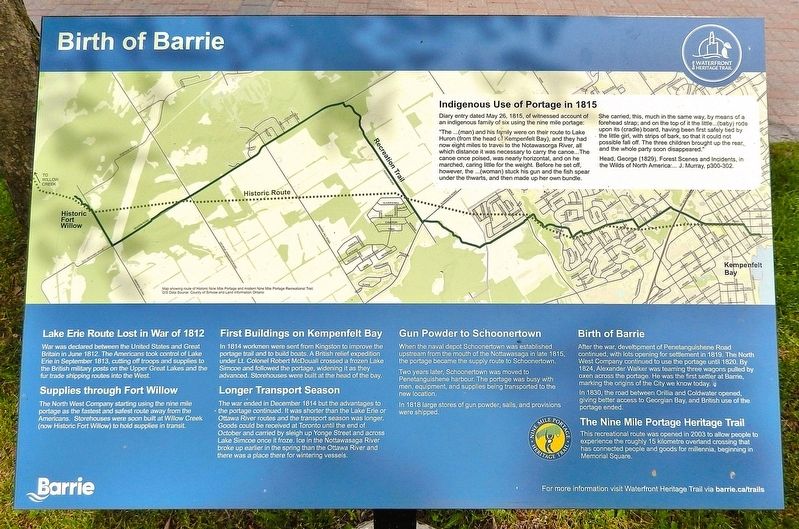
Birth of Barrie
| — | Waterfront Heritage Trail & Nine Mile Portage Heritage Trail | — |
Photographed by Cosmos Mariner, June 5, 2024
1. Birth of Barrie Marker
Lake Erie Route Lost in War of 1812
War was declared between the United States and Great Britain in June 1812. The Americans took control of Lake Erie in September 1813, cutting off troops and supplies to the British military posts on the Upper Great Lakes and the fur trade shipping routes into the West.
Supplies through Fort Willow
The North West Company starting using the nine mile portage as the fastest and safest route away from the Americans. Storehouses were soon built at Willow Creek (now Historic Fort Willow) to hold supplies in transit.
First Buildings on Kempenfelt Bay
In 1814 workmen were sent from Kingston to improve the portage trail and to build boats. A British relief expedition under Lt. Colonel Robert McDouall crossed a frozen Lake Simcoe and followed the portage, widening it as they advanced. Storehouses were built at the head of the bay.
Longer Transport Season
The war ended in December 1814 but the advantages to the portage continued. It was shorter than the Lake Erie or Ottawa River routes and the transport season was longer. Goods could be received at Toronto until the end of October and carried by sleigh
this page online
Gun Powder to Schoonertown
When the naval depot Schoonertown was established upstream from the mouth of the Nottawasaga in late 1815, the portage became the supply route to Schoonertown.
Two years later, Schoonertown was moved to Penetanguishene harbour. The portage was busy with men, equipment, and supplies being transported to the new location.
In 1818 large stores of gun powder, sails, and provisions were shipped.
Birth of Barrie
After the war, development of Penetanguishene Road continued, with lots opening for settlement in 1819. The North West Company continued to use the portage until 1820. By 1824, Alexander Walker was teaming three wagons pulled by oxen across the portage. He was the first settler at Barrie, marking the origins of the City we know today.
In 1830, the road between Orillia and Coldwater opened, giving better access to Georgian Bay, and British use of the portage ended.
The Nine Mile Portage Heritage Trail
This recreational route
GIS Data Source: County of Simcoe and Land Information Ontario
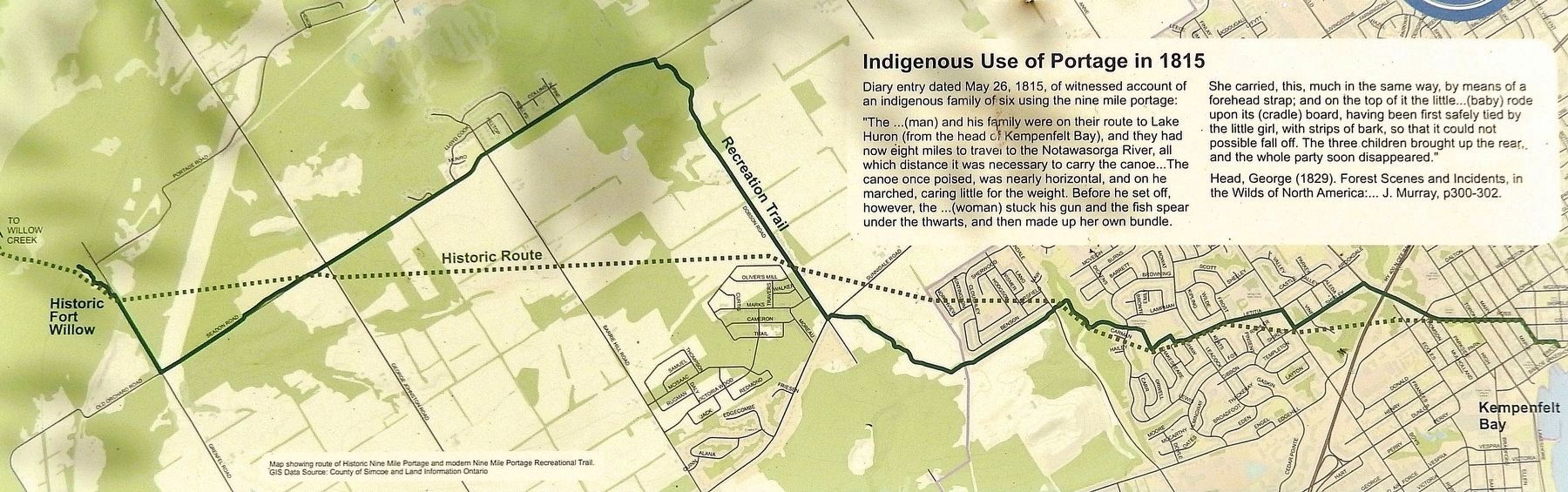
2. Marker detail: Nine Mile Portage Map
Map showing route of Historic Nine Mile Portage and modern Nine Mile Portage Recreational Trail.
Indigenous Use of Portage in 1815
Diary entry dated May 26, 1815, of witnessed account of an indigenous family of six using the nine mile portage:
"The ...(man) and his family were on their route to Lake Huron (from the head of Kempenfelt Bay), and they had now eight miles to travel to the Notawasorga River, all which distance it was necessary to carry the canoe... The canoe once poised, was nearly horizontal, and on he marched, caring little for the weight. Before he set off, however, the ...(woman) stuck his gun and the fish spear under the thwarts, and then made up her own bundle. She carried, this, much in the same way, by means of a forehead strap; and on the top of it the little...(baby) rode upon its (cradle) board, having been first safely tied by the little girl, with strips of bark, so that it could not possible fall off. The three children brought up the rear, and the whole party soon disappeared."Head, George (1829). Forest Scenes and Incidents, in the
Photographed by Cosmos Mariner, June 5, 2024
3. Birth of Barrie Marker
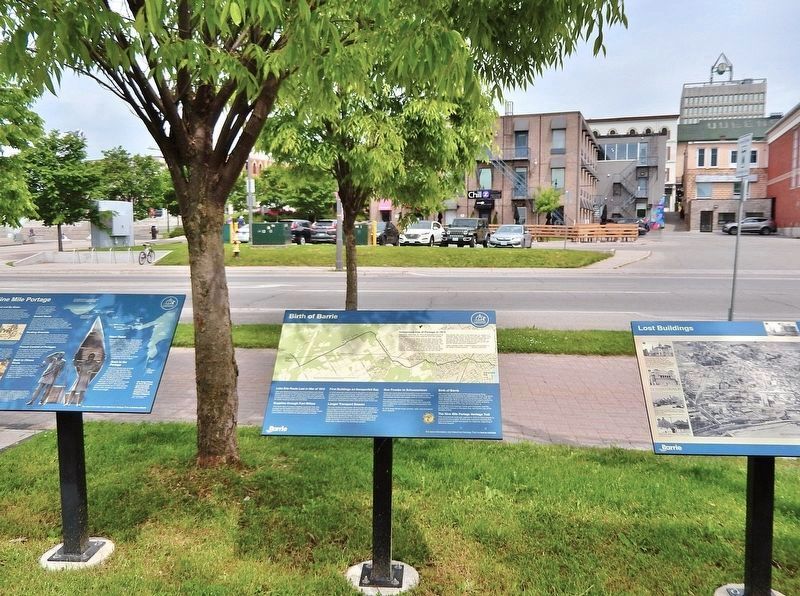
Looking north across Simcoe Street from Heritage Park. It is the center one of three interpretive panels in this photo.
Erected by Barrie Waterfront Heritage Trail.
Topics. This historical marker is listed in these topic lists: Forts and Castles • Roads & Vehicles • Settlements & Settlers • War of 1812. A significant historical month for this entry is June 1812.
Location. 44° 23.304′ N, 79° 41.217′ W. Marker is in Barrie, Ontario, in Simcoe County. It is at the intersection of Simcoe Street and Lakeshore Mews, on the right when traveling east on Simcoe Street. The marker is at Waterfront Heritage Trail Station #9 ("Downtown"), on the west side of the Heritage Park parking lot. Touch for map. Marker is at or near this postal address: 5 Simcoe Street, Barrie ON L4M 1L6, Canada. Touch for directions.

Regionally, this marker is in Central Ontario Cottage Country and specifically in Georgian Bay Country. It is also in Central Canada. Globally, it is in North America, on the Great Lakes, in the Western Hemisphere, in the Western World, and in the Anglosphere. Historically, it finds itself in what was once a British colony, the Viceroyalty of New France, the Haudenosaunee (Iroquois) Confederacy, and Rupert’s Land.
Other nearby markers. At least 8 other markers are within walking distance of this marker: Nine Mile Portage (here, next to this marker); Lost Buildings (here, next to this marker); County Town (here, next to this marker); Memorial Square (here, next to this marker); Market Hall (here, next to this marker); Five Points (here, next to this marker); Railway Watercraft (here, next to this marker); Wharfs & Boatworks (here, next to this marker). Touch for a list and map of all markers in Barrie.
Related markers. Click here for a list of markers that are related to this marker.
Also see . . . Nine Mile Portage mostly gone but not forgotten (Barrie Today).
(by Peter Bursztyn, 8/21/2024) Excerpt: The portage was used by the Wendat, the Algonquin, fur traders and, finally, the British military. The Nine Mile Portage was used to supply a British military depot on Willow Creek, and Penetanguishene, for four decades. Originally called the Nottawasaga Portage, it was a minor trade route for furs from the Lake Huron region. The French River route — Ottawa River to Georgian Bay via Lake Nippising — was far more important.(Submitted on May 22, 2025, by Cosmos Mariner of Cape Canaveral, Florida.)
Seventeenth-century explorer Étienne Brûlé used the Nottawasaga trail, as did Alexander Henry, an 18th-century fur trader linked to the North West Company. It was abandoned in the 1850s when railways arrived, providing a faster route, capable of carrying far more cargo.
Credits. This page was last revised on May 22, 2025. It was originally submitted on May 20, 2025, by Cosmos Mariner of Cape Canaveral, Florida. This page has been viewed 98 times since then and 14 times this year. Photos: 1, 2, 3. submitted on May 22, 2025, by Cosmos Mariner of Cape Canaveral, Florida.
